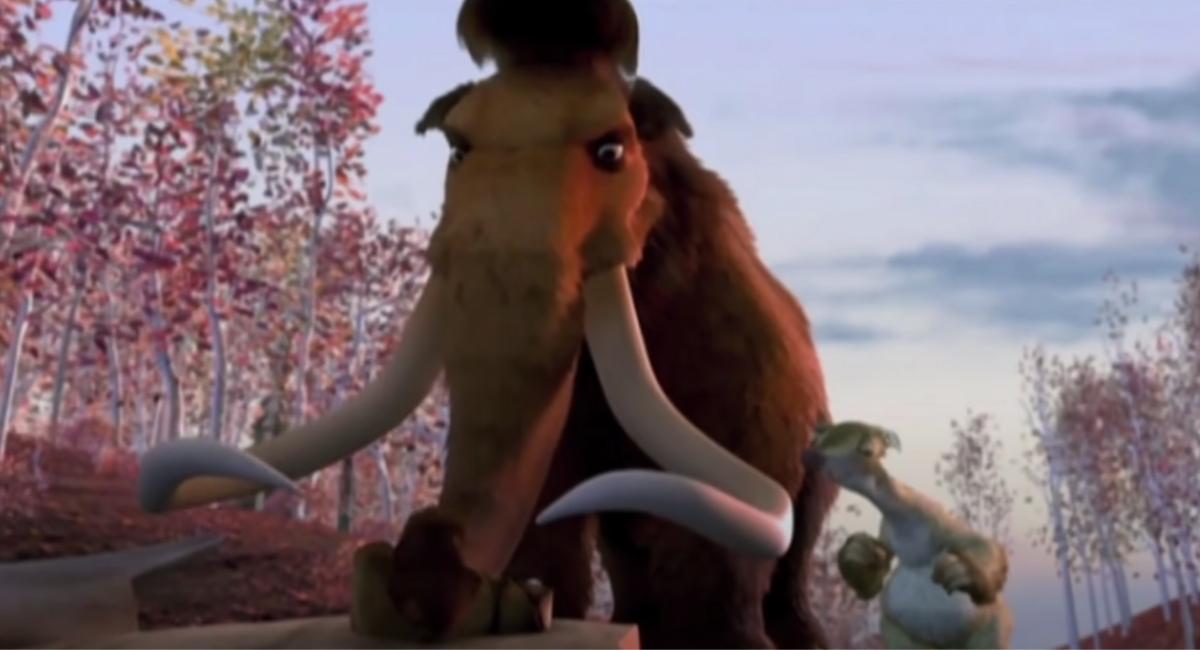
With the impending ice age almost upon them, a mismatched trio of prehistoric critters – Manny the woolly mammoth, Diego the saber-toothed tiger and Sid the giant sloth – find an orphaned infant and decide to return it to its human parents. Along the way, the unlikely allies become friends but, when enemies attack, their quest takes on far nobler aims.
Diego, Manny and Sid return in this sequel to the hit animated movie Ice Age. This time around, the deep freeze is over, and the ice-covered earth is starting to melt, which will destroy the trio’s cherished valley. The impending disaster prompts them to reunite and warn all the other beasts about the desperate situation.
Times are changing for Manny the moody mammoth, Sid the motor mouthed sloth and Diego the crafty saber-toothed tiger. Life heats up for our heroes when they meet some new and none-too-friendly neighbors – the mighty dinosaurs.
Manny, Diego, and Sid embark upon another adventure after their continent is set adrift. Using an iceberg as a ship, they encounter sea creatures and battle pirates as they explore a new world.
Set after the events of Continental Drift, Scrat’s epic pursuit of his elusive acorn catapults him outside of Earth, where he accidentally sets off a series of cosmic events that transform and threaten the planet. To save themselves from peril, Manny, Sid, Diego, and the rest of the herd leave their home and embark on a quest full of thrills and spills, highs and lows, laughter and adventure while traveling to exotic new lands and locations.
Walt Disney Animation has consistently broken boundaries and pushed the envelope, both in terms of technology and storytelling. They were responsible for the first animated short with synced sound (“Steamboat Willie“), the first feature-length animated film (“Snow White and the Seven Dwarfs“), and the first animated feature completely inked by computer (“The Rescuers Down Under“).
But as technology advances and storytelling becomes even more immersive and innovative, Disney Animation Studios has taken the unprecedented step of moving into an entirely new dimension — virtual reality. Their first animated VR short, “Cycles,” premiered at SIGGRAPH earlier in 2018 and recently screened as part of the New York Film Festival. (It will play at Unity’s developer conference next week, and the Infinity Film Fest in Beverly Hills on November 1 and 2.)
And we were lucky enough to be one of only a handful of people to have experienced it first hard.
First, a bit of background, as provided to me from “Cycles” director Jeff Gipson (who works at Disney Animation primarily as a lighting artist on films like “Zootopia,” “Moana,” and next month’s “Ralph Breaks the Internet“): Gipson admits that they didn’t really have a pipeline set up for how to make a VR short since, you know, nobody had done it yet.
“We all jumped in and figured it out along the way,” he said. The story was inspired by several aspects of Gipson’s life, including his previous career as an architect (“Where you’re taught that every home has a story”), his off-time hobby of riding BMX bikes through empty swimming pools (he’d take photos of the abandoned houses where he rode), and his relationships with his grandparents (“I loved looking at them when they were young and in love, and she’d write ‘Hubba Hubba’ on the photo”). In fact, the main characters of the short, Bert and Rae, are named after his grandparents.
Disney
To experience the short, you put on the fairly sophisticated helmet rig — which includes headphones that cover your ears — and once the short starts, you’re in a midcentury home on a sunny day. “Look towards the door when you want to start,” Gipson instructed me. So I did. What follows is a truly emotional journey, as Rae prepares to leave her home after Bert’s passing.
Then, through the magic of VR, we do a reverse time lapse, traveling backwards more than 50 years and pausing at important moments in the family’s life. It’s really beautiful and breathtaking; the VR element adds a level of immersive interaction and emotional connection that would have been impossible to capture if told in a traditional, “flat” style. (At one point, the couple dances by you and you want to join in.)
It’s also breathtakingly deep, not just in the dimensionality of the physical space (since you really do feel like you’re in the house) but in the level and detail of storytelling. After I took my helmet off (and, it should be noted, was holding back tears — didn’t know if they would short-circuit the device), Gipson told me there’s a moment where you can see the couple’s daughter climbing over a backyard fence. I didn’t even notice that, mostly because there’s just so much to take in. Most VR experiences that I’ve tried out, to date, have been interested in the visceral physical sensation of a place (you can smell the sulfur outside Darth Vader’s castle, or whatever), but this is the first VR thing that is mostly interested in making you feel something emotionally.
And that, beyond all of the cutting-edge technology, made it feel like an evolutionary leap forward for the medium.
Afterwards, I asked Gipson why he needed to tell the story in VR. “I think the biggest piece of it was being in those homes I showed you and just thinking, ‘Wow, what happened here?’ I was imagining, in my head, going from the present moment, back to when the family first got there, and just seeing it happen around you. I thought it was a cool feeling and wondered, ‘How do you share that?’”
The answer was VR. And it turned out to be the perfect medium, running smoothly at an astonishing 90 frames-per-second (as opposed to the 24-frames-per-second of something like “Ralph Breaks the Internet,” which is animated at that speed) and making you caught up in the storytelling at the same time.
It’s unclear how, exactly, people are going to get to see “Cycles,” but there are a couple of different versions of the short being developed (another great plus about the technique is being able to quickly retrofit content for multiple platforms), including an AR version and an app-based version. And I wouldn’t be surprised if, somehow, you’re given the option to view the short before the new “Ralph Breaks the Internet”-inspired VR experience coming to The Void this fall. (Disney owns a controlling interest in The Void and has Void stations at Downtown Disney in California and Disney Springs in Florida.)
Somehow, very soon, more and more people will get to see “Cycles.” And they need to. It’s just so beautiful.
The stop-motion marvel, directed by the great Henry Selick, remains the crown jewel of Burton’s stop-motion output (and he didn’t even direct it), full of the kind of darkly humorous personality and rococo visual grandeur that we’ve come to expect from the director of “Batman,” “Beetlejuice,” and “Edward Scissorhands.” And while since it’s become a staple of not one but two holidays, it’s easy to take its masterfulness for granted.
But here are nine things you probably didn’t know about “The Nightmare Before Christmas,” which will probably make it even more special (again). The following is best enjoyed with either a cup of eggnog or a giant mound of Halloween candy. It’s up to you.
Touchstone
1. Tim Burton Originally Developed the Idea While Working As an Animator for Disney
It’s very hard to imagine Tim Burton toiling away at Walt Disney Animation, in the pre-comeback days of the early 1980s. But that’s exactly what he did, providing largely unused concept art and animation for forgettable fare like “The Fox and the Hound” and “The Black Cauldron.” (He also contributed, even more bafflingly, to “TRON.”)
Not that all of his work was middling. His time at Disney also allowed him to experiment — it’s where he made “Vincent,” a charming stop-motion short film narrated by Vincent Price, a Japanese-themed fairy tale that aired on the Disney Channel and a half-hour live-action short called “Frankenweenie.”
During his time at Disney, he also wrote a three-page poem called “The Nightmare Before Christmas” and worked with frequent collaborator Rick Heinrichs on concept art and storyboards. He also sought insight from fellow Disney animator Henry Selick, who would eventually direct the feature version. In 1982, Disney decided to develop the story into either a short film (like “Vincent”) or a holiday special (in a 1993 interview with the LA Times, Burton suggested that Vincent Price would provide narration). But in 1984, Burton was fired from Disney (admittedly, his singular style didn’t really fit in amongst all the cheery animated fables) and — for many years — the project was largely forgotten.
2. It Unexpectedly Rose from the Grave
The project had stayed on Burton’s mind, even after leaving Disney and becoming one of the most successful and sought-after filmmakers in the world. In 1990, he found out that Disney still owned the rights, so he contacted them. Co-producer Kathleen Gavin, in a documentary released around the same time as the movie, said: “When Tim Burton went back to Disney a couple of years ago and said, ‘You have a project of mine I’m still interested in doing,’ they dug out not only his treatment, but they dug out a lot of his artwork.” In the video, you can see a distinctly Tim Burton sketch of Jack, with the words “It was Zero, Jack’s ethereal friend, the best friend he had / But Jack didn’t even notice him, which made Zero very sad,” written in cursive behind Jack’s slumped figure.
Disney wanted Burton, but he was already committed to other projects; Burton wanted the creative freedom to do what he wanted.
The answer to both problems was the involvement of Selick, Burton’s old animator chum from Disney, who was brought on by Heinrichs (“I’m from the same planet, if not the same neighborhood, as Tim,” Selick says in the promotional making-of doc). Selick set up an animation studio (Skellington Productions) in San Francisco and stocked a 40,000-square-foot studio space with 120 specialized animators, artists and technicians. (According to Gavin, the team moved in July of 1991 and they had to be in production by October 1.)
“It was important to me to stay away from Los Angeles,” Selick told the Los Angeles Times in 1993. “I think that if Disney and even Tim had too much access to us, they would have gotten too nervous and gummed up the works.”
Touchstone
3. It Took a L-O-N-G Time to Make
According to Disney, they “assembled 13 of the most brilliant animators” for “The Nightmare Before Christmas” which, if you hadn’t noticed, isn’t that many animators. Disney’s official numbers are that, over a three-year period, they filled 19 soundstages with 230 sets, and “hundreds” of individual puppet characters (there are 60 characters in the movie but duplicates of most were needed). Supervising animator Eric Leighton explained in that same promotional doc that, “We’re shooting at 24 frames-per-second, which means that we have to pose the character 24 times for every second of completed film.”
The sets were constructed so that the animators wouldn’t have to reach more than two feet to adjust a puppet, and if they did have to reach further, special trap doors were built into the set. (Many of the scenes required 20-30 specialized lights to create the exaggerated, German expressionist look.)
And that’s not counting all of the work that went into the film before they even started animating, which included storyboarding the entire movie several times (Joe Ranft, a legendary Pixar contributor who died tragically in a car accident before the release of “Cars,” was the head of story.)
4. There Really Wasn’t a Script
“We didn’t really have a script, but there was a storyline that Tim had much earlier,” Danny Elfman said at the time. “We were running out of time, so I said, ‘I’ll just write some of the songs based on what we’d talked about.’ He’d come over and listen and then I’d say, ‘Let’s just talk about the next section of the movie.’ And as soon as he left, I’d write the next song. He had pictures of all these characters, so I had a really good visual stimulus to get going.”
So, yes, they had all of Burton’s original drawings, the poem, and some songs. And while the final screenplay is credited to Caroline Thompson, there was additional work by Michael McDowell, a horror novelist and “Beetlejuice” screenwriter, who helped initially move Burton’s poem into movie-form.
Since the script was finished after the songs, the animators initially worked on the musical numbers, starting with the first song, “This Is Halloween.” Selick has stated that they really didn’t know what they were doing initially, and that sequences that they animated earlier look cruder than ones they did at the end of production. This is definitely true of the “This Is Halloween” sequence, which is visually stunning but also a little rough around the edges.
Interestingly, ahead of the film’s release, Elfman cited that “Nightmare Before Christmas” was “the greatest collaboration I’d ever been involved with,” even though disagreements on the film led to a very public falling out with Burton. Elfman, who provides Jack with his singing voice, had also laid down vocal tracks for his speaking role, too. Selick and Burton found his dialogue delivery unsatisfactory and replaced him with “Fright Night” actor Chris Sarandon. (Elfman also does the speaking voice for Barrel, one of Oogie Boogie’s henchmen.)
But Elfman, who had grown quite attached to Jack, felt slighted, which led to him parting ways with Burton. “Ed Wood,” released by Disney the following year, would be the first Burton movie to not be scored by Elfman. They wouldn’t work together again until 1996.
Touchstone
5. At One Point, There Was More to Oogie Boogie
One of the movie’s best, grossest gags is the reveal of Oogie Boogie’s true self — a mass of wiggling worms.
This was one of the most difficult sequences in the entire film, consisting of four incredibly detailed shots that each took a full month to create and animate (see #3). But there was even more to this sequence originally. Early storyboards revealed “a surprisingly different storyline that ultimately wasn’t pursued” (according to Selick on the Blu-ray special features), one in which, when Oogie Boogie is split open, Dr. Finklestein is revealed inside. “Yes, Jack Skellington, it’s me!” Finklestein crows. “Me! The man who created Sally from bits of flesh and scraps of cloth! As Oogie Boogie, I wanted to teach her a lesson she’d never forget!” (Yeah, this doesn’t make a lot of sense.)
There was one additional surprise as a trap door on Boogie’s roulette table opens up to reveal the doctor’s hunch-backed assistant Igor. Even in rough form, it’s clear that the sequence didn’t really work and was wisely cut. Bye bye, Boogie.
6. Pixar Helped Out
If you have watched the credits for “The Nightmare Before Christmas” as much as I have, you’ll notice that a small team from Pixar is given a credit. It’s still, all these years later, unclear as to what exactly Pixar contributed to the film. (Selick and Pixar godhead John Lasseter went to Cal Arts together and Lasseter worked alongside Burton at Disney Animation.)
Most likely, it had to do with some post-production coloring, as Pixar had recently developed and introduced the CAPS system to Walt Disney Feature Animation, which replaced the traditional ink-and-paint model (a staple since Walt’s time) with a new digital coloring system. There were other minor CGI fixes/augmentation that the studio could have provided, since at the time they were a similar independent animation outfit located in the greater San Francisco area. Pixar and “The Nightmare Before Christmas” would continue to be connected for years to come (see #8).
7. It’s Technically Not a Disney Movie
During the lead-up to “The Nightmare Before Christmas’” release, then-head of Disney Michael Eisner got a look at early footage from the film and deemed it too dark and scary. (He also requested a moment when Tim Burton’s severed head is being passed around like a hockey puck be deleted from the movie; it was replaced by a Jack-o-lantern in the final film.) He would still allow for the “What’s This?” sequence to be included in Disney animated home videos from around that time (it was the full sequence, uninterrupted) but he also wanted some distance placed between the Disney brand and “The Nightmare Before Christmas.”
So, as it was, the Disney name was removed from the film and it was replaced with a card for the Touchstone Pictures shingle that would note that the film was slightly more adult and sophisticated. In an interview with IGN in 2006, Selick said that the company worried that it would “too dark and scary for kids.” He continued: “Their biggest fear, and why it was kind of a stepchild project, was they were afraid of their core audience hating the movie and not coming.”
And, to be honest, there was some merit to this apprehension. The film wasn’t a breakaway box office success, instead growing in stature over the years, to the point that it is now a yearly seasonal overlay to the Haunted Mansion and countless pieces of merchandise are sold each and every year. When the film was released, though, all of the toys (housed in nifty, coffin-shaped boxes) sat unsold at Disney Stores around the country.
Interestingly, if you watch the film today, either on Blu-ray or digitally, the iconic Disney castle greets you when the movie begins. It is no longer a stowed-away Touchstone Picture; it’s now, firmly, a Disney classic.
8. Without It, There Would Be No ‘Toy Story’
It’s hard to explain how, exactly, “Nightmare Before Christmas” paved the way for Pixar’s “Toy Story,” a film that would end up revolutionizing the entire film industry and serving as the bedrock for another Disney animation renaissance. But maybe John Lasseter can explain.
In a 2011 interview with Entertainment Weekly, he said: “Disney kept trying to hire me back after each of the short films I had made. I kept saying, ‘Let me make a film for you up here [at Pixar].” They always said, ‘No, a Disney animated film will always be made at Disney.’ They had no interest in doing an outside project.” Lasseter continued: “What changed their mind was Tim Burton. Tim and I went to college together, and he had developed a feature idea called ‘The Nightmare Before Christmas.’ He went on to become a successful live-action director and was trying to buy ‘Nightmare’ back from Disney. And they said, ‘Why don’t you just make it for us?’ That opened the door for Disney to think of these niche animated films that could be done. They said, ‘Okay, we’re willing to talk with you. We’ve got puppet animation going [with Tim Burton] and now we’ll be willing to develop the computer animation.’ They said to come back when we had an idea. So we started thinking…”
And, of course, their thinking led to “Toy Story,” another project that started as a holiday special before morphing into a bona fide feature film.
To make an interesting history even more interesting was the announcement in 2010 that Selick would set up a brand new stop-motion studio at Pixar. The new outfit, called Cinderbiter Productions, was already hard at work on a feature called “ShadeMaker” and, according to the press release, would serve as “a new stop motion company whose mandate is to make great, scary films for young ‘uns with a small, tight-knit crew who watch each other’s backs.”
Unfortunately, in 2012 the studio was shut down after Disney and Pixar management found the development of the current film to be unsatisfactory. After spending more than $50 million on the film itself, the company announced a write-down north of $100 million, given the amount of employees and real estate the new shingle occupied. Gone was Selick’s relationship with Lasseter, along with a potentially lucrative deal with Disney (after completing work on “ShadeMaker,” he was set to direct a live action/animated adaptation of Neil Gaiman’s deeply brilliant “The Graveyard Book”). Sigh.
Touchstone
9. Jack Had Cameos in Selick’s Subsequent Films
This is more of the Easter Egg-y variety, but Jack Skellington would appear in two of Selick’s other films.
In 1996, he would reteam with Disney and Burton for the considerably drabber “James and the Giant Peach” adaptation. While a largely joyless affair (those live action sequences are terrible), there is a bright spot when Jack and his insect pals visit a sunken pirate ship manned by a pirate-y Jack Skellington. (Richard Dreyfuss’ Mr. Centipede even refers to the character, in his broken New Yawk accent, as “Skellington.”)
Additionally, there’s a blink-and-you’ll-miss-it appearance by the Pumpkin King in Selick’s animated feature for Laika, “Coraline.” There’s a moment when Coraline is in the kitchen and the Other Mother is making her food; the Other Mother cracks open an egg and, in the yolk, is the face of Jack. It’s very subtle and tiny and hard to spot, most likely because they were navigating some very choppy legal waters with the insertion, but he’s still there, epitomizing the Halloween spirit in a very literal Easter egg.