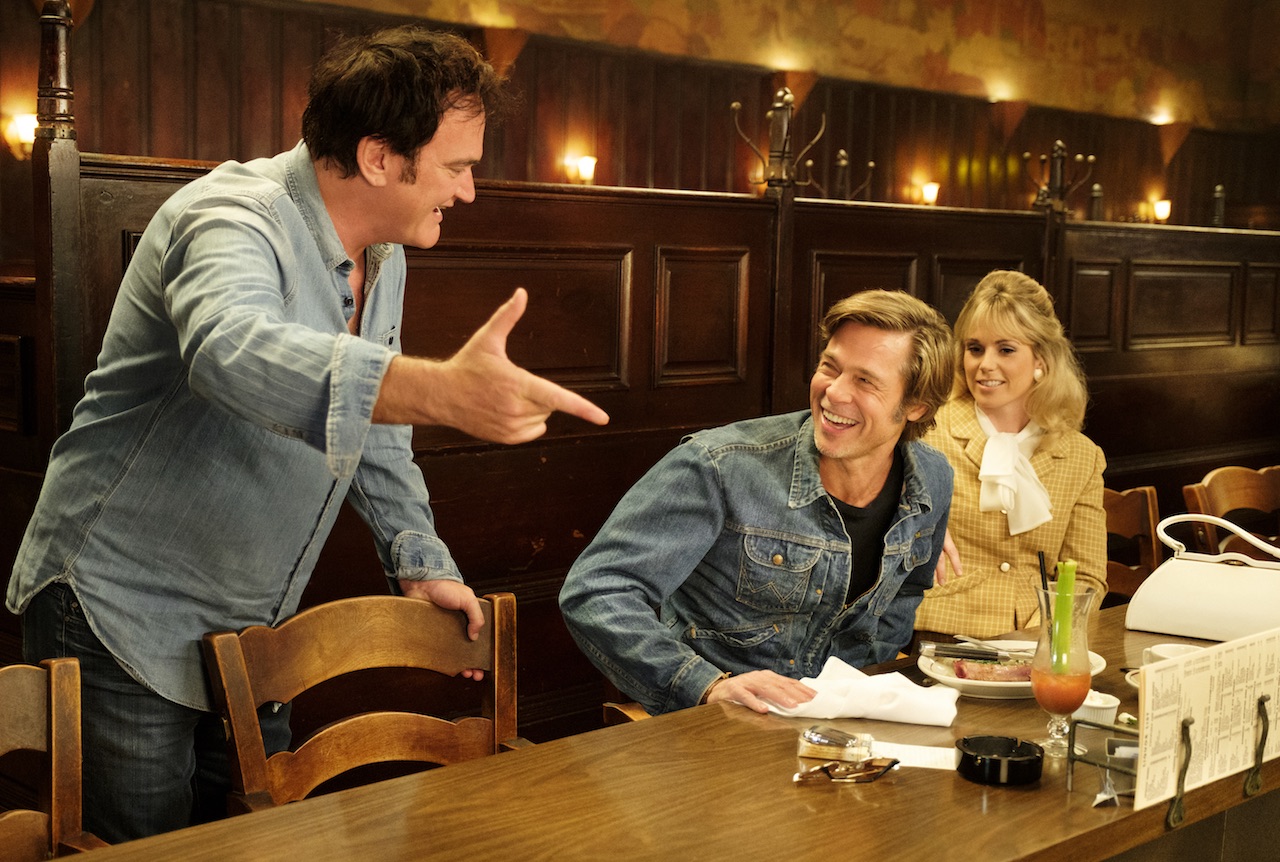
Friends and family of the late actor, including his daughter Shannon, have blasted the movie for turning the iconic star into “an arrogant punching bag.”
In the film, Lee (Mike Moh) tells bystanders on the set of “The Green Hornet” that he could “cripple” Cassius Clay (later known as Muhammad Ali). Stuntman Cliff Booth (Brad Pitt) then challenges him to a best “two out of three” fight. They trade rounds, but are interrupted before they can duke it out in the third round.
Shannon Lee complained that her father “comes across as an arrogant asshole who was full of hot air.” She added, “It was really uncomfortable to sit in the theater and listen to people laugh at my father.”
But in recent interviews in Russia, Tarantino said that Lee was “kind of an arrogant guy.”
The director also noted that the portrayal was rooted in fact.
“The way he was talking, I didn’t just make a lot of that up,” Tarantino said. “I heard him say things like that, to that effect. If people are saying, ‘Well he never said he could beat up Muhammad Ali,’ well yeah, he did. Not only did he say that, but his wife, Linda Lee, said that in her first biography I ever read … She absolutely said it.”
As to criticism that Lee would ever lose to Brad Pitt, well, Tarantino noted that he doesn’t — he cedes one round to Cliff Booth. There’s a difference.
“Could Cliff beat up Bruce Lee? Brad would not be able to beat up Bruce Lee, but Cliff maybe could,” Tarantino said.
“If you ask me the question, ‘Who would win in a fight: Bruce Lee or Dracula?’ It’s the same question. It’s a fictional character. If I say Cliff can beat Bruce Lee up, he’s a fictional character so he could beat Bruce Lee up.”
We know Quentin Tarantino loves genre movies and he he’s a big fan of gory violence, so what are the odds his 10th film will be a horror movie?
While he’s still trying to get his R-rated take on “Star Trek” made (which may or may not his mythic “final” 10th film), he’s open to other ideas.
During an interview on his international “Once Upon a Time in Hollywood” press tour, Tarantino said, “If I come up with a terrific horror film story, I will do that as my tenth movie. I love horror movies. I would love to do a horror film.”
He added that a sequence in his current film, where Brad Pitt‘s character goes out to the Spahn Ranch and realizes that his new friend “Pussycat” (Margaret Qualley) and her pals aren’t your average hippies, already feels like a horror movie.
Sony
“I do actually think that the Spahn Ranch sequence is the closest to a horror sequence, because I do think it’s vaguely terrifying,” he said of Pitt’s character meeting members of the Manson Family. “And I didn’t even quite realize how good we did it, frankly, to tell you the truth, until my editor told me.”
As his editor said, “It’s ‘The Texas Chain Saw Massacre‘ with a budget. It’s like Brad Pitt is walking into ‘The Texas Chain Saw Massacre’. It’s f***ing terrifying.”
Tarantino admitted he hadn’t seen the similarity at first, but once it was pointed out, took it as “about as good a compliment as you can make.”
It’s hard to believe but 2019 is more than halfway over. Which means that we should pause and take stock. This year’s film conversation has largely been defined by massive blockbusters like “Avengers: Endgame,” which is okay considering how great the movie is, but there are just as many independent movies and smaller studio fare that deserve your love, attention, and fervent Twitter debate. So without further ado, we run down the very best movies of 2019. And don’t worry, we’ll update periodically throughout the year.
‘Always Be My Maybe’
Netflix
In what is arguably Netflix’s greatest romantic comedy (sorry, “Set It Up”), Ali Wong and Randall Park star as two friends who briefly became lovers, quickly lose touch and reconnect much, much later (with appropriately awkward results). Much of the success of the film has to do with the leads’ chemistry (they also co-wrote the screenplay with Michael Golamco) and Nahnatchka Khan’s delicate direction, which never loses its edge and emphasis on socioeconomic specificity, even when it gets very, very cute. (There are even some stylistic flourishes! In a mainstream rom-com!) And obviously Keanu Reeves should get a Best Supporting Actor Oscar nomination for his brief turn as an exaggerated version of himself. Rarely is he allowed to be this funny and this outré and seeing him do both feels like, if not a revelation, then a rediscovery. “Always Be My Maybe” is refreshingly earnest and quietly revolutionary, a movie you never knew you needed until you watch it.
‘Apollo 11’
NEON
A deeply beautiful and optimistic documentary, “Apollo 11” recounts the first manned mission to the moon using only archival footage (much of it seen for the first time) and audio (including candid statements from the astronauts themselves). Soaking in every detail from the period, from the rivets on the rocket’s engines to the design of the Coca-Cola cans onlookers were sipping on as they watched the launch, it’s impossible to not get swept up in the spirit not of conquest but of scientific discovery and utopian ambition. The space race might have been a largely political construct, but it was still, as this documentary brilliantly expresses, quite an adventure.
‘Avengers: Endgame’
Marvel Studios
It seemed like an impossible task — wrap up more than 10 years and 22 films worth of mythologies, interpersonal character relationships and plot threads — in a single, super-sized (over 3 hours!) film. And yet, somehow, Joe and Anthony Russo’s “Avengers: Endgame” managed to not only fulfill even the loftiest expectations but also exceed them. The resulting film, with its wildly different tones, going from a somber examination of survivors guilt to a time travel romp (are there any sweeter words than “time heist?”) to an all-out brawl that manages to dwarf everything that came before it. But the biggest accomplishment of “Avengers: Endgame” is how emotionally resonant it is, from the pre-credits sequence of Hawkeye’s family disappearing, to the conclusion of both Tony Stark and Steve Rogers’ storylines, it was in these moments that “Endgame” became something more; sure, it thrilled, but it also made you deeply feel too.
‘Booksmart’
Annapurna
One of the few films out of SXSW this year that felt like a genuine sensation, “Booksmart” was widely released at the start of summer and … didn’t quite break through like we all thought it would. Olivia Wilde’s directorial debut is tender and fun, about a pair of high school girls (Kaitlyn Dever and Beanie Feldstein) who cast off their bookish tendencies for one wild night of fun. Featuring a soundtrack full of A+ party jams and some terrific supporting performances (from Jessica Williams and Billie Lourd), this is a silly, sublime teen comedy that stands apart thanks to the sophistication of its writing and direction and by its distinctly female point of view, which is progressive, sex-positive and utterly fun. In some alternate (perhaps more just) universe, it has made more money than “Avengers: Endgame.”
‘Climax’
A24
If “Climax” had been released in the heyday of 1990s American independent cinema, it would have been a word-of-mouth smash. Now it barely registers. After garnering rave reviews out of Cannes last year, “Climax” was finally released in America cinemas earlier this spring and nobody paid much attention. Which is a shame. Because “Climax” is unlike anything you’ve ever seen, an adrenalized dance party descent into hell, where a group of French dancers, celebrating the end of a grueling rehearsal schedule (they’re about to embark on a tour) take sips of some spiked sangria and it all goes spectacularly downhill. Auteur Gaspar Noe is a notorious enfant terrible, and there are certainly a number of sensational aspects of “Climax” that will probably rub people the wrong way (among them: self-mutilation, child murder, and some incredibly misogynistic dialogue). But it’s also so breathlessly told (with a series of unbroken long takes) and authentically acted that the camp only heightens it. Like an adaptation of Chuck Palahniuk’s “Haunted” set to 90s club music, “Climax” is a future midnight movie classic. Fingers crossed.
‘Cold Pursuit’
Lionsgate
Liam Neeson made a major gaffe during the promotional cycle of “Cold Pursuit,” which more or less doomed the film’s commercial chances. This is a bummer, considering how wonderfully weird “Cold Pursuit” is. Neeson plays a snowplow driver whose son dies under mysterious circumstances. Instead of merely allowing the law to investigate, they quickly rule it a drug overdose and leave Neeson to mete out his own form of justice, namely killing each and every person who had anything to do with it. Director Hans Petter Moland directs a western remake of his own “In Order of Disappearance” with the same wit and dry, dark humor. If you need to scratch that weird, windswept itch before “Fargo” comes back, this will hit the spot.
‘Crawl’
Paramount
A hurricane floods a small Florida town, leaving a college athlete (Kaya Scodelario) to rescue her father (Barry Pepper) from their childhood home, now overrun with bloodthirsty alligators. That’s really it. But director Alexandre Aja and producer Sam Raimi, both of them horror luminaries in their own right, expertly stage the action, turning even the slightest gesture into a white-knuckle suspense set piece. And when Aja is called upon to let loose on the gore, he does so with great aplomb. “Crawl,” released in the dog days of summer, was the perfect antidote for the bloated blockbusters and prestige-y arthouse fare that was basically all you could find. Instead, this was just bloody good fun.
‘Fyre’ / ‘Fyre Festival’
Netflix
The doomed Fyre Festival, a music festival based solely on artifice, built by charlatans and conmen, was such a colossal screw-up that its story had to be documented by two separate films. Each documentary (Netflix’s “Fyre” and Hulu’s surprise “Fyre Festival”) offer different details about the formation and ultimate dissolution of a festival that every influencer on planet earth simply had to attend, only once they got there realized that the island-set event wasn’t actually set up and that people, who had paid thousands to attend, where huddled in refugee tents, eating cold sandwiches with a slice of American cheese. The ultimate depiction of hubris, hype and the gullibility of millennials, it’s a powerful reminder that if something is a house of mirrors, eventually, it shatters.
‘The Great Hack’
Netflix
The feel-bad documentary concerns the Cambridge Analytica scandal and the handful of whistleblowers who outed the company following the one-two punch of evil that was Brexit and the 2016 United States presidential election. “The Great Hack” documents how the shady company, which filed for bankruptcy shortly after the scandal broke largely to hide evidence and dodge prosecution, had a history of taking part in disruptive, largely harmful political campaigns all over the world. And it is … sobering. Not even the whistleblowers get away clean, as their motives seem, at the very least, suspect. The only dopey element of the documentary is its framing device, around a goofball New School professor who is suing for his personal date. Everything else is terrifyingly sublime.
‘Greta’
Focus Features
The best Brian De Palma movie of 2019 wasn’t actually directed by Brian De Palma. (His movie, “Domino,” which is has already publicly stated was taken away from him during post-production, is just okay.) Instead, that honor goes to “Greta,” Neil Jordan’s guilty-pleasure stalker thriller about a young girl (Chloe Grace Moretz) who falls under the spell of a charismatic older woman (Isabelle Huppert, having a ball) who is full of sinister secrets. With a svelte 98-minute runtime, it’s able to indulge in a number of the genre’s tropes while also gleefully upending them (particularly in the final act, which has a deliciously empowered message of sisterhood and femininity). It’s a blast.
‘Happy Death Day 2U’
Universal/Blumhouse
2017’s “Happy Death Day” was a welcome surprise, a movie where a young woman (the vivacious Jessica Rothe) finds herself stalked by a sadistic killer and each time she dies, the day starts over. The only way she can break the loop is if she figures out who killed her. It was a terrific conceit with a lovely, smart-ass-y tone, “Scream” meets “Groundhog Day.” So with the surprise gone, what was there left to do in the sequel? Well, go even crazier, it turns out, by introducing an actual time travel mechanic and some dweeby kids studying physics. Shockingly emotional and so much fun, “Happy Death Day 2U” wasn’t the sleeper hit that the original was, which is strange because it isn’t just as good — it’s better.
‘High Flying Bird’
Netflix
2019 will be graced by a pair of new Steven Soderbergh movies (on Netflix, no less). The first was “High Flying Bird,” a shot-on-an-iPhone sports drama about a charismatic agent (Andre Holland) navigating an NBA strike, armed with some bold new ideas. Full of long, talky scenes that still remain captivating (the script is by playwright Tarell Alvin McCraney), with a killer supporting cast that includes Zazie Beetz, Zachary Quinto, Kyle MacLachlan and Bill Duke, it’s a sports movie that feels totally unlike any sports movie you’ve ever seen (and not just because they had to skirt around NBA copyrights like an Olympic speed skater). Whip-smart and paced with a breakneck speed, “High Flying Bird” is the latest triumph from a filmmaker who, we should be reminded, was retired until very recently. Thankfully that didn’t last long.
‘John Wick: Chapter 3 – Parabellum’
Lionsgate
The first thirty minutes or so of “John Wick: Chapter 3 – Parabellum” might be the best movie of the year, period. In that amount of time, Keanu Reeves, picking up right where the last film left off, is marked for death by a squadron of secret assassins, kills a giant man in a library, throws dozens of knives into people, uses horses as an accessory to murder, and takes part in a daring bridge chase while on horseback. From there, the movie occasionally meanders (although the sequence with Halle Berry and the dogs in Casablanca is fun), but never relents, culminating in a climactic sequence in a glassy Manhattan tower. Aside from the “Mission: Impossible” films, it’s hard to think of an action franchise more pitch perfect or eager to please. Bring on chapter 4.
‘Once Upon a Time … in Hollywood’
Sony
Quentin Tarantino’s 9th film certainly courted controversy, even before it was release. After all, the notoriously sensationalist filmmaker would be tackling the Manson murders, of all things, perhaps the only subject matter touchier than World War II. And yet, “Once Upon a Time … in Hollywood” was released and everyone was generally surprised by how sweet the movie was, how deeply felt and nostalgic and charming it would end up being. Brad Pitt and Leonardo DiCaprio give all-time best performances as a washed-up actor and his deeply committed stunt-double and gofer, and Margot Robbie is luminous as the doomed Sharon Tate. Tarantino’s most relaxed film, it beautifully spends time with its characters as they luxuriate in 1969 Los Angeles, with the camera soaking in every period detail (there’s a sequence devoted to various neon signs turning on). Breathtaking and bloody, it’s a film that we cannot stop thinking about.
‘The Perfection’
Netflix
For maximum satisfaction, try to go into Netflix’s “The Perfection” knowing as little as possible. Just know that it stars Allison Williams as a fading cello star and reteams her with frequent “Girls” director Richard Shepard. That’s it. What follows is one of the scariest, most surprising thrillers you’ll see all year, beautifully photographed, richly performed, and totally outrageous. Okay, now go watch it.
‘Toy Story 4’
Disney•Pixar
“Toy Story 4” feels like a rebuke to everyone who cried that the “Toy Story” series wrapped up perfectly with the third installment (back in 2010). The fourth adventure for Woody (Tom Hanks) and the gang sees the pull-string sheriff reconnect with his long-lost love Bo Peep (Annie Potts) while on vacation with Bonnie. More formally adventurous than any other film in the series (it features flashbacks, dream sequences, and cut-away gags), it feels uninhibited by the previous movies and positively fearless in its willingness to forge a new and altogether different path. What’s more, it’s arguably the most emotionally complex, with characters who have complicated feelings for one another and their place in the world at large, with a tender, moving villain (Christina Hendricks) and some A+ new characters, including an insecure Canadian stuntman (Keanu Reeves) and a pair of county fair prizes (voiced by Keegan-Michael Key and Jordan Peele). Also, “Toy Story 4” is the most beautiful-looking animated film ever, with director Josh Cooley proving himself to be a next-level visionary. This is the bittersweet coda you never knew you wanted but now cannot live without.
‘Triple Frontier’
Netflix
It took a long time to get “Triple Frontier” across the finish line. What started as a re-team of “Hurt Locker”/”Zero Dark Thirty” writer Mark Boal and Kathryn Bigelow went through a number of key personnel changes before winding up in the hands of writer-director J.C. Chandor, who overhauled the existing script and assembled a kick-ass group of performers (including Ben Affleck, Oscar Isaac, Charlie Hunnam, Garrett Hedlund and Pedro Pascal). This tale of ex-military men who steal a lot of money from a South American drug lord is exciting and violent, the kind of muscular, no-frills action movie that they used to make throughout the 1980s and 1990s (complete with a streak of mournful melancholy). It took long enough to get finished, but we’re very happy “Triple Frontier” finally saw the light of day. It’s an edge-of-your-seat wonder.
‘Under the Silver Lake’
A24
It seemed like a sure-thing: David Robert Mitchell, the director of the buzzy low budget horror movie “It Follows,” teamed with arty distributor A24 for an ambitious, sprawling neo-noir about a burnt-out loser (Andrew Garfield) who goes looking for his missing neighbor (Riley Keough). But after a mixed response at Cannes last year and a number of released dates that were either missed entirely or hastily rescheduled, “Under the Silver Lake” was quietly released in a handful of theaters this spring before quickly going VOD. But maybe the home format is the best way to enjoy the film, with its multiple layers of meaning, hidden clues, and tangential narrative paths. (At a whopping 140 minutes, it might also take a few sittings.) Garfield is pitch perfect as a typical LA loser who is more intent on distracting himself with labyrinthine mysteries than dealing with the troubles of his everyday life head on. Also, he might be a serial dog murderer? Rewarding and ramshackle, “Under the Silver Lake” is a movie that will be endlessly analyzed and speculated about. How many other movies can you say that about?
‘Us’
Universal/Blumhouse
Jordan Peele followed up his massive, paradigm-shifting, Oscar-winning chiller “Get Out” with the unfathomable: a movie that is even more ambitious, artful and scathing than his game-changing debut feature. In the masterful “Us” Lupita Nyong’o plays a woman who travels with her family back to the seaside town where she had a traumatic event as a child. Soon enough, she and her entire family are menaced by scarred doppelgangers who are “tethered” to their normal counterparts. (There’s a fairly deep mythology established here that never feels cumbersome or too complex.) As the movie progresses, going from a home invasion thriller to something much larger in scope, it manages to fold in the Hands Across America charity event from 1986, an entire underground world of creepy doubles, multiple amazing uses of the 1995 Luniz single “I Got 5 on It” and one of the very best horror movie twist endings ever. “Us” proved that “Get Out” wasn’t a fluke and cemented Jordan Peele as one of the most exciting, original voices in genre filmmaking.
‘Velvet Buzzsaw’
Netflix
“Nightcrawler” writer-director Dan Gilroy reteams with Jake Gyllenhaal for this art-world-set horror romp, which seems to take equal inspiration from Robert Altman movies and the “Final Destination” series. (How many movies can you say that about?) A captivating Zawe Ashton stars as a young up-and-comer who finds a treasure trove of paintings in her dead neighbor’s apartment and brings them to the attention of Gyllenhaal (as a critic) and various arty weirdos, who all become enthralled. The only problem is that the paintings are haunted and, well, people start dying in spectacularly violent ways. (If you’ve ever wanted to see Toni Collette get her arm gnawed off by a sculptural centerpiece, this is the movie for you.) While it’s sort of unclear what “Velvet Buzzsaw” is saying about creativity, art, and criticism’s place in the intersection of the two, it does offer some biting satire and some spectacularly realized, phantasmagorical kills.
‘Yesterday’
Universal
“Yesterday” doesn’t open until the end of the month, but it premiered at Tribeca and is getting a wide release so we’re breaking the rules! In Danny Boyle’s latest masterpiece, Himesh Patel is a struggling musician who suffers a cataclysmic accident at the same time that a strange blackout envelopes earth. When he wakes up, he realizes he’s the only person in the world you remembers the Beatles. But what to do with this awesome power/gift/revelation? Rom-com mastermind Richard Curtis’ beautiful script not only weaves a wonderful love story (between Himesh Patel and Lily James, as his beleaguered, constantly friend-zoned manager and friend), but complicates your own feelings about the Beatles by adding layers of doubt and regret to all of the songs that you deeply love. The reaction out of Tribeca was muted but know this: “Yesterday” rules.
High on the list of Quentin Tarantino collaborators is Zoë Bell, the New Zealand-born stunt performer-turned-stunt coordinator who has been an inherent part of Tarantino’s films since he originally cast her as Uma Thurman’s stunt double in “Kill Bill.” Since then, she has been a part of each of his films, usually playing a character on-screen while also supervising the stunts and doubling performers (“Inglourious Basterds” is the only movie where she doesn’t have a speaking role in addition to her behind-the-scenes duties). Perhaps most famously she starred as a slightly different version of herself in “Death Proof,” Tarantino’s half of his “Grindhouse” project with Robert Rodriguez.
And, if you’ve seen “Once Upon a Time … in Hollywood,” you know that Bell pops up in the small but pivotal role of Janet, the wife of a long-time stunt coordinator (Kurt Russell), who gets to tell off Brad Pitt’s stunt performer Cliff Booth in the middle of a scene where he’s fighting Bruce Lee (Mike Moh). It’s an incredible scene made all the better thanks to Bell’s performance, which is powerful and hilarious.
Mild spoilers for the film below, but if you haven’t seen it yet, that’s on you!
Miramax
Moviefone: So you were initially hired as a stunt performer for the “Kill Bill” films, right?
Zoë Bell: Yeah.
And did you guys immediately have a rapport?
Well I first met in L.A. at the auditions, which was ostensibly one of my first real auditions. I know we met there because there’s video footage of it in a documentary called “Double Dare.” So I know that it happened. But my personal memory is a little bit blurry of that day cause it was a little bit like, “My god, there’s ‘Splash’ – Daryl Hannah. Oh my God, there’s ‘Reality Bites’ — Ethan Hawke. Oh my God, that’s Uma Thurman.
But once I got to China, I actually don’t have a clear recollection of the first time we hung out. I just remember all of China is, it felt like I’d found a buddy at school. I was like, “Yeah, my people!”
In film when you’re working on location and you’re away from home, there’s sort of an adult summer camp vibe. The difference being, it was one of the first times I’d ever really been on location, especially internationally. I was barely an adult. I mean, I was 21. I look back now and I’m like, oh my God, I was a baby. That whole crew became family. The conditions are pretty insane. The hours were really long. We played hard and we worked even harder. Because we were removed from Hollywood and you’re on location so people aren’t going home to their real lives, we kind of maintain the bond, the bubble.
It’s also a little bit more realistic because there isn’t the bullshit of who is famous and who’s not and who’s this and who’s important, who’s not. I mean there’s the hierarchy happens on set, as it happens in any kind of industry that needs structure. But when you’re outside of the work zone, we’re all hanging out as equals because there is no social structure. We were all on equal playing fields. It was a pretty cool way to walk into Hollywood.
When did he talk to you about starring in “Death Proof?”
Literally the day he turned up to my house with the script. I think we won a couple of MTV awards for fight sequences, particularly the one between Uma and Daryl in “Kill Bill.” So Monica, who was Daryl’s stunt double and myself went over to Quinton’s house, because we were all going to the awards together and we had a couple of pre-drinks and we were hanging out there and he started telling us about his new movie “Death Proof” about a stunt guy who’s got a car that is decked out and has a cage so that he basically uses it as a weapon.
But in my memory, I’ve said this a couple times and I said I don’t know if I’ve just made it up or whether it really happened this way, but my memory is, I was like, “Okay you absolutely have to cast someone who looks like me in the movie cause I have to work on the movie. You can’t make a movie about stunt people and not have me be one of the stunt people, that they would literally destroy my feelings. I’d be so sad.”
And he was like, “Oh yeah, okay.” Then he said, “Oh, I want to put you guys in the movie.” And I was like, “F*ck yeah, I get to double one of the leads.” What I believed was that the lead women would be sitting around the table and that Monica and I would be in the background, she and I would get into a fight and f*ck each other up in the background. No one needed to know, but [Tarantino] would be able to go, “Those are my stunt girls from ‘Kill Bill.’” And that would be a little Tarantino-verse magic moment.
But when he called me, he was like, “I’m coming over to your house. I’ve got the script for ‘Death Proof’ and Robert has done something really cool with the cover, I think you’re gonna love.” And I was like, Oh God, what has he done? I think I made some joke like, “Has he put my face on Pam Anderson’s body or something?” Cause I knew it was going to be a grindhouse-style flick. And he showed up and it wasn’t that, it was just an bad ass cover of a car with a lightning bolt. Kurt, at the beginning, wasn’t going to be Stuntman Mike. So it had “Starring Mickey Rourke and Zoë Bell.”
And I was like, “Can I take a photo and show my mom and dad?” And he was like, “You can keep this good the script turn to the page with the folded corner.” And I turned to a page and it was the introduction of the Zoë character coming off the plane and read, “cute as a bug’s ear, Zoë Bell bounds off the plane.” And I was like, “What the hell? Who is going to play that?” And I think I did something like, “She better be hot and she’d better look like me, cause I’m definitely doubling her.” And he said, “Oh no, you’re playing her.” And I swear the blood drained from my face and probably not in the way that any sane person, particularly an actor on the planet, the blood would drain because they’d be like, “Oh my God, that’s amazing!” My thing was like, “Holy shit, what are you talking about? I don’t know if I can even act” And so he, knowing me very well then, took me out for beers and uh, explained the ship’s mast to me. By the end of that conversation, I was like, “I’m so in.”
Weinstein Company
So how did that play out? You’re in so much of the movie.
So basically I took him out for a margherita and said, “How do you act? What do I do?” And he basically said to me, I could almost put this in quotations but it’s been so long, but he basically said, “I know you have what I want. I believe I know how to get it. I need you to know the lines inside out, back to front so that I can get you to be who I need you to be on the screen. Because you’re basically being yourself and I know how to do that with you. And you just need to learn the lines.” And I asked him how that happens. And he is so funny because he said, “Get a Dictaphone and do your off lines,” exactly like Rick does in the movie.
So I did that. I did all, all my off lines from the moment the second set of girls comes into the film. I had the whole lot on off lines and I had other people do them. So it wasn’t just my voice. I had my mom playing Tracy was hilarious. My brother was Rosario’s character at one point. So that was basically it. I learnt everybody’s lines inside out and backwards.
And then once we started shooting, we had rehearsal time which was a godsend, I don’t know how any director wants to make a movie without rehearsal time with their actors. It’s such a beautiful process and it’s such a beneficial process. Once he was shooting, every night I would call Rosario, Tracy and Mary Elizabeth and be like, “Okay, so I’ll provide the wine if guys provide the lines.” They would come over and run lines with me because that’s all I know to do. Then it was handed over to Quentin.
Weinstein Company
You were in “Django Unchained.” And there has been a lot of speculation on the internet about your character having potentially grown up with Django and been disfigured. How much of that stuff was true?
There’s all of it in there. And one of the fun things about Quentin is even if it wasn’t in the script, and there was one version of the script that had an extended piece in there. But even if it wasn’t, he would have thought about it all. Like every character in there and he knows when they come from and where they’re going. It’s phenomenal.
So Tracker Peg, she had history with one of the other trackers. They used to be lovers. She was disfigured in a way. never had to go through the prosthetics because we ended up not keep that bit. But we knew what they looked like and there was potentially a fight sequence with Django and these redneck racist trackers.
And the beautiful thing is I don’t feel like it’s missing from the movie. I would love to be in the movie more and I would have loved to have had a fight with Jamie. But I feel that backstory is there in all of his work anyway, because I know for a fact it’s there. Even if it was never in the script that was always in the story, it was always in his head. And he would have always told me, there’s always some story to my character. It’s all there. I remember saying, “Why is she a Kiwi? Do you not like my American accent?” He said, “I do. I particularly like your Kiwi accent. And Australians and New Zealanders, blah, blah, blah, blah.” And I was like, “Okay. Right. Okay.”
He’s talked recently about knowing all about every character from “Once Upon a Time … in Hollywood” and even writing several episodes of “Bounty Law.” But what about Janet? Where is she in all of this?
[laughs] How cool is Janet? I love that her name is Janet! She’s such a bad ass! Janet was referenced in the script. Randy references her when he’s in the trailer with Rick. I don’t think I even talked with Quentin about it, but there’s a lot of information in all of Quentin’s scripts, but particularly in this one because there’s all kinds of references to movies and TV shows and music and back and forth and jumping in. And if you don’t have a brain like Quentin’s, which few of us do, there’s a lot to decipher and take on and put into context.
But for some reason Janet existing was really cool to me. I was like, “Oh, Janet, she’s interesting.” Hadn’t thought anything of it. It came about on the day that it was going to be Janet that interrupted this fight rather than Randy. Randy was going to come along, haphazardly walk in the middle of it.
There really wasn’t a whole lot of print. And again I’m not quoting Quentin because we haven’t actually had this specific conversation, but I had watched Leo doing some of the “Bounty Law” stuff and just had this awakening again, where I was like “Man, I want to act,” just because it looked so satisfying and explorative and exciting. I’d been out of the acting game for a little minute because I got burned out on it all over again. And I starting having conversations with Quentin about that again. There was one role that I pitched myself for and they wanted to go for someone else.
I wanted to fight for this role and not fight because I felt angry or I was hurt because I was excited to go outside my comfort zone. I didn’t get the role. I’m just not right for it. I totally regret that, but I was really excited that I pitched myself. I was really excited that I put myself on tape. My boyfriend and I went home and did a little scene and sent it to the casting agent and Quentin. It was a real pleasure to be excited and passionate and really desire something but felt no pressure, no desperation for it.
It didn’t work out. I was still coordinating with movie and I had a lot on my plate. I was good. Then the other part was when we were putting some fight choreography options on tape to show Quentin. Originally it’s Randy that breaks up the fight. And often I’ll put my doubles in place of the actors and we’ll put people in just so that there’s some semblance of a scene so Quentin can get his head around it. And I took on the role of Kurt and I just full tilt on my version Kurt Russel. It was kind of a little bit of him from “Death Proof” as the stunt coordinator.
I was having a laugh. I was hoping Quentin would really enjoy it because the writing’s just funny. We were all cracking each other up. And why not have fun while working your ass off?
And I wonder if that combined with, because he’d told me he’d watched the audition that I’d put on tape for the other character and he told me, “I really enjoyed that you did such a great job.” He was really proud of me putting myself on the line and committing 100%. I feel like those things combined meant that on the day when the opportunity presented itself that click, “I’m going to have Zoë come in and do Kurt Russell but she’s going to be Janet because that’s probably what happened on the day.” It just felt, I’m not much of a kismet fan but it was a real fun couple of days. Quentin went home that night and came back with the scene written. I feel like we all had a lot of fun with that kind of larger than life character. Telling Brad Pitt go get f*cked was pretty fun.
Sony
Well you shooting the scene was no guarantee that you would make it into the movie, as a number of big actors, including Tim Roth and Danny Strong, failed to make the final cut.
Well that’s sort of the beauty, right? I wasn’t relieved cause there was no desperation around it. I was really excited. When I went to see it at Cannes Shannon, one of the producers on the movie, said Janet was in the movie. I was like, “Yeah!” I still didn’t know how much. When I watched it at Cannes, I was like, “Yeah!” Because I outside of me playing Janet, I really liked Janet. I think she’s such a cool character and she seems so currently relevant in a perfectly dated way. She’s so intrinsic of that time. But she’s such a relevant character right now and the fact that I’m playing Kurt Russel’s wife in 1969 and I’m stunt coordinator today in 2019. Everything about it was exciting. And when I say it was fun to tell Brad Pitt to get f*cked, it’s only because I really like him. If that wasn’t the case it would have been uncomfortable.
“Once Upon a Time … in Hollywood” is playing everywhere right now.
Bruce Lee‘s daughter, Shannon Lee, says she was “uncomfortable” watching how Quentin Tarantino portrayed her late father in “Once Upon a Time in Hollywood” and hated that the director turned the martial arts legend into “an arrogant punching bag.”
In the movie, if you haven’t seen it, Lee (played by Mike Moh) is boasting to everyone on the set of “The Green Hornet” that he’s invincible and that he could even “cripple” Cassius Clay (as boxing great Muhammad Ali was known at the time.) That’s when stuntman Cliff Booth (Brad Pitt) challenges him to a best “two out of three” fight.
Lee wins the first round, laying out Booth with a kick to the chest, but in the next round, Booth throws Lee so hard against a car, it leaves a dent. They are interrupted before they can fight the third round.
Sony
Shannon Lee told The Wrap, “I understand that the two characters [Booth and DiCaprio’s Rick Dalton] are antiheroes and this is sort of like a rage fantasy of what would happen… and they’re portraying a period of time that clearly had a lot of racism and exclusion.”
She added: “I understand they want to make the Brad Pitt character this super bad-ass who could beat up Bruce Lee. But they didn’t need to treat him in the way that white Hollywood did when he was alive.”
She thought maybe Tarantino was trying to make a point about how Lee was stereotyped during his lifetime,”but it doesn’t come across that way.”
Shannon Lee is upset that in the film, her father “comes across as an arrogant asshole who was full of hot air.” She said, “It was really uncomfortable to sit in the theater and listen to people laugh at my father.”
She didn’t have an issue with Moh, who plays her father, but says, “I think he was directed to be a caricature.”
Matthew Polly, the author of “Bruce Lee: A Life” also had an issue with how the future “Enter the Dragon” star was portrayed.
“Bruce Lee was often a cocky, strutting, braggart, but Tarantino took those traits and exaggerated them to the point of an ‘SNL’ caricature,” Polly said.
He added that he thinks Tarantino didn’t do his homework on Bruce Lee: “Bruce revered Cassius Clay; he never trash-talked him in real life. Bruce never used jumping kicks in an actual fight. And even if he did, there wasn’t a stuntman in Hollywood fast enough to catch his leg and throw him into a car.”
“The Lion King” still reigned at the box office this weekend, but Quentin Tarantino‘s “Once Upon a Time in Hollywood” was the must-see movie, with a record-setting debut to land in second place.
Tarantino’s nostalgic, R-rated ode to the Hollywood of 50 years ago opened with $40 million from 3,659 North American theaters, a career best for the filmmaker. Sony had forecast a more modest $30 million opening for the film, which is set in Los Angeles in 1969 and stars Leonardo DiCaprio as an aging western star and Brad Pitt as his stunt double and best friend. It also scored an opening-day record for Tarantino, with a $16.8 million haul on Friday.
[Here’s the obligatory gif of an emotional DiCaprio in the film, who’s just been told by a young costar that his acting was “the best she’s ever seen.”]
Sony
“Once Upon a Time in Hollywood” surpassed Tarantino’s previous best opening weekend, which was “Inglorious Basterds” ($38 million). The 2009 revisionist WWII drama, which also starred Pitt, earned a total of $120 million in North America and $321 million worldwide. “Django Unchained,” Tarantino’s biggest box office success, debuted with $30 million over the holidays in 2012, and went on to earn $425 million worldwide.
His new film, which also costars Margot Robbie as Sharon Tate, cost $90 million to produce, making it one of his most expensive movies. According to THR, DiCaprio took a $5 million pay cut from his usual $20 million asking price to get the film made. But he stands to make more than $45 million, thanks to his back-end deal.
Audiences gave it a “B” CinemaScore, slightly down from the “A-” earned by “Inglourious Basterds” and “Django Unchained.”
Disney
Meanwhile, “The Lion King” collected another $75.5 million, down roughly 60% from its first weekend. The remake has racked up $350 million at the domestic box office, making it the fourth-biggest release of the year after 10 days in theaters. Overseas, “The Lion King” has earned $612 million for a global total of $963 million.
Disney now owns the five-highest grossing movies of the year with “Avengers: Endgame” ($856 million), “Captain Marvel” ($426 million), “Toy Story 4” ($395 million), “The Lion King” ($350 million) and “Aladdin” ($345 million).
Sony is doing well with the No. 2 and No. 3 films at the moment: “Spider-Man: Far from Home” is in third place its fourth weekend. Spidey is still a Sony-owned character, despite Marvel sharing him with the Disney-owned MCU.
Here are the top 10 estimates for July 26-28, 2019
1. “The Lion King” (2019), $75,524,000
2. “Once Upon a Time in Hollywood,” $40,350,000
3. “Spider-Man: Far from Home,” $12,200,000
4. “Toy Story 4,” $9,872,000
5. “Crawl,” $4,000,000
6. “Yesterday,” $3,000,000
7. “Aladdin” (2019), $2,788,000
8. “Stuber,” $1,679,000
9. “Annabelle Comes Home,” $1,560,000
10. “The Farewell,” $1,553,864
Quentin Tarantino’s “Once Upon A Time In Hollywood” is, like all of his earlier films, a celebration of the writer-director’s eclectic, encyclopedic influences. But rather than designing another tribute to a genre he loves, like he did in the past with Westerns (“Django Unchained”), war films (“Inglourious Basterds”) and martial arts movies (“Kill Bill Vol. 1” and “2”), the ninth film of his proposed ten-film oeuvre is a deeply personal trip down memory lane that attempts to recreate the cultural climate of his childhood, filtered through fictionalized versions of TV shows and movies whose influence bled into his soul.
As always, it becomes a fun exercise to discover — or maybe more accurately, try and figure out — what, where and how Tarantino was influenced by for the disparate and eclectic components of his characters, scenes and overall stories. But as “Once Upon A Time In Hollywood” arrives in theaters, Moviefone offers a short primer, and a laundry list of key titles, that can provide fans with continued (and expanded) viewing options after the filmmaker’s latest settles into its cinematic “happily ever after.”
Leonardo DiCaprio’s character Rick Dalton was loosely inspired by Burt Reynolds, who spent several years in TV guest spot purgatory playing bit parts and villains after leaving the series “Riverboat” in 1960. Part of his eventual comeback included this low-budget Sergio Corbucci film where Reynolds played a Native American who squares off against the gang of outlaws that massacred his tribe.
Anthony Quinn and one of Tarantino’s favorites, Michael Parks (“Kill Bill Vol. 2“), star in this thriller about four hippies who kidnap a mob boss and hold him for ransom. Like others on this list a film Tarantino showed recently at his Los Angeles movie theater, the New Beverly. Its premise distantly echoes some of the details of his new film, and touches on the way that early counter-culturalists were depicted during the heyday of the hippie era.
Frank Sinatra starred alongside Raquel Welch in this neo-noir about a detective who discovers a woman encased in concrete at the bottom of the ocean, and must uncover the perpetrator. Seen only briefly in the film — appropriately enough as a movie trailer — films of this ilk, star vehicles that have gone largely forgotten, lend an atmosphere of verisimilitude to Tarantino’s recreation of the time period.
Mia Farrow starred in this Academy Award-winning horror movie about a young woman who discovers she may be giving birth to something unholy after her ambitious husband (John Cassavetes) makes a possibly literal deal with the devil in order to kickstart his career. Though the movie doesn’t make an appearance in “Hollywood,” Tate’s relationship with director Roman Polanski figures into the sprawling tapestry of Tarantino’s film.
Starting in 1965, Dean Martin starred in a series of adaptations of novels about spy Matt Helm — a franchise designed to compete with James Bond, but only by parodying all of the elements that made 007 cool and popular (not to mention the same elements in the source material). Sharon Tate not only starred in this fourth film, but played by Margot Robbie in the film, Tate attends a matinee of the film in Westwood, California, where she enjoys listening to her fellow moviegoers laughing and cheering along with her bumbling exploits as a klutzy Danish woman who teams up with Helm.
Paul Mazursky wrote and directed this incisive comedy about two couples dealing with honesty and infidelity after one pair attends a couples retreat and tries to incorporate its lessons of complete candor into their regular lives. Another film Tarantino screened at the New Beverly, the film captures not only the films being shown in theaters at the time in which “Hollywood” is set but reflects a changing sensibility about monogamy and relationships that is mirrored in the depiction of Tate’s marriage to Polanski and her ongoing relationship with former lover Jay Sebring.
Played by Timothy Olyphant in the film, James Stacy was a television star who led the 1968-70 series “Lancer,” in whose pilot DiCaprio’s character Rick Dalton portrayed the villain. During the same year in which the movie takes place, Stacy starred in this seedy thriller starring Raquel Welch as a Vegas dancer trying to figure out who’s trying to kill her.
Bruce Lee had become a minor TV star by the late 1960s thanks to his role as Kato on the series “The Green Hornet” and makes an appearance as a minor character in “Once …” as Sharon Tate’s stunt choreographer on “The Wrecking Crew” and, well, we won’t get into his other big scene. Although he wouldn’t achieve international fame until after the release of “Enter the Dragon” in 1973 (and the release of his four Hong Kong films), he first gained the attention of American audiences in this adaptation of the Raymond Chandler novel “The Little Sister” starring James Garner.
Jacques Demy directed his first English-language film with this wonderfully contemplative story of an unemployed architect (played by “2001” star Gary Lockwood) who falls for an exotic, melancholy “model shop” actress (Anouk Aimee) after his girlfriend (Alexandra Hay) grows tired of his aimlessness. Demy captures late ‘60s Los Angeles like almost no one else, chronicling its endless network of streets and highways as well as a mood that anticipated but wasn’t quite ready for the countercultural forces that were bringing change.
Future “Parallax View” and “All the President’s Men” director Alan J. Pakula directed this comedy-drama starring Liza Minelli as a young woman who falls for a reserved college student (Wendell Burton), and their relationship is subsequently tested by the challenges of growing up — together, and independently, as individuals. The late ‘60s became a clearing house for studios exploring relationship dynamics with sex-comedy premises, and this one was regarded as uniquely thoughtful about the changes that occur between the two people at the heart of its story.
Although Brad Pitt’s character Cliff Booth was loosely inspired by stuntman-turned-director Hal Needham (“Smokey and the Bandit”), Pitt reportedly based elements of his performance on the title character from this movie, played by actor Tom Laughlin. Laughlin plays a half-Navajo Vietnam veteran who battles injustice (often violently) on behalf of other Native Americans in order to preserve peace near an Arizona college.
While many directors fight to get final cut, Tarantino got something even more precious: copyright control.
According to The Hollywood Reporter, Sony agreed to a deal that gives Tarantino full ownership of the underlying copyright to the movie after 30 years (with some sources saying it’s a much shorter time table).
Owning the copyright allows a director to share in each part of the revenue stream and eventually sell their stake to a library.
Tarantino joins an exclusive club of directors who have had ownership stakes in their films, including George Lucas, Mel Gibson and Richard Linklater.
To get a copyright deal, those directors had to pony up either their money or time. Lucas took a smaller fee on the original “Star Wars” movie to keep ownership of the merchandising, licensing, and sequels. Gibson was able to get the copyright deal because he self-financed “The Passion of the Christ.” Linklater staked 12 years of his life making “Boyhood.”
Tarantino didn’t have to make similar sacrifices, but Sony was still willing to make the deal. That means if he does somehow end up making a “Bounty Law” TV series (the show seen in “Once Upon a Time in Hollywood”), Tarantino will own it, not Sony.
Quentin Tarantino is a talker. Everyone knows this. And one of the things he likes to talk a lot about is the possible R-rated “Star Trek” movie he’s been working on.
Now, Tarantino is likening it to one of his most famous films, “Pulp Fiction.”
In an interview with Deadline about his upcoming film “Once Upon a Time in Hollywood,” Tarantino addressed his involvement with the project, which has a script by Mark L. Smith (“The Revenant”).
First, he blasted Simon Pegg, who co-wrote “Star Trek Beyond” and stars as Scotty in the film series.
“I get annoyed at Simon Pegg. He doesn’t know anything about what’s going on and he keeps making all these comments as if he knows about stuff. One of the comments he said, he’s like, ‘Well, look, it’s not going to be Pulp Fiction in space.’ Yes, it is!” Tarantino laughed.
“If I do it, that’s exactly what it’ll be. It’ll be ‘Pulp Fiction’ in space. That ‘Pulp Fiction’-y aspect, when I read the script, I felt, I have never read a science fiction movie that has this sh– in it, ever. There’s no science fiction movie that has this in it. And they said, I know, that’s why we want to make it. It’s, at the very least, unique in that regard.”
What that “‘Pulp Fiction’-y aspect” is remains unclear. But Tarantino remains cagey about just how involved he’ll be in this possible “Star Trek” movie.
“I don’t know if I’ll do it or not,” he demurred. “I’ve got to figure it out, but Mark wrote a really cool script. I like it a lot. There’s some things I need to work on but I really, really liked it.”
“Star Trek” will have to compete with other projects. Tarantino wrote five episodes of the black-and-white Western TV series headlined by Leonardo DiCaprio’s character Rick Dalton in “Once Upon a Time in Hollywood.”
“I really started loving those half hour ’50s Western scripts. The idea that you could write something like 24 minutes, where there was so much story crammed in those half hour shows, with a real beginning and a middle and an end,” he said.
Of course, it’ll be nearly impossible getting DiCaprio to sign on to do TV.
“I can’t imagine Leonardo is going to want to do it,” Tarantino acknowledged. “Cast somebody else? If he wants to do it that would be great. I’m not planning on that but I have an outline for about three other episodes,”
He added, “So I’ll probably write about three other episodes and then just do it. Direct every episode. They’re a half hour long. I wouldn’t mind doing it for Netflix but I’d want to shoot it on film. Showtime, HBO, Netflix, FX. But I also like the fact that I built up this mythology for Bounty Law and Jake Cahill.”
“Once Upon a Time in Hollywood” is set to hit theaters at the end of the month and will debut against the dramas “The Ground Beneath My Feet” and “See You Soon”; the comedy-drama “Tel Aviv on Fire”; and the documentaries “Honeyland” and “Mike Wallace Is Here.” Notably, Disney’s “The Lion King” will be on just its second weekend, offering up some additional competition.