Tag: quentin-tarantino

  • Emile Hirsch Talks ‘Pursuit’

    Emile Hirsch with hands up
    Emile Hirsch in Liongate’s ‘Pursuit.’

    Opening in select theaters and On Demand beginning February 18th is the new action movie ‘Pursuit,’ from director Brian Skiba (‘Flowers and Honey’).

    The film stars Emile Hirsch (‘Speed Racer’ and ‘Once Upon a Time in Hollywood’) as Rick Calloway, a ruthless hacker who’s trying to save his kidnapped wife from a drug cartel. Pursued by the police, Rick must put his trust in his estranged gangster father, Jack Calloway, played by John Cusack (‘Grosse Pointe Blank’ and ‘Being John Malkovich’). Now the two must work together to elude the police and the drug cartel, if Rick has any hope of ever seeing his wife alive again.

    In addition to Hirsch and Cusack, the cast also includes Jake Manley (‘Midway’), Elizabeth Faith Ludlow (‘Peacemaker’), Graham Patrick Martin (‘Major Crimes’), and William Katt (‘Carrie’).

    Emile Hirsch has been acting professionally for over 25 years! The actor has appeared in such popular movies as ‘The Girl Next Door,’ ‘Lords of Dogtown,’ ‘Alpha Dog,’ ‘Into the Wild,’ ‘Milk,’ ‘Killer Joe,’ ‘Savages,’ ‘Lone Survivor,’ and most recently, Quentin Tarantino’s ‘Once Upon a Time in Hollywood’ as real-life Manson Family victim Jay Sebring. But Hirsch might be best known to audiences as the title character in the Wachowskis’ criminally underrated ‘Speed Racer.’

    Moviefone recently had the pleasure of speaking with Emile Hirsch about his work on ‘Pursuit.’ The actor discussed his new movie, how he got involved with the project, reuniting with actor John Cusack, how his performance was inspired by Elon Musk, face tattoos, stunts, and working with Quentin Tarantino on the Oscar-winning ‘Once Upon a Time in Hollywood.’

    rz2FC3Dq

    You can read the full transcript of our interview with Emile Hirsch about ‘Pursuit’ below, or you can watch a video of the interview in the player above.

    Moviefone: To begin with, can you talk about how you got involved in this project?

    Emile Hirsch: So originally, I got involved with the film when they sent me the script and I found out that John Cusack was attached. I had worked with John Cusack on this film, ‘Never Grow Old.’ I just had an amazing experience with him. He’s such a great actor and he was so good in ‘Never Grow Old.’ But this was a change of pace for us. This was making an action film, where it was more of a potboiler, kind of pulpy action genre film. I just thought we could have fun with it.

    I wanted to bring a sense of humor and a sense of lightness to the character, and a goofiness. Because whenever I watch these action films, I like at least one of the characters to be the comic relief in a way. I think that Rick turns into that at a certain point. At first, you think he’s this normal guy. Then you realize just how demented he really is. He has no morals. He’s a cold-blooded killer. He’s not a very good guy. I think when you realize just how off-the-reservation he is, it’s a lot more fun. I knew that it would be a good experience working again with John.

    MF: What do you like about working with John Cusack, and what have you learned about acting from working with him over the years?

    EH: One of the things that John is great at, is he’s very experimental when he does scenes. He’s constantly willing to try new things and to go down a way in a scene, and just sort of explore that and then try something totally different. He likes to try different beats until he finds one that he really likes, which is great. It’s like mining for gold. You can stumble upon greatness.

    He also has a really good logic to the way he breaks down scenes. He understands script analysis really well. It’s one of those innate things. He’s just a talented actor. Sometimes you can’t even necessarily describe what that is, but when you’re in the scene with someone that’s like that, you just know it.

    John Cusack reading a newspaper
    John Cusack in Lionsgate’s ‘Pursuit.’

    MF: Do you like working like that? Do you enjoy having a lot of takes, as you put it, “to mine for gold?”

    EH: I’ve been doing it so long now to where I find every different way of working, and there’s something fun about it. So, I’ll work with a director who only wants to do two takes. That will become exciting. That will become, “Oh, my gosh, we got to get it,” or, “What is it going to be?” There’s a certain pressure and a thrill to it. I’ll work with directors who want to do twenty takes. Then the excitement is, “Okay, we are going to master this. We’re going to try it so many different ways. We are going to find the exact, perfect, weird, most nuanced take we can think of.” So, I think it’s more about having a positive attitude to where you’re able to enjoy whatever process comes at you.

    There’s a lot of actors out there that if it’s not the process and the way that they exactly want to work, then maybe they have an issue or they’re not as happy. But my philosophy has always been embracing the process that the project is going to be done under, whether it’s from the schedule, the time you have, or the director, or the producers, or whatever, and you have the most fun with it in the way that you can. Don’t go on the Goliath rollercoaster, expecting it to be the Mad Tea Party ride and vice versa. Have a good time on whatever ride you’re on.

    MF: I understand that you pulled inspiration for your character Rick Calloway, from CEO of Tesla Motors Elon Musk. Can you talk about how that inspiration helped you to create the character?

    EH: I had read the script. It was a little bit of deadpan humor, kind of an offbeat character, a nerdy hacker guy. I was watching that famous Joe Rogan interview with Elon Musk. It was in the news and everything. I had never actually seen Elon Musk talk before. So, I’d always seen these very dapper, svelte pictures of him. Then when I actually saw him talk, I realized how intelligent he comes across. Nerd is probably not the right word, but something in that ballpark, where it’s like, “Okay, I can see this guy’s like a rocket scientist, very easily.” But I also really appreciated his deadpan sense of humor a lot.

    So, I didn’t put a bunch of posters of Elon up in my bedroom and play the tapes back of how we talked between takes or anything like that. I just watched that one interview. Based off of that, I said, “That’s a direction. That’s a flavor that I want to try to capture a little bit.” But he was definitely the inspiration for it, which is kind of funny. It’s this crazy pulp action movie, ‘Pursuit’. It’s like, “Do you want to see this guy try to play Elon Musk? Then check this movie out!”

    Emile Hirsch with Face Tattoos
    Emile Hirsch in Liongate’s ‘Pursuit.’

    MF: Can you also talk about creating the specific look for your character?

    EH: The character in the script comes across almost like ‘The Boy with the Dragon Tattoo,’ where he’s this hacker. He’s got all these tattoos. So, I said, “Well, we can’t just give him a bunch of tattoos or piercings, because that’s too much like Lisbeth Salander in those books. So, let’s give him some face tattoos. Let’s go full Mike Tyson and Post Malone, and make it kind of weird and shocking.”

    There was something strange about a hacker with face tattoos. But there are a lot of these guys, now. I mean, face tattoos are more popular than ever. The kids these days are, if you haven’t noticed, out of their minds, and the face tattoos, a lot of them have them. So, I was like, “All right, let’s just give him some face tattoos.”

    MF: You have a lot of action sequences and stunts in the film. Is that fun for you to do when you get an opportunity to do those types of scenes on a project?

    EH: Getting to do stunts, it’s a challenge. You want to do it right, especially when you’re doing a lot of weapons work with Uzis and full blank rounds. With the Uzis, there’s an element of danger anytime you do these types of extended gun fight sequences with these really powerful weapons. But it’s also a lot of fun. It’s undeniably a blast. It’s a great time. I’m kind of a dude with a “capital D” in a sense, where I like watching an action movie. I like firing my crazy Uzi with my circle-framed sunglasses on in slow-mo. I’m like, “Yeah, that looks pretty cool!”

    Emile Hirsch with an Uzi
    Emile Hirsch in Lionsgate’s ‘Pursuit.’

    MF: Finally, what was it like for you to work with Quentin Tarantino on his masterpiece, ‘Once Upon a Time in Hollywood?’

    EH: I mean, working with Quentin was a lifelong dream of mine. I grew up watching his films, loving his films. I met him years and years before. I think I met him at the premiere of ‘The Green Mile,’ when I was 14 years old. He wouldn’t remember this. But he knew a woman that was there and said, “Hi.” I was with her daughter and I got to say hi. I said, “I love ‘Reservoir Dogs.’” He asked, “Who’s your favorite dog?” I didn’t understand what he meant. I said, “A Dalmatian.” He said, “No, no, no. Your favorite ‘Reservoir Dog.’” And I went, “Oh, oh, oh, Mr. Blonde.” Then he said, “Oh, yes, Mr. Blonde.”

    Then years later, I get to know him. I think one of the reasons why Quentin and I originally got along is that he was the guy that always worked in the video store growing up and was the video store master. Growing up as a kid, I was always in the video store, renting every genre film and watching films. He’s a way bigger film nerd than me, but for an actor, I’m a film nerd, as far as that scale goes.

    So, we always got along over the years based off of that similarity. Then when he gave me the role of playing Jay Sebring in ‘Once Upon a Time in Hollywood,’ every day I was pinching myself, because I was so grateful to be there. I knew what an amazing opportunity it was to get to be a part in his filmography, really. I mean, he doesn’t make very many films. So, that’s pretty cool.

    NUuaLCQAamVNuURlc9OMa2 o3Kp1ogIJcN936z8YLf7n3
  • These Are the Best Female Assassins in Movies

    These Are the Best Female Assassins in Movies

    With ‘The Protégé’ starring Maggie Q out this week and ‘Kate’ starring Mary Elizabeth Winstead out in September, it’s the perfect time to look back at some badass women assassins in film.

    Yuki Kashima (Meiko Kaji) in ‘Lady Snowblood’ – 1973

    Meiko Kaji as Yuki Kashima in 'Lady Snowblood'
    Meiko Kaji as Yuki Kashima in ‘Lady Snowblood’

    Based on a manga of the same name written by Kazuo Koike and illustrated by Kazuo Kamimura, and a huge inspiration on Tarantino’s Kill Bill films, this Japanese classic stars Meiko Kaji as Yuki Kashima, aka Lady Snowblood. Told in a non-linear fashion, the film follows Yuki as she seeks vengeance on the gang of men who raped her mother and killed her father and brother. It was such a smash hit that the next year a sequel, ‘Love Song of Vengeance’, was released.
    UavsdpkSny969gQP65HXD4


    Nikita (Anne Parillaud) in ‘La Femme Nikita’ – 1990

    Anne Parillaud as Nikita in 'La Femme Nikita'
    Anne Parillaud as Nikita in ‘La Femme Nikita’

    Written and directed by Luc Besson (‘The 5th Element’), this film not only launched an English language remake and two television shows, but also reignited the subgenre of female assassin films. When a robbery goes awry, junkie Nikita (Anne Parillaud) kills a police officer, finding herself locked up for life. However, while in prison, her death is faked, and she’s forced to work as a sleeper agent for a secret government agency. And that’s just the beginning.
    20006923


    Maggie (Bridget Fonda) in ‘Point of No Return’ – 1993

    Bridget Fonda as Maggie in 'Point of No Return'
    Bridget Fonda as Maggie in ‘Point of No Return’

    Inspired by the Besson’s breakout hit, this American take on the story stars Bridget Fonda (‘Jackie Brown’) as Maggie, again a drug addict convicted of murder. After her death is faked, she finds herself working for a spy named Bob (Gabriel Byrne) and trained to be a ruthless assassin by a woman named Amanda (Anne Bancroft). Like in its French predecessor, Maggie fights against her new life towards freedom.
    7931


    Charly (Geena Davis) in ‘The Long Kiss Goodnight’ – 1996

    Geena Davis as Charly in 'The Long Kiss Goodnight'
    Geena Davis as Charly in ‘The Long Kiss Goodnight’

    From a screenplay by Shane Black (‘Lethal Weapon’, ‘Iron Man 3’), this cult film stars Geena Davis as amnesiac school teacher ​​Samantha Caine who discovers she’s actually a deadly CIA assassin after a bump on the head brings all her memories flooding back. With the help of skeevy private eye Mitch Henessey (Samuel L. Jackson), she slowly rediscovers her old life and finds herself in a deep and twisted conspiratorial web.
    2813


    Black Mamba aka The Bride aka Beatrix Kiddo (Uma Thurman) in ‘Kill Bill Vol. 1 & 2’ – 2003/2004

    Uma Thurman as Beatrix Kiddo aka The Bride (Code Name: Black Mamba) in 'Kill Bill Vol. 1'
    Uma Thurman as Beatrix Kiddo aka The Bride (Code Name: Black Mamba) in ‘Kill Bill Vol. 1’

    Released in two volumes, Quentin Tarantino’s iconic homage to grindhouse cinema stars Uma Thurman as the Bride, who upon waking up from a comma goes on a revenge-fueled killing spree against the team of assassins (Lucy Liu, Michael Madsen, Daryl Hannah, and Vivica A. Fox) who tried to kill her and her unborn child. On the top of her revenge list is her old boss and one-time lover Bill (David Carradine). Filled to the brim with gore, this franchise was a worldwide box office success, and has since become a midnight movie staple.
    14263
    16648


    Jane Smith (Angelina Jolie) in ‘Mr. & Mrs. Smith’ – 2005

    Angelina Jolie as Jane Smith in 'Mr. & Mrs. Smith'
    Angelina Jolie as Jane Smith in ‘Mr. & Mrs. Smith’

    Spawning two TV remakes – the short-lived 2007 version starring Martin Henderson and Jordana Brewster, and an upcoming remake starring Donald Glover and Phoebe Waller-Bridge – it’s impossible to top the scorching chemistry of stars Angelina Jolie and Brad Pitt. While in the midst of marriage counseling, John and Jane Smith (Jolie & Pitt) discover that they are both actually deadly assassins working for rival companies. When they both botch the same job, they’re then assigned to kill each other. That’s certainly one way to add a spark back to a marriage!
    19793


    Fox (Angelina Jolie) in ‘Wanted’ – 2008

    Angelina Jolie as Fox in 'Wanted'
    Angelina Jolie as Fox in ‘Wanted’

    Angelina Jolie is no stranger to this genre (see also the spy thriller ‘Salt’), so you just have to include this visually bonkers adaptation of the comic series of the same name by Mark Millar and J. G. Jones. James McAvoy plays Wesley Gibson, an anxiety-ridden man in a dead-end job. One day, a mysterious woman named Fox (Jolie) informs him that his deceased father was a world-class assassin and that he’s in danger unless he trains with her and takes over his father’s legacy.
    28120


    Cataleya (Zoe Saldana) in ‘Colombiana’ – 2011

    Zoe Saldana as Cataleya in 'Colombiana'
    Zoe Saldana as Cataleya in ‘Colombiana’

    Co-written and produced by Luc Besson, ‘Colombiana’ follows 9-year-old Cataleya Restrepo (Amandla Stenberg) from Colombia, who becomes an orphan when her family is killed by a drug lord. Avoiding the foster system, she tracks down her uncle (Cliff Curtis) in Chicago, who trains her to kill. 15 years later, grown up Cataleya (Zoe Saldana) is now an accomplished assassin, hellbent on seeking revenge against those who murdered her family.
    51990


    Hanna (Saoirse Ronan) in ‘Hanna’ – 2011

    Saoirse Ronan as a young assassin in 'Hanna'
    Saoirse Ronan as a young assassin in ‘Hanna’

    Later made into a TV series, this film stars Saoirse Ronan as the titular Hanna, whose father, ex-CIA operative Erik (Eric Bana), raises her as an assassin in the wilderness of northern Finland. When Marissa Wiegler (Cate Blanchett), also with the CIA, tracks them down, Hanna learns the truth about her origins.
    51540


    Mary Goodwin (Taraji P. Henson) in ‘Proud Mary’ – 2018

    Taraji P. Henson as Mary Goodwin in 'Proud Mary'
    Taraji P. Henson as Mary Goodwin in ‘Proud Mary’

    With nods to Blacksploitation classics like ‘Coffy’ and ‘Foxy Brown,’ Taraji P. Henson stars as Mary Goodwin, an assassin employed by the mob in Boston. After taking care of business one day, she notices her target has a young son named Danny (​​Jahi Di’Allo Winston). Mary watches over the boy from afar, but when he finds himself dragged into the underworld himself, she starts to question everything she thinks she knows about her employers.
    cXkGETHyZjqa80PadDVFQ3

  • Harvey Keitel: I Never Played a Gangster, I Played a Person

    Harvey Keitel: I Never Played a Gangster, I Played a Person

    Harvey Keitel is the aging Meyer Lansky in 'Lansky'
    Harvey Keitel is the aging Meyer Lansky in ‘Lansky’

    Harvey Keitel‘s long and varied career has seen him working with iconic directors like Martin Scorsese on ‘Mean Streets‘ (with Robert De Niro) and ‘Alice Doesn’t Live Here Anymore,’ and Quentin Tarantino on ‘Reservoir Dogs‘ and ‘Pulp Fiction‘ and Jane Campion on ‘The Piano.’ Born and raised in Brooklyn, New York, Keitel studied at the famed Actors Studio under Lee Strasberg, whose ‘Godfather: Part II‘ character Hyman Roth was largely inspired by real life organized crime figure Meyer Lansky. Now Keitel is playing the real man in ‘Lansky,’ and he and writer/director Eytan Rockaway sat down with Moviefone to talk about their new movie.


    Moviefone: You’ve played gangsters before, real gangsters like Mickey Cohen and Angelo Bruno. What’s your entry point to Meyer Lansky to give you something different to do?

    Keitel: Well, I have to correct you, in a sense. I never played a gangster. I played a person, and there’s a lot of aspects to being a person. So you never use them up trying to discover them in your own life to be a person. So the search is a good search when you’re creating anything. In a theater, cinema, dance, music. You go to these forces that work on you and try to touch them in some way. Grab them.

    MF: So what about Lansky as a person was interesting for you, as an artist, to bring to life and explore?

    Keitel: Well, we have something in common. He is the child of immigrants. So am I. And I know a bit about that journey, coming from an immigrant family into America and trying to make a living. My parents tried to make a living, and that wasn’t always easy. It was tough going.

    And those great experiences growing up that way, having to steal once in a while from the supermarket, a potato to go put it into a fire in the lots. And you had baked potatoes there. And once in a while, stealing a little bit of this, a little bit of that. One time, a bar of chocolate dropped out of my coat. It scared the hell out of me. I thought I’d get locked up.

    So all these life experiences that make up a life and how you get into a life. I mean, Meyer was a brilliant, brilliant man. Everything he created was like a Midas touch. Some of it was not for the good, but then again, he found employment for millions of people. And then again, he was a father. He had children. The wonderful, complicated journey.

    MF: You were a kid around the era that Lansky would have really been hitting it big. What would a young Harvey Keitel think about playing an adult Meyer Lansky, years later?

    Keitel: (Laughing) Harvey Keitel probably wanted to be Meyer Lansky as a kid, never mind play him! I mean, he was a mythical figure. And when one is looking to become something in life, there are all those waterways you travel down. And if you’re lucky, you survive it, you survive the rush of water, and you don’t drown in it. I did my time drowning and rescuing myself. Meyer did his as well. And he created a lot of good. At the same time, he did a lot of things that were not so good.

    MF: Eytan Rockaway, your director, describes Lansky, and Siegel and some others, as these larger than life, almost mythical Greek or Norse figures. Is there a trick for you in finding the humanity and putting that aside?

    Keitel: We make the myths. We make them. They were handed down, stories about living. So we are part of making the myths. And a lot of us would like to live the myths. By that, I mean, to make the hero’s journey. And unless you read Parsifal… You know that the journey is fraught with danger, death, suffering, doing the good. He cures the sickly king by asking one question, “Uncle, what ails you?”

    That is the essence of that myth. Arguably, they say, one of the great myths, if not the greatest one ever written. Who would know that unless we pass down these stories to each other? So Meyer Lansky, and the movie, I hope that we’re passing down this journey that the myths are written about, that we all have to experience.

    MF: You’re playing a man who is very close to your own age now, who is telling his story. And at some point is, from time to time, passing on the things he’s learned to the younger David Stone. Did that get you thinking about some of your own things that you pass on, especially when you’re working with, say, younger directors like Rockaway?

    Keitel: Everything. Everything. I mean, I’m a father. And I was that kid once, and everything in between. So I just read something, maybe it was last week. Someone wrote this line, “Teach your kids what you learned later on in life.” So I think we have this natural instinct to do the right thing.

    I think Meyer had an instinct to do the right thing, but he was caught up in the life he created for himself. He and Lucky Luciano, and the things that they did. So they were caught in a way. Or caught themselves, trapped themselves, to go on to figure it out. I like to think I would have sat down with Meyer, and we would have had some fun.

    MF: When you see and hear stories about the men in this business and in that profession, so often it’s focused on the Italians, and maybe less so personally on the Jews in that situation. And this movie really shows how important it was to Meyer to fight against the Nazis and support Israel. What’s that mean to you? And was that something that helped it stand out?

    Keitel: It means to me that that Meyer had an aspect of himself that was a righteous man. A man that wanted to do the right thing. He had suffered oppression in Europe. And now in America, you had the young Nazis raising money to support their cause, the Nazi cause. And he wanted to put a stop to that. So who is Meyer Lansky?

    That guy over there, that is me. I mean, I once asked this woman I know, this writer … because we were talking about killing somebody. And this person said, “You never kill anybody. You are not allowed to kill anybody. I would never kill anybody, no matter what.”

    So of course, the example we give everybody is: Okay, there you are… And this Nazi has a gun to a child’s head, and he’s about to pull the trigger. And you can kill him and save this child’s life. What do you do?” Let me ask you that question. What do you do?

    MF: I’d probably pull the trigger, but probably feel bad about it.

    Keitel: I would too. I’d feel bad about it, but I would also feel I did the right thing. So, we’re not so one dimensional. It doesn’t have to be this or that. It could be this and that. Up and down, in and out, sideways. We haven’t gotten it figured out yet. We’re still an experiment. As you could tell, if you turn on the news.

    MF: You’ve been doing this for 55 years and some change, at least, and parts of the process have evolved. What’s changed for you, and what’s changed that’s been good?

    Keitel: Awareness. Awareness. Awareness. That, for me, is the goal.

    MF: Awareness of others that are working with you?

    Keitel: Awareness of the complexity of being on the planet. Awareness of doing the good. Awareness of protecting what’s worthwhile, and suffering the evil that exists. Trying to make a difference. It’s right upon us now. You know that.


    ‘Lansky’ is the second feature film for writer/director Eytan Rockaway. He spoke to Moviefone about how long it took to get the movie made, and how his father inspired him to write the story.

    Moviefone: What’s it like working with a legend like Harvey Keitel?

    Eytan Rockaway: Tt’s an amazing experience, probably one of the greatest experiences of my life. I mean, he’s a legendary actor. And nerve-wracking the first day on shoot, you have Harvey Keitel doing the first take, looking at you, and he’s just warming up and asking you, “How was it?” And then you have to say, “Well, it was great, but maybe do another one.” I mean, how are you going to say to a guy like him like that?

    MF: What’s it take to get past that? Because at some point, you’re there to tell him what to do, you’re directing the film.

    Rockaway: Well, I mean, for a guy like that, you let him do his thing, and you just guide them through it. That’s usually how it works with the actors. But he’s such an amazing human being. I mean, the first day on set, before we started shooting, he walked up, I think there were like 50 people on set or more.

    And he just shook every single person’s hand, everybody from making the coffee to the caterer, to the grip, to the gaffer, until he didn’t shake every single person’s hand we didn’t do the first take. And that’s an indicator of what type of person that he is.

    And once you get him, we became very, very good friends. I love the guy, see him as a mentor, especially when you have such knowledge to somebody like that, an actor like that, you just take it all in.

    MF: Meyer Lansky’s shown up so many times on film, and so many of these gangsters have been covered on film. What’s it take for you, as a writer, to really focus on this as a separate story and make it its own story?

    Rockaway: I tried being objective as possible. What interests me was the question of morality of the story. His morality. As he was the type of person that did good, he did a lot of bad, but he always trod that thin gray line between the two. And that’s what interests me. And luckily, I had my father. My father interviewed Meyer last year before he passed away. So the character of David Stone that Sam Worthington is playing is based on their interviews. So I had a good head start on that.

    MF: Meyer Lansky’s Jewish identity definitely motivates some of his actions, like taking on the Nazis, contributing to Israel. Historically, we see so much of the Italian gangsters and Irish gangsters. Was it important to you to focus on what being a Jew actually means to Lansky?

    Rockaway: He grew up in Russia where Jews were prosecuted and that changed his life. It traumatized him. Then he arrived in New York. He was poor. Jews were second-class citizens. Everybody in America, or most of us, are children of immigrants.

    And it was important to me to show this is an important piece of American history. Doesn’t matter if you’re an Irish immigrant, Italian immigrant, Jewish immigrant, Asian immigrant. I mean, this is the story of this country. And he chose his path, but a lot of his path was because of the life that he led and the prosecution of Jews across Europe and America.

    MF: How did the casting process go? And how did he get attached?

    Rockaway: Well, we did have a casting director, Billy Hopkins, Ashley Ingram were great casting directors, but he was… Before we even had a casting director, a friend of mine, Danny Abeckaser who also plays the role of the young FBI agent, worked with his daughter on a movie, and he got the script to him, and he read it, and then he met with me.

    And yeah, and then he got attached to the project. But it took me five years to make this movie, so from the moment I gave him the screenplay three years passed, and we live in the same area in New York and I used to see him in the streets. And the first year I used to see him like, “Hey Harvey, it’s the director of Lansky.” He’s like, “Hey, hey.” The second year, he was like, “The guy is annoying already.”

    The third year, he was like, “This is never going to happen. This guy is like a stalker.” When we finished shooting the movie, he gave me a book by Kazan, and he wrote, “To my dear friend Eytan, the only stalker I was happy that ever got caught up with me.” So, yeah. But he was a trouper, he stayed attached to the project all along. And I mean, if it wasn’t for him, we wouldn’t have had a movie about Meyer Lansky.

    MF: When you’re casting a character, or when you’re working on a story about a character, you’re showing you different parts of their lives. What are you looking for in the two different actors, the younger version and the older version, that’s going to allow you to work with them, to show the same person?

    Rockaway: Well, I do look out for some similarities visually, but what we did in this movie is that we were lucky enough to shoot all of Harvey’s scenes first. And then I took the dailies and I showed it to John Magaro, and then he could kind of emulate that a bit.

    But I do try to get as close as possible, at least with the nuances of it all. Obviously there were two different types of people, like when he was in his twenties, thirties, and forties, he was very different from he was in his eighties.

    MF: You shot most of this in Alabama, right?

    Rockaway: Yeah, we shot all of it in Alabama. It was my first time in the deep South and I loved, loved Alabama. Some of the sweetest, hardest working people I ever met. I want to back to visit the beautiful place.

    And yeah, the reason we shot in Alabama was because they have the Gulf Shores there in Orange Beach, which is very similar to Miami in the 1980s. But then they have cities like Mobile, which have these old buildings from the 1930s and forties that are beautiful.

    And we shot the interiors there. So it played out as New York back in the day. And yeah, I mean, we shot it in 20 days, which was crazy, but we managed to do that. I had an amazing crew.

    MF: This is a low-key eighties environment, as opposed to the Miami Vice-style bright colors, big-houldered suits. How closely did you work with your costumer, and especially your automotive person, to really nail that?

    Rockaway: Well, we worked very closely. All of my heads of departments were amazing. Everything from production design, wardrobe, to makeup, we worked very closely. I did try giving a real feel to Miami back in the day, even in the music, there was a lot of synthesizer, 1985 music throughout the soundtrack that you mix your classes, and you could give it the feel and give it that modern type of feeling. Yeah, we tried making it as real as possible.

    MF: One of the shots I love in this movie is looking up through the typewriter keys at David. How did you guys achieve that one?

    Rockaway: We broke the typewriter and put the camera underneath and just had him type it. And we had a problem breaking the typewriter, so it took us 45 minutes to open it apart and everybody was like, “We have to move on, and we have to get this typewriter shot!” So we broke it and put the camera, put it over the camera and got it.

    MF: You mentioned that David is a somewhat based on your own father’s experience. What did your father talk to you about having talked to Meyer Lansky?

    Rockaway: Yeah, so when I say it was loosely based, obviously not with the FBI and the down-on-his-luck writer, all of that, I took creative liberties. But his research and meeting Lansky, for him, was very interesting.

    Obviously, I don’t think he was as objective as I was, because once you meet a person, especially when they’re in their eighties, and they remind you of your grandfather, so it’s a bit different, but it was very interesting to get his perception on it and his perspective.

    And I definitely leaned on his research that he did, and doing research on organized crime in America for 40 50 years.

    ‘Lansky’ is now in theaters and on demand.

    gGVcfXT811FFNG5oPFAka6
  • 15 Things You (Probably) Never Knew About ‘Natural Born Killers’

    15 Things You (Probably) Never Knew About ‘Natural Born Killers’

    Warner Bros.

    At the time it was released, “Natural Born Killers” was considered one of the most controversial movies ever made. Based on a story by then-newcomer Quentin Tarantino, the film unapologetically depicted a pair of serial killers and the media blitz that they attract, turning upside down the relationship between real and on-screen violence with a brutal satire that only someone like Oliver Stone had the commercial and creative muscle to pull off. Today it remains a galvanizing look at the way that media controls and exploits real-life tragedy for ratings, while also serving as an absolutely singular triumph of technique. As the film celebrates its 25th anniversary, Moviefone looks back at the unique and sometimes troubled production, remembering a time when major studios took big chances with ambitious filmmakers on stories that didn’t merely transport audiences but challenged them to examine and reconsider the world around them.

    1. Quentin Tarantino sold producers Jane Hamsher and Don Murphy an option for his “Natural Born Killers” script for $10,000 after he was unable to direct the film himself for $500,000. When Oliver Stone signed on, he, David Veloz and associate producer Richard Rutowski heavily overhauled Tarantino’s script, which is why he retains only Story By credit on the film.

    2. Stone initially wanted to make a gritty, violent action film that offered a logistical reprieve after the challenges of his film “Heaven & Earth.” But a number of high-profile court cases that dominated the news during that time (including the O.J. Simpson case and the Tonya Harding/Nancy Kerrigan incident) prompted him to transform the would-be road movie into a commentary about the dangerous role of the media in Americans’ daily lives.

    3. Although many real-life murderers and serial killers inspired different aspects of the story and characters, Stone was perhaps most strongly influenced by Arthur Penn’s “Bonnie & Clyde,” and in particular the film’s then-innovative editing techniques, which used footage from different cameras shooting simultaneously at different speeds.

    4. Tom Sizemore revealed that Stone would play African tribal music at high volumes in between takes in order to keep up a level of manic energy on set.

    Warner Bros.

    5. Cinematographer Robert Richardson broke his finger and a replacement cameraman cut his eye shooting the scene where Mallory runs into the wire mesh and knocks herself out. Juliette Lewis also broke Sizemore’s nose in the scene where she slams his character Jack Scagnetti into a wall.

    6. Coca-Cola was reportedly furious to discover what the movie was about after their famous commercial featuring the polar bears was used twice prominently as cutaways.

    7. In the scenes involving rear projection, the background footage was shot prior to principal photography, edited together and projected live at the location behind the actors and actresses.

    8. The scene where Mickey (Woody Harrelson) and Mallory are apprehended at the drug store was purposely filmed in a way to evoke the Rodney King incident.

    9. Oliver Stone used more than 150 rattlesnakes, some real and others fake, for the scene where Mickey and Mallory walk through the field of snakes. Since the scene was filmed at night, the snakes were colder and therefore more sluggish — if not sleeping — and therefor less dangerous to the actors.

    10. Ashley Judd appears in a deleted scene as a sorority girl who is the only survivor of one of Mickey and Mallory’s killing sprees. Mickey questions her on the stand before stabbing her to death with a pencil.

    Warner Bros.

    11. The prison riot was shot at Stateville Correctional Center in Joliet, Illinois. Eighty percent of the inmates there were detained for violent crimes, but they were allowed to participate in the riot scenes with rubber weapons.

    12. Stone and Richardson use eighteen different film formats on screen throughout the film.

    13. Shooting of the film only took 56 days, but editing it took another 11 months. The finished film features almost 3000 cuts, which is almost four time as many as average.

    14. The film was banned in several foreign countries upon its initial release, including in Ireland. The bans were later lifted.

    15. The film became a lightning rod for controversy after author John Grisham helped bankroll a court case against Stone and the filmmakers when a young woman named Sarah Edmondson and her boyfriend dropped acid and went on a shooting spree after watching the film. Although the case was initially dropped on the grounds that filmmakers are protected by First Amendment rights to freedom of speech, an appellate court overturned the ruling; Hollywood held its breath for more than four years to see whether the court would find the filmmakers responsible for inciting violence. But the case was fully dismissed in March of 2001.

  • 6 Movies You (Probably) Never Knew Quentin Tarantino Worked On

    6 Movies You (Probably) Never Knew Quentin Tarantino Worked On

    As Quentin Tarantino‘s new feature, the Charles Manson-adjacent “Once Upon a Time in Hollywood” continues to capture our imagination (how many times have you seen it?), we thought it might be fun to look back at his smaller contributions to filmmaking. So small, in fact, that you might not even be aware of them.

    ‘It’s Pat: The Movie’ (1994)

    Touchstone

    Yeah … it doesn’t make sense. But then again, it sort of does. Julia Sweeney, who immortalized the androgynous Pat on “Saturday Night Live” before spinning the movie off into a woefully under-seen theatrical feature, has a brief but memorable role in “Pulp Fiction.” Also, consider this: the script for “It’s Pat” was co-written by Stephen Hibbert, Sweeney’s ex-husband and the guy in the gimp costume in “Pulp Fiction.”

    Tarantino revealed in a 1994 Playboy interview that he did some uncredited re-writes on the movie but watching it, much like anyone dealing with the character of Pat, will be hopelessly confused.

    ‘Crimson Tide’ (1995)

    Hollywood Pictures

    The first script Tarantino ever sold was “True Romance,” long before he was a poster boy for the American independent film renaissance, and the filmmaker who finally would up making that film was the late British director Tony Scott. So, a few years later, after Tarantino had firmly established himself as a wunderkind, Scott called on him to finesse his script for the submarine thriller “Crimson Tide.”

    Tarantino’s contributions are far more evident in this film than any of the others he anonymously worked on, from an early discussion of submarine movies, to later dialogue built around “Silver Surfer” comics and the original “Star Trek” series (surprisingly, Denzel Washington is a big Trekkie). He adds just the right amount of QT flavor to an otherwise standard (and totally brilliant) suspense movie.

    ‘Curdled’ (1996)

    Rolling Thunder Pictures

    This is a weird one. Tarantino saw a short film by Reb Braddock and encouraged the director to turn it into a feature film, which he did (Tarantino produced it via his A Band Apart production company and released it through his Miramax-housed Rolling Thunder Pictures shingle). While Tarantino’s interjections into the “Curdled” screenplay remain hard to track, it is clear that he wrote the news report recited by Kelly Preston, who played the same character in “From Dusk Till Dawn” (“Curdled” also uses old footage of George Clooney and Tarantino from that film).

    Apparently, the Tarantino Cinematic Universe goes beyond Red Apple cigarettes and Big Kahuna burgers.

    ‘The Rock’ (1996)

    Hollywood Pictures

    While watching the finished movie, it’s hard to tell, but Michael Bay‘s “The Rock” had some pretty heavy-hitters in the writer’s room. Not only did Jonathan Hensleigh contribute significant rewrites (so much so that Bay wrote to the WGA to protest the arbitration process), but Aaron Sorkin also provided additional work, along with (of course) Mr. Tarantino.

    Again, it’s hard to pick out what his contributions were, but “The Rock” is an action movie that ends with several characters having to inject themselves in the heart with adrenaline. Why does that sound so familiar?

    ‘Girl 6’ (1996)

    Fox

    It’s weird to think of Tarantino and Spike Lee ever being buddies, especially after Lee took Tarantino to task for his excessive use of the n-word. But, there was a time before such grudges, and 1996 was that time. Tarantino appeared, in a brief role (essentially playing himself, but still dramatic) in “Girl 6,” Lee’s call girl comedy.

    The movie isn’t very good, aside from some well-placed Prince songs, and Tarantino isn’t very good either, but it’s worth watching as a pre-feud time capsule.

    ‘Muppet Wizard of Oz’ (2005)

    ABC

    Everything about “Muppet Wizard of Oz” is a painful exercise in WTF-worthy randomness, and this includes Tarantino’s brief cameo as himself. What does he do? He pitches a “Kill Bill“-style take on the classic story, which somehow already felt dated and unfunny even though “Kill Bill, Vol. 2” had just been released the year before.

    Watching Tarantino yell at Kermit, while swinging a samurai sword around, is supposed to be off-putting but maybe not this off-putting. (On the DVD’s special features, Tarantino says that the Muppets are some of his “favorite actors.”) Well, Tarantino, you worked with the Muppets, check it off the list and move on.

  • 18 Things You (Probably) Never Knew About ‘Inglourious Basterds’

    18 Things You (Probably) Never Knew About ‘Inglourious Basterds’

    Universal

    Once Upon a Time in Hollywood” has perhaps understandably stoked a lot of discussion about its portrayal and reimagining of not just certain events (like the tragic murder of Sharon Tate) but many of the myths upon which Tinseltown is based. But ten years ago, writer-director Quentin Tarantino created his first film in which fiction and real-life history were skillfully blended into “Inglorious Basterds,” an operatic alternative timeline where a small group of American soldiers and a vengeance-seeking French projectionist unknowingly team up to kill Adolf Hitler and stop World War II overnight. In honor of its anniversary (and its eight Academy Award nominations, the most yet for any of his films) Moviefone takes a look back at the lore and the legends that inspired Tarantino to create this unforgettable war movie.

    1. Quentin Tarantino’s movies often seem to gestate for a long time before he puts them on the page – and eventually, on screen. He first began thinking about “Inglourious Basterds” while making “Kill Bill Vol. 1” and “2” but didn’t revisit it until after “Death Proof” because he was coming up with what he deemed a satisfying ending.

    2. Perhaps even moreso than in his other films, Tarantino’s character names were inspired by actors and filmmakers that he loves. Aldo Raine’s (Brad Pitt) name is a composite of real-life WWII veteran Aldo Ray and “Rolling Thunder” character Charles Rane, while the name he gives at the end of the movie, Enzo Gorlomi, is the birth name of original “Inglorious Bastards” director Enzo G. Castellari. General Ed Fenech (Mike Myers) was named after giallo actress Edwige Fenech. Omar Ulmer (Omar Doom) got his surname from Edgar G. Ulmer, a German expressionist filmmaker. The name of Wilhelm Wicki (Gedeon Burkhard) was inspired by directors Georg Wilhelm Pabst (“The White Hell of Pitz Palu”) and Bernhard Wicki (“The Longest Day”). Sergant Hugo Stiglitz’ (Til Schweiger) name came from the eponymous Mexican b-movie actor. Sergeant Donny Donowitz (Eli Roth) uses the alias Antonio Margheriti, the Italian director of “Cannibal Apocalypse.” And Shoshanna Dreyfus’ (Melanie Laurent) last name come from his friend and former collaborator Julie Dreyfus (“Kill Bill Vol. 1”) who plays a small role in the film as translator Francesca Mondino.

    3. Their stories are completely different, but Tarantino sought Enzo Castellari’s blessing after deciding to name his film after “The Inglorious Bastards,” eventually purchasing the film’s remake rights.  Not only did he cast the director as a General yelling “fire!” just like he did in his own film (this time pointing out the fire in the theater) but he also cast “Bastards” star Bo Svenson as an American Colonel. Although Castellari was cut from the film, he repaid Tarantino by naming his 2010 film “Caribbean Basterds.”

    Universal

    4. Though her name was invented by Tarantino, Bridget von Hammersmark (Diane Kruger) was inspired by several real-life actress-turned-agents, in particular Marlene Dietrich, who didn’t serve overseas but made recordings for the Office of Strategic Services’ Morale Operations Branch.

    5. Tarantino revealed that Schweiger had categorically refused to don a Nazi uniform for a role before this film, and only agreed to do so for “Basterds” because he got to wear it while killing them.

    6. Quentin Tarantino personally offered Rod Taylor the role of Sir Winston Churchill, in what would be the actor’s final role. Tarantino is a huge fan of Taylor’s film “Dark of the Sun,” and in the scene in which Hickox (Michael Fassbender) is talking to Stiglitz while he sharpens his knife, the theme to that film is playing.

    7. Meanwhile, Samm Levine, who plays Pfc. Hirschberg, actually had two roles in the film, including a painter in the background of Adolf Hitler’s introductory scene.

    8. To play Shoshanna, Melanie Laurent worked as a projectionist for several weeks at Tarantino’s New Beverly Cinema in Los Angeles. Meanwhile, the character’s theater was loosely based on the Vista Theatre in Silverlake where Tony Scott filmed exteriors for the “Street Fighter” marathon in “True Romance.”

    9. While tackling the main film, Tarantino hired Eli Roth to direct “Nation’s Pride.” Enlisting his brother Gabriel with a second camera, the Roths were able to get 130 camera set-ups in just two days. The entire film they shot runs about five and a half minutes, but it’s meant to be a collection of various scenes from a longer film rather than a coherent narrative unto itself.

    10. Tarantino makes a voice cameo in “Nation’s Pride” as an American soldier who says “we must destroy that tower!” He also appears in dummy form as the first German to be scalped in the film.

    Universal

    11. Filmmaker Tom Tykwer translated the parts of the script that were to be in German. However, Tarantino did not learn his dialogue in the various foreign languages in which the lines were performed and directed those scenes intuitively.

    12. Tarantino was meticulous in creating period-accurate posters for “Nation’s Pride,” including a German censor approval stamp and design elements common to that era.

    13. He also drew upon real historical events in order to provide interesting motivations and details about his characters. When Goebbels (Sylvester Groth) tells Francesca (Julie Dreyfus) never to mention Lilian Harvey’s name, it’s because the real actress fled Nazi Germany in 1939 after helping a Jewish choreographer, Jens Keith, escape to Switzerland.

    14. Meanwhile, the second marquee at Shoshanna’s theater advertises “Le Corbeau,” a film produced during the Nazi occupation of France that famously featured hidden anti-Nazi messages that censors failed to detect.

    15. Tarantino somewhat infamously confessed to being the one to personally strangle Diane Kruger during von Hammersmark’s death scene, in order to achieve the “authentic” look he wanted from her on camera.

    Universal

    16. According to the “Quentin Tarantino Cinematic Universe,” Lieutenant Aldo Raine is the grandfather of Floyd, the pothead on the couch in “True Romance” played by Brad Pitt. Meanwhile, Donny Donowitz (Roth) is the father of “True Romance” character Lee Donowitz, the producer who made “Coming Home in a Bodybag.”

    17. Christoph Waltz won an Academy Award for playing Colonel Hans Landa, in what was his first American film after working for 30 years in Germany. He remains the only actor thus far to win an award for acting in a Tarantino film. What’s more, he would perform the feat twice, when he won again for “Django Unchained.”

    18. To this day, Tarantino refuses to explain why he intentionally misspelled the name of the movie in its title, suggesting that to do so would undermine it as an artistic flourish.

  • Every Quentin Tarantino Movie, Ranked From ‘Reservoir Dogs’ to ‘Once Upon a Time in Hollywood’

    Every Quentin Tarantino Movie, Ranked From ‘Reservoir Dogs’ to ‘Once Upon a Time in Hollywood’

  • ‘Venom 2’ Hires Cinematographer Robert Richardson, Favorite of Tarantino and Scorsese

    ‘Venom 2’ Hires Cinematographer Robert Richardson, Favorite of Tarantino and Scorsese

    Miramax

    Robert Richardson, the three-time Academy Award-winning cinematographer who just shot “Once Upon a Time in Hollywood,” has signed on as D.P. for “Venom 2.”

    He’s one of the most in-demand cinematographers, having worked with such top directors as Quentin Tarantino, Martin Scorsese and Oliver Stone and been nominated for 9 Oscars. His three wins are for  Scorsese films “Hugo,” “The Aviator,” and Stone’s “JFK.”

    Richardson has worked with Tarantino since the “Kill Bill movies” and shot “Inglorious Basterds,” “Django Unchained,” and “The Hateful Eight.”

    His work with Scorsese includes “Casino,” “Bringing Out the Dead,” “Shine a Light,” and “Shutter Island.”

    Besides “JFK,” he worked with Stone on “Platoon,” “Wall Street,” and “Natural Born Killers.”

    Andy Serkis, who was hired last week to direct the sequel, previously worked with Robertson on his directorial debut, the 2017 drama “Breathe.”

    In July, it was inaccurately reported that Richardson would be working on “The Batman” with director Matt Reeves. The job went to” Rogue One”’s Greig Fraser.

    In “Venom 2, ” Tom Hardy is reprising his role of a crusading journalist who merges with a ravenous alien symbiote. Michelle Williams and Woody Harrelson are also expected to return for the sequel.

    “Venom 2” will be in theaters October 2, 2020.

    [Via THR]

  • ‘Where’d You Go, Bernadette’ Director Richard Linklater on Cate Blanchett, Architecture and Quentin Tarantino’s Hangout Movie

    ‘Where’d You Go, Bernadette’ Director Richard Linklater on Cate Blanchett, Architecture and Quentin Tarantino’s Hangout Movie

    Annapurna

    Looking for relief from the summer’s never-ending onslaught of superheroes, strongmen and animated birds? Well, director Richard Linklater has you covered. The filmmaker behind “Dazed and Confused,” “Boyhood” and “Before Midnight,” has something frothy and wonderful up his sleeve in “Where’d You Go, Bernadette,” a slick adaptation of the best-seller by Maria Semple about a woman (Cate Blanchett), who becomes stifled with her suburban life and strikes out on her own, in the biggest way possible.

    It’s another charming left turn from the American auteur and the kind of thoughtful, performance-driven piece that you expect around Oscar season, not in the dog days of summer.

    So you can imagine how thrilled we were to talk about the process of adapting the book (which took a very long time), what it was like working with such a legendary actress, whether or not he’d want to do a horror movie, and what he thought of his bud Quentin Tarantino’s very Linklater-esque “Once Upon a Time … in Hollywood.”

    Moviefone: What drew you to this project initially?

    Richard Linklater: It was just Maria Semple’s book, you know? It was an exhilarating read. Bernadette’s such a fascinating character — so complex. I just felt the book was about a lot of things, it gets its hooks in you.


    You were announced for the project so long ago.

    It’s been quite a journey, that’s for sure. It’s been a number of years. Cate Blanchett and I were just talking yesterday. It was like, “When we first had breakfast about this, it was coming up on five years.” That tells you something about, from the time we had both read the book and what the journey would entail. And the film itself, the postproduction journey took longer to edit than usual. There was a lot of story there. I think that adaptation process continued, but I was super happy with it. It’s just complex. It took longer than, than you expect. Everything about it was a little trickier than usual for me.


    What was so tricky about it and how did you get it into shape in post-production?

    It was just an extra layer of production. We had to literally go to the end of the earth and shoot this. We couldn’t actually shoot in Antarctica at times, because if it’s winter down there, they don’t even let you. So we shot early, we shot when it was summer down there, and then we had those plates we used and when we shot it in the North Pole with them around the icebergs. It was a bit of a visual trick, like most movies putting it all together, but that’s just technical. The psychological trick was probably the tougher one. Just like, what was this movie really about? Is Bernadette crazy? Is she normal and the world’s crazy? That was the fun part.

    Annapurna

    How essential was Cate Blanchett to this whole process?

    I don’t think you have a movie without Cate. I can’t imagine anyone else really.


    If you were talking about this five years ago, what was her insight and input as you went along?

    Well Cate to me is the dream, just the ideal collaborator. She works so hard, there’s a reason she’s Cate Blanchett. Genius is k hard to quantify and hard to talk about, but it’s easy to know when you see it. So she’s got that. What I liked about her that I can talk about is her work ethic. She really wanted to rehearse, really always digging in. There was always say and think about. We had a great time. I really loved working with her. I can’t put it any other way.


    Is a move with this much plot challenging in a way?

    Well, movies or stories are different to varying degrees. Even in my most hangout movies, there’s usually a clock ticking of some kind or there’s something driving that. And in this case we’re just revealing more and more about Bernadette and heating up these forces against her. At the one hand, she’s being characterized in a way and that’s reaching a boil that’s going affect her life. On the other hand, she’s sort of rediscovering her calling and that’s coming too, so there’s this big train wreck in the intervention scene, which to me is like a mini horror film. And she’s very right to jump out that window. Then she proceeds on her mystical journey to the Antarctica. She’s been drawn there, so that’s definitely the right track for her.


    Is there a parallel between architecture and filmmaking?

    Absolutely. I can’t think of another art form that’s closer to filmmaking than architecture. The director and the architecs are similar. You’re designing and all that but there’s still a lot of people to collaborate with before you have a finished building or a finished movie. There’s a lot can go wrong between that thing on paper and the final thing. It’s pretty heady. And also I think on another level, more of an anxiety, vulnerability level, I know a lot of architects who have designed some really cool buildings that never got built. They even made a little cool model of them but never got built. Sort of, I’ve written a lot scripts that haven’t been made. I mean, no songwriter wrote a song that didn’t get written. They wrote it, they played it, it might not become a hit or get big distribution, but they got to do it. The writers got to write, the painter got to paint. I’m not talking where it went from there, but the architect doesn’t get to build the building, sometimes. It stays on a drawing board or in a little model. For a filmmaker, it stays there. And that in itself is incomplete, that’s not the end. The plans are the beginning, not the anything unto themselves. I always felt that way about scripts. It’s just merely the jumping off point.


    “Where’d You Go Bernadette” feels like new territory for you, tonally and genre-wise. Is there a genre that you haven’t done that you would like to do? You talked about the, the intervention sequence being sort of a horror movie. Would you like to do a full-on horror movie?

    Yeah. But whatever that means. I’d like to do my horror movie, but I just don’t usually think in that those terms. So I don’t know if I’ll ever have a horror movie that interests me enough, that I can wrap my head around. Jarmusch just did his zombie movie, which is pretty interesting. He attacks each genre in some wonderful way. So I admire that. I don’t know. I think I’m less of a genre guy. What genre is “Bernadette” even?


    It’s a big-time literary adaptation, which they don’t do that often.

    Out of Africa” it’s not.

    Sony

    Before e leave I was wondering if you had seen the new Quentin Tarantino movie, because it struck me as the most Linklater-y non-Linklater movie I think I’ve seen.

    Oh yeah. can’t tell you how much I love that movie and it’s true. Quentin has pulled off the miraculous. He has made the biggest budget hangout movie of all time. It’s a total triumph.


    That’s great that you loved it.

    That’s a good observation about Quentin’s movie. I felt the same way but you’re the first person that mentioned that. I’ve known him for years and said, “I’m thinking of doing a hangout movie.” So I think he did his hangout movie.


    Did he give you the script or anything?

    No, I knew what he was working on. I even visited while he was shooting, but I didn’t know. I kind of knew what he was up to in the abstract. I want to be surprised in the theater, which I certainly was.


    “Where’d You Go Bernadette” is in theaters on Friday.

  • The 16 Best Movies About Making Movies

    The 16 Best Movies About Making Movies

    Warner Bros/Universal/Fox/Filmways

    Hollywood loves turning the camera on itself. Movies about making movies let filmmakers poke fun at the absurdity of their jobs, examine the dark side of ambition, and recreate long-lost eras. With that in mind, and the current zeitgeist-capturing energy of “Once Upon a Time … in Hollywood,” we wanted to highlight 16 of the very best movies about making movies.

    The Stunt Man” (1980)

    20th Century Fox

    Peter O’Toole plays a manipulative director who lets a criminal (Steve Railsback) hide out on his set if he does the incredibly dangerous stunts required. Could make a great double-feature with Burt Reynolds’ similar “Hooper.”

    Living in Oblivion” (1995)

    Sony Pictures Classics

    Steve Buscemi has his hands full trying to direct an indie film in this underrated comedy. Among his headaches: A leading man who insists on wearing an eye patch and an actor (Peter Dinklage) who objects to appearing in a dream sequence just because he’s a dwarf.

    Saving Mr. Banks” (2013)

    Disney

    Walt Disney (Tom Hanks) and “Mary Poppins” creator P.L. Travers ( Emma Thompson) butt heads over the making of the classic 1964 film. She objects to the songs, any animation and just about everything else, in this surprisingly heartwarming and underrated film.

    The Disaster Artist” (2017)

    A24

    James Franco cowrote, directs and stars as Tommy Wiseau in this “making of” biopic about the cult sensation “The Room.” He won a Golden Globe for Best Actor and was joined onstage by the real Wiseau. (Whom he wouldn’t let near the microphone. Awkward!)

    Shadow of the Vampire” (2000)

    Shadow of the Vampire
    Lions Gate Films

    What if the actor playing the vampire in the silent film “Nosferatu” was a real vampire? Willem Dafoe plays Max Schreck, who’s not just starring in the film, but also picking off the cast and crew one by one. A charming and funny film that also serves as a compelling alternate history tale.

    Blow Out” (1981)

    Filmways Pictures

    In this Brian De Palma thriller, John Travolta stars as a sound effects technician, whose main job is supplying the appropriate screams and spooky sounds for low-budget horror films. While out recording one night, he becomes an ear-witness to the murder of a presidential hopeful. The final scene will gut you.

    Bowfinger” (1999)

    Universal Pictures

    Unable to land big star Kit Ramsey (Eddie Murphy) for his movie, aspiring filmmaker Bobby Bowfinger (Steve Martin) plans to shoot the film around him on the sly. When that fails, he casts a dimwitted lookalike (also Eddie Murphy). As real as it is funny.

    The Player” (1992)

    Fine Line Features

    Robert Altman‘s meta-movie is about a producer (Tim Robbins), who kills the screenwriter he thinks has been sending him death threats. Featuring cameos galore, a long opening shot about a long opening shot, and a star-studded movie-within-a-movie, this is essential viewing, thrilling and hilarious.

    Postcards from the Edge” (1990)

    Columbia

    In this film adaptation of Carrie Fisher‘s book (which is very much about her real-life relationship with mom Debbie Reynolds), Meryl Streep is an actress whose drug problems make her a liability on set. She’s forced to take roles the real-life Meryl would never do, like a cheesy cop movie where she’s tied to a cactus at one point. Funny, funny stuff.

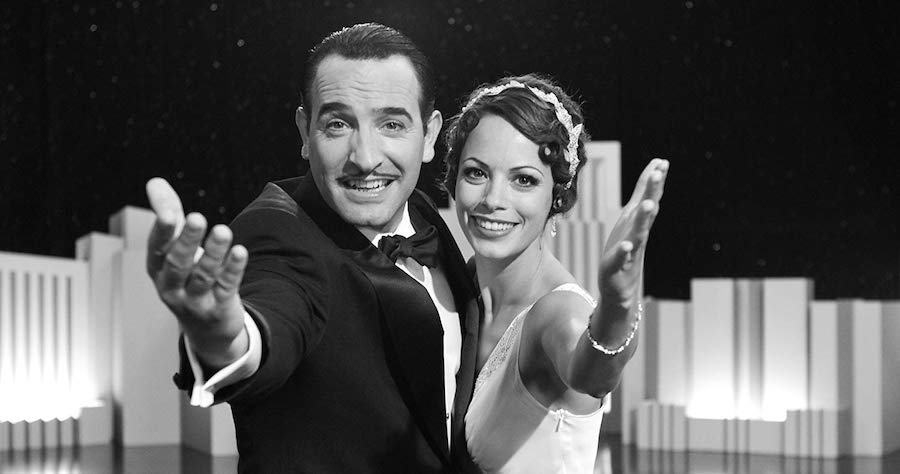
    The Artist” (2011)

    The Artist
    Warner Bros.

    It might have been a bit light to walk off with Best Picture and Best Actor, but this ode to the silent era is still delightful. Especially the dog. (RIP, Uggie.)

    Tropic Thunder” (2008)

    Paramount

    One of the funniest movies ever made about moviemaking brings together a Tom Cruise-esque action star (Ben Stiller, who also directed), a ridiculously dedicated method actor (Robert Downey Jr.) and a coked-up comedian (Jack Black) for a Vietnam war film. (And keep in mind this is a movie where Cruise appears looking nothing like himself.) When the filming stops and the real violence starts, they don’t even realize it.

    Once Upon a Time in Hollywood” (2019)

    Sony

    Although we never see Rick Dalton (Leonardo DiCaprio) and stuntman Cliff Booth ( Brad Pitt) on a movie set, Quentin Tarantino‘s ninth film is very much an ode to Hollywood’s dream factory and the end of an era. By the film’s end, Rick has re-invigorated his fading career with several spaghetti westerns, which almost make up for the fact he didn’t land the Steve McQueen role in “The Great Escape.”

    Hail, Caesar!” (2016)

    Universal Pictures

    The Coen Bros. deliciously revisit the studio era, dropping in on dizzying dance routines, swimming spectacles, and religious epics. Standout scene: Alden Ehrenreich is a cowboy star who’s been upgraded to a prestige society pic.  The “trippingly” sophisticated patter keeps tripping him up, however.

    A Star is Born” (1954)

    Warner Bros.

    The best version of the oft-told “rising star who marries a self-destructive has-been.” Judy Garland‘s character wins an Oscar in the film — a devastating scene where her drunken husband (James Mason) crashes her acceptance speech to beg for a job. The Oscar was rightfully Judy’s in real life as well, but went that year to Grace Kelly for “The Country Girl.”

    Sunset Blvd.” (1950)

    Paramount

    A faded silent movie star (Gloria Swanson, who really was a silent movie star) plots her return to the big screen with the help of a broke screenwriter (William Holden) in Billy Wilder‘s savage noir. This American dream is rotting from the inside out. The final scene, “Mr. DeMille, I’m ready for my close-up,” is legendary.

    Singin’ in the Rain” (1952)

    MGM

    This smart, funny send-up of Hollywood’s transition from the silent era to talkies is still the best movie ever made about Tinseltown. Getting diva Lina Lamont (Jean Hagen) miked up is just one of the priceless set-ups. Trivia: The voice dubbing over Lina’s awful one? Jean herself, not Debbie Reynolds.