 Few writer-producers in television have had the kind of impact as Ronald D. Moore has.
From his earliest work on “Star Trek: The Next Generation” and “Star Trek; Deep Space Nine,” to his acclaimed reinvention of “Battlestar Galactica,” to his current run bringing author Diana Gabaldon’s cherished historical romance novel series “Outlander” to life, Moore has been engaging and entertaining fans for more than 25 years.
With “Outlander” launching its third season Sept. 10 — much to the relief of the show’s diehard fans, who have dubbed the agonizing 16-month wait between seasons “Droughtlander” — Moore joined Moviefone to discuss the making of the newest episodes, the challenges of the new season’s constant hopping through time and countries, and the pleasures and pains of keeping the series’ central lovers Claire (Caitriona Balfe) and Jamie (Sam Heughan) apart.
Moore also reflected on his long involvement with “Star Trek: The Next Generation,” which celebrates the 30th anniversary of its Sept. 28, 1987 premiere this month, including his experience with “Star Trek” creator Gene Roddenberry and his favorite personal contributions to the “Trek” mythos.
Moviefone: What were the big challenges for you in the new season of “Outlander” on both a storytelling level and on a production level?
Ronald D. Moore: The production challenges were much bigger. The scope of the season is so big. Traveling through the different time periods –- not just 20th century to Scotland, but also ’40s, ’50s, and ’60s in the 20th century. And then all the Scottish stuff. Then pivoting the show in the middle, and going to South Africa, and the ships, and then Jamaica. It was very complicated production-wise. That was easily the biggest challenge.
In terms of story, actually, this was an easier book to adapt than the prior season was, so that laid out pretty well. Just in terms of story, probably [the most challenging aspect] was figuring out what the Claire/Frank story was going to be. That took the most thought, because it wasn’t really in the book, so we constructed it from various other books and backstories, and things that were suggested but maybe not clearly defined.
Was it at all worrisome keeping your two leads apart for a length of time in the story?
Not to me. I kind of felt like, every week, the audience is going to be saying, “I can’t wait for them to get back together.” But good. You want to build that yearning and that desire, so that when it happens, it has a big emotional payoff. I feel like if we they had gotten back together after one or two episodes, it’d be nice, but it’d be kind of like an “Okay -– great.” Holding it as long as we’ve held it, I think that builds the suspension and tension.
What do you think it did for the characters to leave them apart for so long, in the ways you were able to explore them?
It’s nice to see them in isolation from each other, because so much of the show is about them together. Splitting them up allows you to sort of see them interact with other people more, and sort of explore them in a different way, so that the relationship between the two of them isn’t front and center.
So you can do things: Jamie’s relationship with his family gets a little bit more time. His relationship to John Grey and Murtagh, and Willie -– you open up all these other doors that, when it’s just Claire and Jamie, that sort of dominates everything else. There’s plenty of that to play in the show, so it was nice to have a one stretch of time where we could do other things.
 Did you want to try to keep your two stars apart as well, so there might be a little extra magic when you did finally get them together on camera?
I don’t know that we talked about that overtly. Not really. I just wanted to keep them apart for the audience. If you look closely through those episodes, you’ll see that, even when they’re thinking about each other and they’re either doing flashbacks or hallucinations, or whatever, we were careful never to put them in the same frame together, so that the audience never had a moment of the satisfaction of seeing the two leads share the screen. So that was a deliberate choice. They were still sort of around each other in Scotland, so they weren’t really in isolation.
Did you have any surprises along the way as you were in production, little zigs and zags that you hadn’t anticipated but turned out well?
The only thing that comes to mind off the top of my head is, in the Battle of Culloden, this sequence between Jack and Jamie was not quite as big and interesting as it was on screen. I wrote it, that they have this moment, and the two men fight, and they collapse together. But the director and the cast just opened it up more and gave it a deeper emotional resonance.
It was also the serendipity of they just happened to be shooting at magic hour when that sequence happened. It’s a gorgeous sky. It looks fantastic. A lot of that was just an accident, and they just embraced it and went for it. Then Tobias [Menzies] and Sam found that moment… All that wasn’t scripted -– that’s just something that they found. So that’s an example: you just find something and it works really well.
Did you cast your John Grey [with Australian actor David Berry] with the thought that this is a character that does have his own adventures, and maybe you will bring those to life on screen sometime?
A little bit in the back of your head you’re thinking about that. That’s come up in casual conversations. It’s not really in active development, so we didn’t really set him up with that specifically like, “Oh, and this is potentially a lead of another show.”
What do you love about what you guys have been able to bring to Diana Gabaldon’s stories at this point?
I think we’ve just opened up the world a bit. Primarily, the stories are told from Claire’s POV. In Season One, we hewed pretty closely to that. But as the series has developed, you start broadening it out and opening the show up a little beyond Claire’s internal dialogue with herself, and her single perspective on the world starts to broaden out to Jamie and to other characters. It’s really nice to sort of have opened up the whole world of “Outlander” a little bit more on camera.
As a crew, were you very excited to create the other eras? To break away from the historical period that you’d already spent a lot of time in?
I don’t think anybody was excited to do the other periods, except maybe the writers! It’s just a pain in the ass for production. They have to keep track of all the stuff: “What’s Claire’s hairstyle in the 50s versus her hairstyle in the ’40s? Wait a minute -– now we’re in 1968. Do we have the right set dec for that on the same set, and later, tomorrow, we’re shooting Jamie in Scotland!” It doesn’t make anybody happy to go sliding around time.
What got you creatively energized when you think about the next season?
Again, it’s a whole different show. Now it’s the American colonies, about a decade before the American Revolution, in the hinterlands of North Carolina. You’re essentially doing version of “Little House on the Prairie.” It’s a pioneer story. You’ve got Native Americans, you’ve got Antebellum south with slaves. You’ve got the first stirrings of things that will become the American Revolution. You’ve got new villains.
Like every year, it’s “Oh, we’re starting from zero, and what’s this year of TV going to be?” It’s exciting. It’s challenging. It’s tiring, because you would like the familiarity and the comfort of just, “Okay, let’s go shoot in the CIC again.” You long for those kinds of days. But creatively, the show never gets boring. You’re never sort of like, “Oh yeah, we’re doing one of these episodes again.” It’s a completely different challenge every time you sit down to write one.
 I also wanted to ask you about “Star Trek: The Next Generation,” and the 30th anniversary.
Is it? This year? Sh*t. I must be getting old. Wow, that’s a trip.
What does that mean to you now, looking back to see what you all were able to accomplish with that series, with that group of characters, with that group of actors, against almost impossible odds?
It’s hard to really think about it in those terms. We were so inside of it, and it was such hard work, and we were doing it so intensively. Now, I feel like doing 13 episodes or 16 episodes is a back-breaker, but we were doing 26 a year — and you just did so many of them, and you were constantly writing and constantly producing. It’s amazing we were able to do it at all.
But it is remarkable. It’s difficult, in some ways, to remember what it was like. When I started on the show in its third season, it was not really accepted as real “Star Trek.” The fans were very skeptical, and the fans were kind of split. There were those who liked “Next Gen,” and there were those that hated it. I remember going to a convention when I was still a fan, and there were like the bumper stickers and the t-shirts that were about “real” “Star Trek,” and various things -– “the bald guy” was not accepted.
And then that all shifted and changed, and suddenly, it became “Star Trek.” It’s really funny to remember that there actually was a moment when “Next Gen” wasn’t taken seriously by the fans themselves, who almost didn’t embrace it. Even though they were watching it religiously, they were still bagging on it privately and among each other.
So I guess I’m just really proud of the fact that we just loved the show ourselves, and we were committed to what we were doing, and we never doubted for a minute that it was “Star Trek.” We just sort of waited for everyone else to catch up.
What were the big tools that you walk out of that experience with as a writer and as a producer?
It was becoming a writer and a producer. “Next Gen,” I was there for five years, and I learned writing. I learned what it was to write for television. I was a complete neophyte. I’d never written for TV before, and I was surrounded by much more experienced writers. By the end of that experience, I had learned television writing and television production.
When I went to “Deep Space Nine,” it was like a graduate course. It was like, “Okay, now let’s push even further. Let’s get deeper inside of character. Let’s challenge the format itself. Let’s try to make it more serialized. Let’s challenge the idea of what ‘Star Trek’ could be.” So it really taught me not to be satisfied with what a show is, that there was always a better show that you could make tomorrow. [That] was really the biggest thing that I took away from that experience.
 Being a fan before you got involved with the show, what was your favorite contribution to the “Trek” mythology? You obviously gave a lot to the Klingon empire.
A lot to the Klingons. You know what the funny thing is? I really liked naming starships! I really enjoyed that. If there was a chance to name a starship, I love doing it, and creating a different class of starship. I really got into that.
I was always pulling back into references of either naval history that I thought were really cool, or I was naming ships after the Hornblower series, or something else — or some random ship that had been mentioned once in an original series episode and I was going to do a new one. That was, like, my favorite gig. I always liked to name starships.
I know that Gene Roddenberry wasn’t in his best health around the time that you came on, but were there things that you learned from Gene in particular from your personal encounters with him? Or just from the way he organized the show?
The show was pretty disorganized when I got there, so I sort of learned, “Don’t do this.” I started third season; he was still definitely involved third season. He rewrote a script while I was there. He was throwing out scripts. He tried to throw out a script of mine, but didn’t, ultimately.
Then his health kind of started declining as the fourth season moved on. I didn’t really have many story meetings with him. He was just a genial, bear-like guy, with a quiet sense of humor. Everyone really kind of liked him as a person, intuitively. He just had this enormous reputation.
But you were catching him in a moment of decline, physically, and he was starting to step away from the show more and more. So yeah, there weren’t really TV writing lessons that I had an opportunity to really get from Gene.
As a fan of the original show, what were the inherent qualities that you were excited to perpetuate forward, those “Star Trek” essences that you really wanted to have in “Next Generation?”
I really wanted to hang on to the nautical and naval traditions that I thought were embedded in the original series. When Gene started talking about “Next Gen,” Starfleet wasn’t really a military organization, and they were starting to drop more and more of those little touches around the show.
I thought those were really compelling, and really gave The Original Series a specific identity as a ship in space. So I kept putting those things back in: Everything from, like, the nautical bell at a court marshal hearing, to dress uniforms, to sort of little ways of there being a watch on the bridge, watches relieving other watches on the bridge. Who was the officer of the deck? The chain of command. I was always trying to keep those as part of the “Star Trek” traditions.
I thought that was important, because it identified what Starfleet was, and it gave a hierarchy and an ethos, and sort of an idea to what there was — even though, yeah, they were more explorers and scientists and so on. There was this core nautical, naval identity of who they were.
We got to see the original cast in their older years, working together, playing those characters. Would you love to see the “Next Generation” cast get a chance to revisit their characters and be together again at least one more time?
Yeah, that’d be a kick. It’d be a lot of fun. None of them look quite as old as they did in “All Good Things” [the series’ final episode, set in part 25 years in the future] in all fairness. Patrick [Stewart] looks much better than the way we portrayed him in “All Good Things!” So none of them have aged even as far as what we said they would. But it would be a kick to put that group back together and do something. Yeah, that’d be a lot of fun.
 Apple is going to space … on television.
 “Outlander” is looking to the future.
  A dear wish of “Outlander” fans is finally coming true.
 Fans are often quick to lash out when a TV show makes any changes from the source material, but “Outlander” just illustrated an exception.
 The long wait is over: Claire Randall and Jaime Fraser are finally back on your television screen!
 You’ve said that to inform your performance as Claire at the age we see her in the new season, you took a look at various actresses with long career spans at dramatically different ages. What was the takeaway for you?
 Can you talk about working with Tobias Menzies now more as Frank than as Jack? That’s quite a shift.
 Aye, the Droughtlander is finally over as of this Sunday, with the premiere of “Outlander” Season 3.
 They may be separated by centuries, but Claire and Jamie’s love endures on Season 3 of “Outlander.”
 When it rains, it pours! Earlier this week, “Outlander” fans finally learned that the #Droughtlander would end when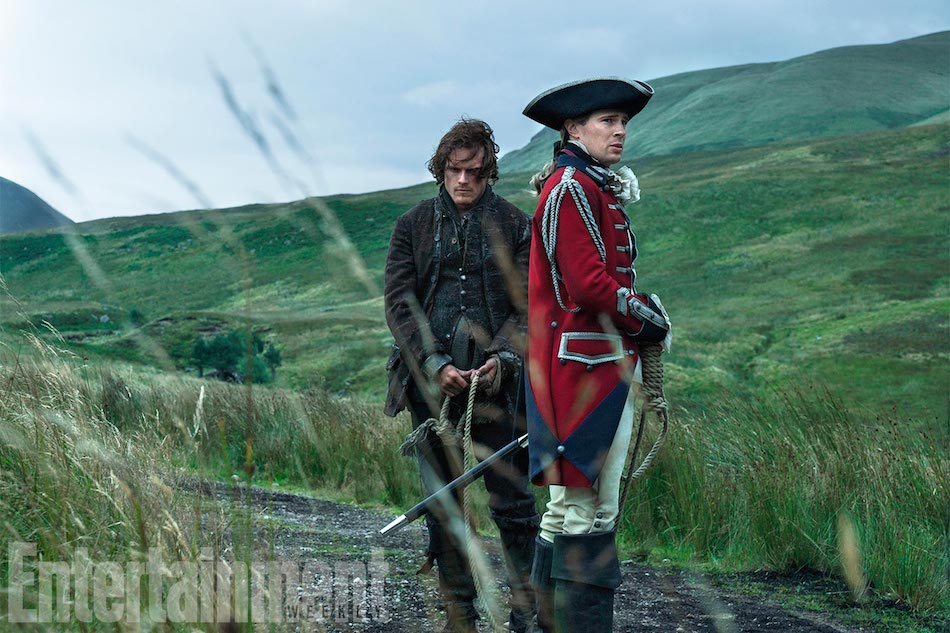
 The #Droughtlander is nearly over.