 Viva Los Pollos Hermanos!
As “Better Call Saul” enters into its third season having earned its reputation as one of the all-time great spinoff/prequel series to its high-bar-establishing predecessor “Breaking Bad,” the timelines of the two series are increasingly converging, meaning a new influx of some of the familiar faces from the precursor.
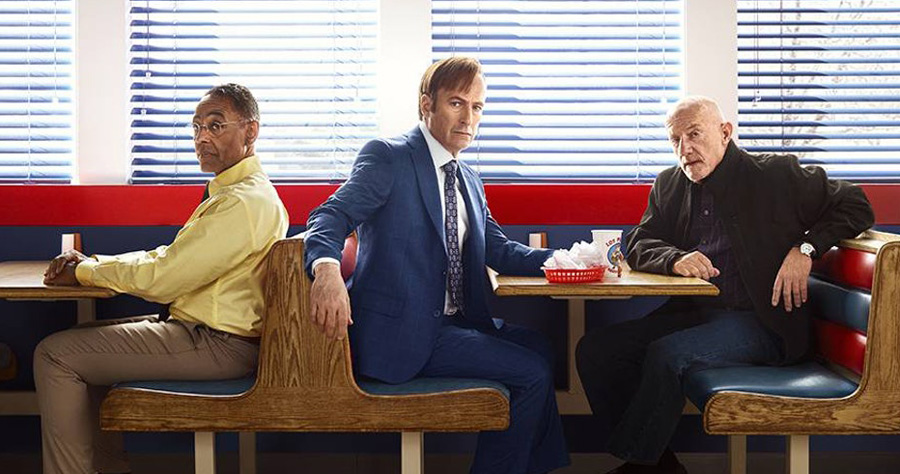
This time, it’s fried chicken franchise king/meth kingpin Gus Fring, adroitly played once again by Giancarlo Esposito, whose orbit crosses over with Jimmy McGill’s (Bob Odenkirk) as Jimmy inches closer to his descent into full Saul Goodman-ness and contends with increasing conflicts within his own inner circle. “I think you can expect problems aplenty, in every aspect of every relationship in ‘Better Call Saul’ going forward,” says executive producer Vince Gilligan, “if for no other reason than that’s what makes for good story telling.”
Gilligan and co-showrunner Peter Gould joined Moviefone and a select group of TV press to offer a glimpse at exactly how their writing team goes about weaving “Better Call Saul’s” storylines into the established “Breaking Bad” mythology — and the approach not as master planned as you might think.
We know that Giancarlo Esposito’s coming back — or more accurately, making his chronological first appearance — as “Breaking Bad’s” Gus Fring. Why was this the time for Gus?
Peter Gould: I think it’s all organic from the story. We started off in the first episode of the show with Tuco, which you go Tuco, you end up getting Hector, and once you get Hector, who knows? Who knows where you go from there?
How much do you look at the timeline and say, “Well, they would have to have met at this point…”?
Vince Gilligan: We look at the timeline a lot.
Gould: We do. We have an office full of really smart people who are always reminding us when we’re about to violate something that we’ve already said. We do look at it, but mostly, the truth is, the show is really the story of Jimmy McGill and Mike Ehrmantraut, our characters, and now also of Gus Fring. So we think about those characters, and we think about what’s important to them, and we think about what their next move would be.
It’s not so architectural. We don’t put up a pushpin and say, this is where this character comes in, and this character comes in. It’s really all about trying to tell the best story we know how.
That being said, going back to when you conceived the show, did you have the idea that you’re like, “If we get three seasons, if we keep going, we are going to get to Gus Fring”? Was that always the plan, to one day hit that point in the story?
Gilligan: Is it fair to say, we had ridiculously few plans going into Season 1 of “Better Call Saul”? There was a time there when “Better Call Saul” could have looked a fair bit like “Dr. Katz,” that TV show where it all takes place, it’s a half hour long — which by the way, was a fun show.
Gould: It was a great, great show!
Gilligan: The show could have been famous comedians come in and talk about their legal problems to Saul Goodman. We knew so little going into this. It’s embarrassing to admit that now.
Once we figured out it was an hour-long show, then we thought, “It’s going to be a 75% comedy, 25% drama.” I think we famously offered that thought going into Season 1. Then we realized not even that was true. This has been a voyage of discovery since Episode 1, Season 1, and Season 3 is no different. We’re learning as we go. There’s no hard and fast plan for when people who up — or if they show up at all.
Gould: That’s absolutely true. Looking back, it seems inevitable. Everything that we didn’t understand seems inevitable now. We think, “Mike Ehrmantraut is arriving in Albuquerque. He’s a cop. He has no connections to organized crime, that we know of, but we know on “Breaking Bad” he’s going to be working for Gus Fring. How the hell does that happen? How does a guy who is maybe a somewhat crooked cop — I don’t know, or a cop certainly who’s…
Gilligan: Conflicted.
Gould: …a conflicted police officer, go and become the right-hand man to a drug lord?
Gilligan: And it’s so much harder to connect those dots than we ever thought it would be. To get from point A to point Z is hard.
We’ve also seen Gus’s backstory before on “Breaking Bad.” Did you go back and watch that?
Gould: Oh yeah. Especially, we had to because Giancarlo asked us! We spent a long phone conversation with Giancarlo talking about where Gus was. We had to go back and remember a lot of things that we talked about but never made it on to screen in “Breaking Bad.”
Gilligan: We had to break out the Blu-ray set.
How easily did the new season come together, story-wise? Was it an easy flow, or did you struggle with it?
Gilligan: It’s never easy. It’s never easy.
Gould: It’s never easy and it’s always different. We almost reset the show at the end of Season 1. So Season 2 we had to figure out, “Where is this guy going? What is important to him?” I don’t think we really understood that until we got into Season 2.
We end Season 2 with two giant cliffhangers. We have what’s going on with Jimmy. We found out he’s recorded. He’s been recorded by his brother who hates electricity. What the hell is Chuck going to do with that? We know it’s going to be a problem for Jimmy.
This all happened in that great episode that Vince directed. You had that wonderful scene where Mike was on the verge of pulling the trigger and killing Hector, and this mysterious force intervenes on behalf of Hector. So the great thing for us about a season like that is that we have a running start. So we had a running start to Season Three, but having said that, it’s still never easy.
Gilligan: It bogged down later. It always bogs down.
Gould: The first couple came pretty quickly. Then there’s always a lot of hair-tearing, a lot of banging our heads against the wall.
Gilligan: Sometimes literally.
So in creating “Breaking Bad” and creating the relationships between Saul, Mike, and Gus, did you already know then how those characters met, or did you have to determine that story now as you’re having their introductions and first meetings in “Better Call Saul”?
Gilligan: I hate to admit how little we knew back then. When Saul Goodman came along …This is the beauty, by the way: I sound like I’m making it into a detriment, into a negative, but the wonderful thing about TV, the wonderful thing about writing for TV, is that it’s such an organic, free-throwing, creative process.
For instance, when we created the character Saul Goodman, a great episode of “Breaking Bad,” we thought he might be a one-off. We didn’t know if the actor we would hire would be up to snuff. When it turned out we were going to hire Bob Odenkirk, that fear was allayed. But every now and then, you don’t know, when you’re going to hire an actor, are they going to be what you hope they will be? Are they going to be good? Then if they’re good, maybe they’ll go off and take some job and they’ll never be available to you again.
TV is so free-throwing, I don’t think we knew ever at that point, let alone knowing how Saul Goodman, and Mike Ehrmantraut, and/or Gus Fring met, little did we even know this guy would ever be back in an episode.
Gould: We don’t make big plans going forward, but I think there’s actually a writer’s trick that we use, which is that we look back. We look back at the show and we try to find, “What do we not understand about what’s already there?” And that’s when we know we’ve kind of hit a vein of gold, is when one of the writers says, “You know I always wondered how this or that happened … I always wondered why Walter White, a genius, was teaching chemistry in high school. I always wondered why Jimmy McGill became Saul Goodman. Why Saul Goodman had this or that. I always wondered why Saul Goodman had a pinky ring.”
When you ask those little detail questions, sometimes the story grows from the details, rather than the big picture informing the small picture.
You’ve got a handle on Jimmy’s evolution most recently. Tell us as much as you can, about that moment when you got it. When you’re like, “OK, we’re there…”
Gilligan: It’s an organic, growing process. I always pictured on “Breaking Bad” — and it’s kind of the same with “Better Call Saul” — you’re kind of going through a tunnel with a tiny little pen light. You wish you had one of those big Maglites. You don’t have that. You’ve got a tiny little pen light, and you’re learning more and more, you’re revealing to yourself more and more the dimensions and shape of the tunnel that you’re in. You’re going inch by inch sometimes, and it’s the same.
Obviously, it’s a metaphor in my head because it’s a similar process, even with a show about a character who you know where he’s going. Sometimes it’s even trickier. Why does he wear a pinky ring? So much of that stuff was just stuff we gave him, and you’re figuring it out, you’re reverse-engineering and you’re figuring it out, just baby step by baby step.
Every now and then I hear a showrunner, like ourselves, talk about his or her show and say, “Yeah, I had the whole ending figuring out in advance. I had the whole thing figured out in advance.” I’m always so jealous of that, because it’s never been that way for us. It’s never the case. You’re kind of finding it as you go. But having said that, that’s kind of the thing that keeps the job interesting.
Gould: When you have to keep using that little light to make sure, you have to look at every inch, because you never know, there might be a pit right in front of you. If you’re too busy shining the light, trying to shine this little light 50 feet down, you might miss the hole that you’re going to fall into.
Were you kind of giddy when you turned the corner on it?
Gould: Oh, giddy is a funny word. I think to be honest with you, sad, because I think that we love Jimmy McGill. I think Bob feels this way. I know Vince and I feel that. I think the whole writers’ room, we have such an affection for Jimmy McGill, for his energy, his good intentions, his humanity, his inability to resist his abilities, that I think we’re all a little bit sad that some day this guy’s going to turn into Saul Goodman. Now that I start understanding it, it’s a big word, but it really does feel like a tragedy.
Gilligan: I think you’re right. The show’s a tragedy. That’s yet another thing we didn’t know going into it. We thought it was going to be fun. We thought it was going to be a lark. We thought it was going to be mostly comedy. And it took a good solid year, year and a half, to figure out it was a tragedy.
There’s tragedy to be mined from this. The very fact you know even what you know now watching the show, you know that Jimmy McGill is a good guy, he means well, he cuts corners, but pretty much every time so far he breaks the rules and breaks the law, it’s in aid of someone else, some underdog who be believes, rightly or wrongly, deserves some help.
Then we know, if you watch “Breaking Bad,” this guy, Saul Goodman, he’s helping someone sell meth, he’s laundering money. Every now and then he floats the idea about killing someone, someone we like. He did that with Jesse along the way in “Breaking Bad.” That’s not the same guy as Jimmy McGill. How do you get from point A to point Z? It’s also a big central crest of the show, of the writers’ room.
Gould: We make it sound like we never talk about the future. But we do. We absolutely do. We talk about where is the season going, but we don’t take the answers seriously until we actually have all the pieces leading up. We can always change things. It’s that flexibility.
“Better Call Saul” Season 3 premieres Sunday, April 10th, on AMC.
 How did we find out that we’re getting a third season of Netflix’s hit comedy “Dear White People”?
 It sure sounds like Gus Fring might be breaking bad on “Better Call Saul.”
 In anticipation of
  When tackling this project, what helped you focus on the story you wanted to tell as you researched the original?
 On a recent trip to the old Ink and Paint building over at Walt Disney Studios, I saw a multi-plane shadowbox for the opening scene of “Bambi,” which I immediately thought of during the opening of your film in its composition.
 Did you catch it? I’m so glad it’s in there. That was an on-set discovery. That was a prop in the background that I pulled and I said, “Oh my god, this is what Mowgli has to use. I knew he had to touch something that would get the attention of King Louie and I saw the cowbell off to the side and I pulled that in and swapped it out for the prop that we had designed for it.