Al Pacino and Jessica Chastain will lead the cast of ‘Lear, Rex’.
Bernard Rose adapted the play for the new movie and will direct.
Rachel Brosnahan, LaKeith Stanfield and Peter Dinklage are also all among a starry cast.
Al Pacino just can’t stay away from the Bard. The actor, who has appeared in several Shakespeare adaptations (and one or two movies inspired by his work), will once more tackle the legendary playwright’s work with a new interpretation of ‘King Lear’.
And he’ll be joined in what is called ‘Lear, Rex’ (“Rex” meaning “king”, “monarch” or “ruler” in Latin, language fans!) by occasional co-star Jessica Chastain and a host of famous faces.
yQxYH784Km1xwfdUpwFpT5
What’s the story of ‘Lear Rex’?
Oscar® nominee, Al Pacino arrives on the red carpet of The 92nd Oscars® at the Dolby® Theatre in Hollywood, CA on Sunday, February 9, 2020.
From the sounds of it, writer/director Bernard Rose is sticking relatively close to the story as laid out by the play… Pacino will be an aging King who divides his land between his three daughters to prevent future conflict.
But he rejects the youngest daughter, Cordelia who loves him and places his trust in her malevolent sisters, who strip him of his power and condemn him to a wretched wasteland of horror and insanity. Tch… you kids today, with your lust for power and your overthrowing of the monarchy!
(Far Left) Rachel Brosnahan on Prime Video’s ‘The Marvelous Mrs. Maisel.’ (Center Left) LaKeith Stanfield in ‘The Changeling,’ now streaming on Apple TV+. (Center Right) Peter Dinklage as Casca Highbottom in ‘The Hunger Games: The Ballad of Songbirds and Snakes.’ Photo Credit: Murray Close. (Far Right) Ariana DeBose at the 5th Annual Hollywood Critics Association Awards.
Alongside Pacino and Chastain (who plays Goneril, one of the older daughters who plot against their naive old dad), the already impressive cast for this one also includes Ariana DeBose as Cordelia (the youngest daughter), Rachel Brosnahan as Regan (Goneril’s scheme-happy sister), Peter Dinklage as the Fool, Danny Huston as Albany, Chris Messina as Cornwall, LaKeith Stanfield as Edmund, Ted Levine as Kent, Matthew Jacobs as Gloucester, Rhys Coiro as Oswald and Stephen Dorff as Poor Tom.
Barry Navidi is reuniting with Pacino to produce the new film, having worked on several movies with the star (including ‘Salomé’ and ‘Wilde Salomé’, which also starred Chastain.)
‘Lear Rex’: the director and producer speak
Al Pacino at the 94th Oscars® at the Dolby Theatre at Ovation Hollywood in Los Angeles, CA, on Sunday, March 27, 2022.
“It is enormously exciting to get the opportunity to work with this extraordinary cast that Al, Barry and Sharon [casting director Sharon Howard-Field] have put together to tackle this radical, but accessible adaptation of Shakespeare’s greatest play.”
And here’s what producer Navidi had to say:
“I am delighted to have the opportunity to collaborate with Bernard Rose. His artistic vision, combined with a talented ensemble cast of players led by Al Pacino, promises to take us on a remarkable and unforgettable cinematic experience. We are merging the worlds of Shakespeare and Hollywood. This marks the commencement of an exciting new chapter, one that Al has poured his heart and soul into. It is a privilege for me to join forces with my dear friend once more, and to contribute to his enduring legacy.”
When will ‘Lear Rex’ be in theaters?
With the distribution rights yet to be sold, there is no current release date for ‘Lear Rex’. The cameras are set to start rolling on August 12th and we can’t imagine such a star-studded film –– even a Shakespeare adaptation with its occasional cultural language barrier –– sitting in the marketplace for too long.
Al Pacino, Francis Ford Coppola and Robert De Niro onstage during the 50th anniversary tribute of “The Godfather” at the live ABC telecast of the 94th Oscars® at the Dolby Theatre at Ovation Hollywood in Los Angeles, CA, on Sunday, March 27, 2022.
Opening in theaters on August 4th is the new action thriller ‘Mob Land,’ which was written and directed by first time feature filmmaker Nicholas Maggio.
What is the plot of ‘Mob Land’?
Deep in the heart of Dixie, in a small town struggling with the ravages of addiction, a local sheriff (John Travolta) tries to maintain the peace when desperate family man Shelby (Shiloh Fernandez) robs a pill mill with his reckless brother-in-law, Trey (Kevin Dillon). But the supposedly easy score takes a violent turn, alerting the New Orleans mafia’s revenge-seeking enforcer (Stephen Dorff), who threatens Shelby’s wife (Ashley Benson) and daughter. With its unpredictable twists and turns, Mob Land is a heart-pounding, action thriller.
Moviefone recently had the pleasure of speaking with writer and director Nicholas Maggio about his work on ‘Mob Land,’ creating the screenplay, directing John Travolta, Stephen Dorff’s performance, the music and shooting a complicated scene in under an hour.
John Travolta as Bodie Davis in ‘Mob Land.’
You can read the full interview below or click on the video player above to watch the interview.
Moviefone: To begin with, can you talk about developing the screenplay and the themes you wanted to explore with this movie?
Nicholas Maggio: I’m obsessed with cars. I love the South. I love Southern Gothic stories. I love neo-noir. I spent a lot of time in the South. I was visiting some friends in northern Alabama. We were at the drag strip. I’m immersed in this culture, in this rural, Southern atmosphere, and I was like, “Man, I got to shoot a movie here. I got to write a script.” So I had that as the location, I knew it was going to take place there, and then the rest is just fiction. I just needed a catalyst to get me into this location, to meet these characters, and it was the robbery, and it was everything that went into it. That’s where the story came from. It was literally just my love for the rural South and cars and having visited there. Then, I guess, as far as themes, I think the fun thing about themes for films is I went into it with a few intentional ideas for themes, what I needed to get done as a filmmaker, what I needed to put in there thematically. But I think the fun thing is that, once the film is out and once people see it, once you see it, the audience takes what they want from it, and it doesn’t matter what my themes are, what my intentions were thematically. I think it’s just up to the viewer, the audience, to pull from it what they need from it. As far as themes, God, it’s subjective. It’s whatever you need it to be.
MF: The film is really void of any clear cut heroes or villains, was that by design?
NM: Yeah, definitely, nail on the head. I love antagonists that aren’t antagonists, and protagonists that aren’t protagonists. Ever since ‘The Sopranos,’ it’s like we fell in love with that idea. You’re rooting for the bad guy, you don’t know why, but they’re so empathetic and sweet. I’ve always been obsessed with that notion that, just because good people do bad things, does that make them bad, and if bad people do good things, does that make them good or bad? Definitely, that is something I wanted to play with, and I had a really good time doing it because everyone does some bad things in this film, and whether or not they do it for the right reasons, does that matter? It’s absolutely something that I wanted to do, that I wanted to play with, because I think that’s something that everyone can relate to in some way, whether or not they themselves are conflicted bad people doing good things, or good people doing bad things. But it’s at least something that most people can be empathetic to. If you’re put in these situations that these characters find themselves in, I think most people can understand why they’re making the decisions they do, and I think that was really fun to play with the empathy of the audience.
John Travolta as Bodie Davis in ‘Mob Land.’
MF: As a first time filmmaker, what was it like directing John Travolta, who is arguably one of the greatest movie stars of all time?
NM: I think anyone, first-time director or not, when you’re standing there in front of an actor, a movie star who’s been a movie star for decades, of course, it’s intimidating. Directing, in the traditional sense, I knew wasn’t going to be something that I was going to have the time or luxury to do because we had such an incredibly tight schedule. Most of the directing I did with the actors was beforehand. I tried to give them all the information. I tried to have conversations, text messages with them, answer all the questions, and then create the environments, whether production design, locations, tweaking the script for them, giving them absolutely everything they needed to do what they could do, to do what they do best, and to do the characters justice. As far as Travolta himself, he did so much homework beforehand. I based the character of Bodie on my grandfather, and on some great uncles, but he wanted to see photos of them. He wanted to know about them, how they talked, and he did so much homework in that way that, when he stepped on set, he was Bodie. He knew every line. He knew exactly the mannerisms he was going to bring to it. In the traditional sense, I really didn’t do much directing with John as far as the character was concerned, day of, on set. It was more physical or we would collaborate with blocking, or maybe he would do this and maybe he wouldn’t do that, and so that’s mostly what it was. But every actor, and John included, they just came so prepared that, thank God, because, on the time schedule we had, I wasn’t able to take the time that maybe some directors and actors would need, and I didn’t need it because they came so prepared, which was really epic to have.
MF: There were lines of dialogue that Travolta delivered in a way that only he could, and it seems that another actor may not of interpreted those lines in the same way. Did you realize that on set?
NM: Yeah, definitely. It’s so nuanced, and that’s great about really great actors. It’s the slight inflection in a word, it’s the mannerism, it’s throwing the line away when I didn’t know he was going to. It’s the little things. For the most part, it was pretty verbatim as far as the script is concerned, we didn’t deviate too much, but when we did, it was John’s idea, and it was always right. I’m not even going to pretend to know that I know acting, as a first-time director, better than John Travolta. Every time he had an idea, it’s like, “What if we cut this line and I just said this?” and it wasn’t because he didn’t want to say the lines. It was because he truly thought, and knew that that was best for Bodie in that moment, and he was always right. It was almost annoying, but the guy was right. It just came down to the little things. He’s so very John Travolta in this role, but at the same time, a lot of people who have watched it, and what I believe as well, is that he’s also uniquely Bodie Davis in this. I think that’s really fun, and I think that’s what a movie star is. You see it’s them and they’re doing it, but they’re also giving you something maybe we haven’t seen before from that actor, which is exceptionally fun to watch with him.
MF: What was your experience like working with Stephen Dorff?
NM: Stephen is such an integral part of this whole thing happening, so I got to give my props to Stephen. He was the first one that read the script. He was super excited. I pitched Shiloh’s name to Stephen and he was like, “Absolutely, I’m on. I love Shiloh.” He got it to Travolta. Travolta read it. They talked. Stephen was a huge part of that. He was a champion of mine very early on. We had a pretty blunt conversation, the very first conversation, and Stephen has a way about him. He’s known for being pretty bold, and he was like, “Hey, don’t mess this up. Are you going to mess this up? How are you going to do this?” Once I got him on my side and I gave it to him how I thought, he was on my side the entire production, which was epic. I do have to give props to Stephen for that. Oh, my God, he’s so good. He’s so beautiful on camera. He’s so fun to watch. His face is just perfect for the type of light, for the type of filming we were doing, and then he is such a great actor. I am biased as hell, but I think this is his best role. It’s my film, and he said my words, but, God, he’s so good in it. It’s fun that everyone who watches it says, “Stephen was so great,” and because he is, he’s so good in it.
MF: Can you talk about Dorff’s character, Clayton, his point of view and what he’s searching for in his life?
NM: I think the fun thing about Clayton is that he lives by his own set of morals that he deems righteous, but also what he’s doing is all of these rules that he set for himself and the questioning of the locals and trying to understand them in his way, knowing that he’s not going to understand them, is all just means to justify the horrible stuff that he does. He’s conflicted. He knows what good and bad is. He knows the difference. He’s not a sociopath. He’s not a psychopath. He truly understands. He’s just looking for meaning like everyone else, but on top of that, he’s looking to justify everything he does, and so he’s constantly searching for justification for the violence, for his way of life. That’s so much fun in the arc of the story is that he does get to understand a little bit of it, and by the end, he does have an understanding through especially the last conversation with Shelby (Fernandez), he does have this understanding of what it means to be in Shelby’s shoes type of thing. That’s the crux. That’s what gives us the ending that it is with Clayton.
Stephen Dorff as Clayton Minor in ‘Mob Land.’
MF: Can you talk about your musical choices in the movie and how those particular songs helped to create a specific tone for each of the characters?
NM: I love you for even mentioning it, because we had no budget for music. We just didn’t. All of the songs outside of score are friends of mine that gave it to me for free, whether it was Devlin McCluskey, the singer of The Dead Ships, who did that unreal cover of “House of the Rising Sun,” he recorded that in his bedroom, or whether it’s Jason Dodson from The Maldives who wrote and recorded that song during the credits. He did that after he read the script. He still hasn’t seen the film. The song that plays while he’s walking to the carwash and back, that is another friend of mine. That’s his band who did that. The metal song that plays during the chase scene is a straight edge, hardcore band out of Birmingham, Alabama, called No Cure that I hit up, and they gave me a song for free. I’m lucky enough to be involved in music as just a massive fan, and being such a fan of music, I’ve met some really great people who were willing to give me this music for free. Massive shout-out to all of the bands, Mind’s Eye out of Denver, the song that’s playing when Kevin Dillon was driving the Honda. Everything was given to me, so just huge thanks to all those people. I was up against it because it really made me search for songs that were accessible. I couldn’t use Journey. I couldn’t use Styx. I had to find songs that I could actually get access to, but because of that, it was a really great thing because it let me get very personal with it. They are songs that really mean something to me because most of them are friends’ bands that really have spoken to me over the years or whatnot. That was really fun to do.
MF: Finally, can you talk about the challenges of shooting the bank heist and care chase sequence?
NM: I’ll maybe blow your mind a little bit. From the time when they have the guns, to the time they run out of the bank, that entire sequence, I shot in 48 minutes. We were on an incredibly tight schedule for the entire principal, and it was one of those things where things were stacked up. We had the location at a certain time. We had the stunts, and we did everything in 48 minutes, to the point where, when we’re in the red room during the robbery, King Orba, who plays Rip, Shiloh Fernandez, and Kevin Dillon, the three of them are in there, and there’s no master shot. We went in there with two cameras, and I told them, “Guys, I am so sorry, but we have three takes,” and all of them immediately were like, “Yep, let’s go. We got it,” and they just nailed it. What’s so beautiful about that is that Rip was going to take his time during the robbery. He was going to deliver these lines very methodically. He was a different character up until, literally, two minutes before we shot. Then King flipped it, and the way he rattles those lines off, it really heightens the entire scene, which ended up being a blessing. I cut a few lines out, I cut a few actions out, literally as we were shooting, and it gave this heightened sense of urgency, stress and anxiety to the scene. I don’t think we would’ve gotten otherwise. Those guys, the three of them are such great actors that they just delivered for three takes and we were done, and God bless them. I lucked out time and time again, whether it was with cast, the crew, or with locations. That’s what filmmaking is. It’s stars aligning, and time and time again, we lucked out.
‘Mob Land’ is produced by 308 Enterprises, Three Point Capital, BondIt Media Capital, and Grandave Capital. The movie is scheduled to release in theaters on August 4th, 2023.
The movie stars Stephen Dorff (‘Blade,’ ‘True Detective’) and Emilie Hirsch (‘Speed Racer,’ ‘Into the Wild‘) as Cody and Alex, respectively, who after a robbery gone wrong, abduct a hostage named Grace (Gigi Zumbado). However, when they decide to hide on a remote farm, they discover a secret horror and becoming victims themselves.
Moviefone recently had the pleasure of speaking with Emile Hirsch about his work on ‘The Price We Pay,’ it’s unusual genre, creating his character, the challenges of acting tortured, reuniting with Stephen Dorff, and working with director Ryûhei Kitamura.
Emile Hirsch in ‘The Price We Pay.’
You can read our full interview below or click on the video player above to watch our interview with Emile Hirsch about ‘The Price We Pay.’
Moviefone: To begin with, ‘The Price We Pay’ starts off as a heist film and quickly becomes a very dark horror movie. Can you talk about the genre-flipping aspects of the screenplay and is that what attracted you to this project?
Emile Hirsch: Well, the initial thing that attracted me to the film was the chance to get to work with Ryûhei Kitamura. I watched his film, ‘Versus.’ The producer, Robert Dean, contacted me and he said, “Watch this movie. I’m going to do this movie with this Japanese director.” ‘Versus’ just had an energy and kind of a movement to it. It’s like cult classic now that Ryûhei shot in Japan.
I loved it and I knew that he would make something different from this. This film has echoes of a lot of different movies and our goal was to give our own spin, and our own unique take on it. As far as the genre shifting, for me, I liked it because the first part, it almost has a ’90s, Quentin Tarantino kind of feel to it. Mobsters being bad, giving witty quips to each other, and really just being total and utter scumbags.
So as an audience member, I think it’s one of those things where you buildup strong opinions about some of these characters. My character in particular, he might be amusing to you, but you don’t like the guy. So, when the genre shifts and you realize that it’s like that animated fish analogy, where there’s one fish and then the bigger fish comes and eats it, after it eats a little fish. It’s kind of like that.
I think part of what’s satisfying about that shift from the first act to the second act is because we’re so in control, it’s almost more satisfying when you see the genre shift because suddenly they have nothing to say. They have absolutely no cool talk to say because they’re totally screwed. You see that these other villains are even worse than they are. They’re not talking like they’re in ‘Goodfellas’ or something. They’re just executing their plan.
So, it’s a genre shift that I think doesn’t weaken the film. It makes it oddly more satisfying because you think that these guys are starring in their own movie. You know how there’s guys that the way they act, it seems like they’re starring in their own movie? Then suddenly it’s like, nope, you’re starring in these other guys’ movie. You guys are just on the chopping block!
MF: Your character is very smart, sarcastic, and at times really funny. Was he written on the page exactly like that, or did you bring a lot of your own sensibilities to the role?
EH: I think that the writer, Christopher Jolley, wrote a really great script and the director, he is very collaborative. So, I could have ideas here and there, but as far as what was written, I consider myself first and foremost an actor and it’s all a collaborative part of the process. We were able to rapidly change things around as we saw. So, very early on I went to Ryûhei and I said, “I think it’d be cool if Alex, if he has a pair of dice.”
It almost reminded me of Humphrey Bogart in ‘The Caine Mutiny.’ You remember that, where Humphrey Bogart has these metal balls that he’s constantly swirling in his hands. I said, “It’d be kind of cool if Alex had something like that, that he refers to, it’s almost like a magic eight ball that he has where he is kind of consulting it and he’s just weird enough that he thinks it has some sort of magic powers.”
We were able to incorporate that at the right moments through the film. Then I think it really pays off for me in my final scene where the ultimate gambler guy, where life is a game of living or dying, it’s just all a game, he finally gets to play this game except he’s like the player. He’s not like the instructor and he realize he’s a member of the game.
It’s only a guy as demented as that that embraces the game. So, when he goes down the path of his fate, he is oddly okay with it and excited to play the game because it’s like he’s the perfect guy to do that with. So, I wanted to tie the logic of that character in so in those final scenes. It’s almost funny because you’re like, this is the guy that would actually want to do that. I didn’t come up with the glasses though, that was Ryûhei and Chris Jolley.
(L to R) Stephen Dorff and Emile Hirsch in ‘The Price We Pay.’
MF: You first worked with Stephen Dorff over a decade ago on ‘The Motel Life.’ What was it like reuniting with him on this film?
EH: Yes, Stephen and I worked together on ‘The Motel Life,’ and we played brothers. We always got along great. He’s such an incredible actor, he’s such a passionate guy and he gives everything he has in every project. So, it was a pleasure to work with him on this, and Gigi Zumbado, Tanner Zagarino and Vernon Wells as well. We had a really great cast. But with Stephen, I think we’ve always had an affection for each other.
We’ve always kind of had that brotherly bond. I met Stephen at the premiere of ‘Old School,’ when I was shooting ‘The Girl Next Door,’ when I was 17 years old. We always liked each other. Here, it’s different because we’re kind of in adversarial roles. But I felt like the cat and mouse between Alex and Cody, I felt like it kind of works because the only reason why Alex doesn’t just completely steamroll or shoot all the hostages, is because Cody, Stephen’s character, is able to match wits with him.
Because he matches wits with him, that’s what brings Alex down. That’s what keeps Alex in control. Because Alex is a guy who, if you can come back and spit something at him, he’ll sort of respect that in a weird way. Dorff was so good at that. I love the way he would spit out some of those lines. Some of the lines are really funny. He’d be like, “Unless you got yourself a bicycle.” I’m like, “We’re going to walk?” And he goes, “Affirmative. Unless you got yourself a bicycle.” It’s just like this military guy saying this sarcastic line. It’s really funny.
MF: Did you enjoy working with actress Gigi Zumbado?
EH: She’s so cool. She’s so spirited, full of ideas and energy, and she was so excited to be a part of this wild movie that we had. I thought she was great. She really takes that third act into the stratosphere for me. Her and Tyler Sanders, the young man who played the Danny. He was a wonderful, and a very intense actor who it was a real pleasure to work with.
Gigi and Tyler, they really owned that third act space. There’s a couple of sequences in it where, when I first saw the movie, my jaw was really on the floor. I was so proud of Ryûhei, and his editor was amazing. If you look at the barbed wire sequence, and I won’t give anything away, it’s one of the craziest sequences in any horror movie, ever. The way that it’s edited and constructed with the machine, and the way it keeps cutting back to the machine, literally adding tension to the scene, it’s really something that I hadn’t seen before. It really spoke to the team that we had, because the sound design, the effects and the editing on that scene are masterful, and the cinematography as well.
(L to R) Stephen Dorff and Gigi Zumbado in ‘The Price We Pay.’
MF: Can you talk about the challenges of acting tortured on screen, and when you are making a movie as intense as this, what’s the vibe on set? Is it fun to play being tortured, or does it take a lot out of you emotionally?
EH: It’s fun in certain circumstances. Let’s put it this way, when we’re shooting the torture stuff, I’m on a gurney, I’m wearing a backless smock, and I’ve got prosthetics all over my face covering my eyes so I’m blind as a bat. Then, there’s all these sharp medical instruments around me and we’re shooting inside this darkened office building, and I can’t see anything. It’s cold, damp and weird, and that kind of stuff, that is still fun, believe it or not. It’s still fun because it’s just so out there. But it’s a little bit nerve-wracking, especially when your vision’s gone.
I asked a girl that was next to me, “You’re on the crew, right?” She’s like, “Yeah.” I was blind and I said, “Okay, don’t leave my side under any circumstances.” She was like, “I will not leave your side under any circumstances.” So, she would keep an eye on me as they were wheeling me around and I was being put in different nooks and crannies and this kind of maze like set. It was really intense with all the medical instruments, scalpels and saws, and being strapped down. Your imagination can go to a lot of places, and honestly, they’re probably not even crazy enough for this movie.
EH: In terms of looking for something out of a director, I’m very simple where I’m only looking for a good movie. That’s it. I’m only looking for a good performance. However we get there doesn’t matter because directors are so very different. So, the process on ‘The Price We Pay,’ we were developing and rewriting the script every single day up to shooting. On the weekends we would get together and be rewriting, reworking, retooling, getting approval, and everything like that. It’s a day by day thing and that was something that Ryûhei was really into and embraced it. Then even on the set, we’re constantly blocking, rewriting, and all that type of stuff. It was an extremely fluid process.
When you work with someone like Tarantino, for the most part, the writing is kind of word perfect. You’re getting there. Tarantino a lot of times will re-block things in his mind visually, and then he will find something in a scene. But he also has the time to do that with those bigger budgets. There’s not really any time constraints on Quentin. Whereas this film, we shot this movie in such a short amount of time, you can’t even believe it really. It was 17 or 18 days. It might even have bene less, and the budget is way less. We just don’t have that much time. So, to have that kind of fluidity with the director that I had with Ryûhei was great. He was insanely collaborative, fun and had a good sense of humor.
I’m a very glass half full actor when it comes to my director. I’ve worked with actors that find things sometimes that they don’t like and they find them very easily. But I’m the kind of actor that I’ll stick my head in the sand about something that they might not like, and then I’ll find a bunch of things that I do like and I’ll just capitalize on the things that I like with that director.
Part of it is just my natural personality, and I love making movies. I love being on set and working, and it’s something I actually have a lot of fun doing. So because of that, the more different the directors are, the more different the situations are, even the budgets are and the speed, I find a way to like every part of that process, even getting tied down to the gurney in the dark. Surprisingly enough, it’s still like, this is a cool new experience. All right, let’s do it.
(L to R) Stephen Dorff and Emile Hirsch in ‘The Price We Pay.’
ZuwxsDThu59t7n1vaebTT3
In the new western, ‘Old Henry,’ Tim Blake Nelson plays Henry, an Oklahoma farmer who has lost his wife, but still works his land with his teenage son. Henry has a past he refuses to share with his son, but when a man on the run turns up on the farm, Henry won’t be able to keep his secret any longer if he hopes to keep his son safe. Nelson and the movie’s writer/director Potsy Ponciroli spoke to Moviefone about their new movie.
First, Tim Blake Nelson talks about what drew him to the project and how he prepared.
Moviefone: How did you get involved in this to begin with?
Tim Blake Nelson: I was cooking dinner for my family and checked my email. And I had an offer to play Henry in a movie called ‘Old Henry.’ And I thought, “Wow, I have a son named Henry. That’s kind of interesting.” And then I thought, “And I’m being asked for the first time to play a character described as old.” And I knew that day was coming, and I thought, “Well, all right, I’ll have a look.” And then was completely sucked in, mostly because it was a father and son story. But also, I love Westerns. And by the time I’d finished it, I wanted to meet the director. And he inspired only confidence. And so, I signed on.
MF: This is Potsy Ponciroli’s first feature, unless I’m mistaken.
Nelson: It’s his second feature, but it’s very much… His first feature is a comedy, a really goofy, funny, but goofy comedy. So in terms of him making a Western, it actually might as well have been his first feature. And everybody has to have their first feature.
I’m interested more in a director’s ambitions and my confidence that they’re going to be able to pull off those ambitions, if the world of the film interests me, than I am in how many movies they’ve made. Because everybody had their first feature.
So Potsy wrote a really interesting script. And after meeting with him for about an hour and a half with his producer sitting beside him, and I became confident he was going to be able to pull this off in a really interesting way, that I could trust him to guide my performance, and that he was going to have the resources and wherewithal to pull off what he was hoping to. And he made an even better movie than I imagined he would.
MF: I’m curious as to how the script read. Because as viewers, we get hints at a mystery, but you get confirmation about that fairly late in the script. How soon did you figure it out while reading it?
Nelson: I never was ahead of the script. I knew that there was gravity in this man’s past, and that he wanted to protect his son from making the same mistakes he had. And that’s an impulse with which I’m familiar as the father of three boys, but I never suspected the extremes that eventually are revealed in the film.
MF: Where did you shoot this movie? Because I know it’s set in Oklahoma, which I believe is your home state.
Nelson: I was born in Oklahoma and raised in Oklahoma to the age of 18. Originally, the film was set in another state. Then as Potsy and I worked on it together, on the script together, we decided to move it to Oklahoma. And then for a while, Potsy thought about shooting it in Oklahoma. But when he’d written the script originally, he had written it with this specific house in mind, in his own state of Tennessee, about an hour outside of Nashville. And he could never divorce himself from that concept.
And so thankfully, he called me up one day and said, “Look, we’ve scouted Oklahoma. And I believe in the impulse, we had to set it in Oklahoma, but I don’t want to shoot in Oklahoma. I want to shoot in Nashville.”
And to me, the writer director has the last word. It’s Potsy’s movie. And so I said, “Then we’re shooting in Tennessee. Great.” And I’m really glad that we did, because his initial impulse was right. It was the perfect location. And he brought in this wonderful production designer, Max Biscoe, and his art director, a woman by the name of Ruby. And they turned this old homestead that was from the periods into a great set for us.
MF: There is a tone here that is not far off from say a horror movie, in that this vision of the Old West is filled with dangers and terrors. What was the tone like on set as you’re shooting?
Nelson: We had very little time to shoot, which is always true with indie movies that are under-budgeted. So there was a seriousness of purpose, definitely. And I think, weirdly, that COVID has engendered more discipline on sets, because COVID protocols take time, and they take vigilance. And that permeates all other areas. And so, there’s just a lot less goofing off than often can happen on movies.
People are more rigorous, more disciplined, and this movie absolutely needed that. It’s also a very taciturn movie, and it’s a lean film. It never wastes a moment. It just starts like a house on fire and just goes until it’s nothing but embers. And that also focused us. There was a leanness to the approach in making it. No bullshit.
MF: There’s a lot of physicality in this role for you, especially with the farming work. Does that require training on your parts? Because I’m also curious, what are you doing when you’re dressing that hog? What was that like?
Nelson: Well, I researched it and trained doing that, really butchering, which I’ve done on another movie within that same year. And so, luckily, I had some knowledge of it, although not this sort of field dressing that we do in Old Henry, so that had its own new set of demands. But yes, it’s a very physical role.
Luckily, I had a lot of time to prepare for this movie, and I used it. I got down to Nashville very early to shoot. And in the months leading up to it, I was given a lot of the props that I was going to use in the movie, like the guns in particular, to work with in my apartment in New York, as contrapuntal as that is. Tim Blake Nelson in ‘Old Henry’
And I’ve done Buster Scruggs, the Coen brothers movie, as well, which had a lot of gun play in it. So there was a good foundation underneath it. And all the other stuff, I got in… made sure I was in really good shape and was never going to tire of stuff during the movie and got there early enough to practice everything every day for several weeks, so the guy looked right,
MF: My last question, a little bit of a lighter one. Is Trace Adkins‘ voice that deep on set? Because he sounds somewhere between Sam Elliott and James Gammon.
Nelson: That is the real Trace Adkins. I’ve got to say, I was anxious about a country music star, and I love country music, playing that role. And I couldn’t be happier with the results. He was incredible. And he’s also a real gentleman. I think he’s wonderful in the movie.
Director Potsy Ponciroli talks about the location that inspired the movie.
Moviefone: What inspired this story for you?
Potsy Ponciroli: I own a production company, Hideout Pictures, and we have a few other projects going and we were actually scouting on this property for a different project. So, we were walking through this 2,500 acres of land and came across the house that you see in the film. We added on… The guy that owns the property, he actually tore down an old barn so we could build that porch and the hog pens and stuff. But the house was a 100+ year old house and it just was kind of sitting there down in this valley. I live in the city suburbs of Nashville, so country’s a little bit of a scary place, especially when it gets dark. So that, kind of sitting there I was like, what would I do if a guy came over the hill and then what if I let him in? It kind of one thing led to another, so it really all stemmed from that property.
And so being able to shoot it there and in coming full circle that was really, that property was such an amazing location that it really came through well on the screen.
MF: Yeah, I was thinking when I was watching the movie that there’s a tension early on in the film that almost feels like a horror movie. And that wild country is scary. I guess where one director, like a Sam Raimi looks at a cabin in the woods and comes up with ‘The Evil Dead‘…
Ponciroli: Right.
MF: You’re giving us this terrifying Old West story.
Ponciroli: Yeah. And that was a piece because John Matysiak, my DP, ‘The Witch‘ was one of his favorite movies. So he was like, “Watch the way,” I was like, “Yep.” Having those moments where it… Because it is scary back then. I think the west was scary because all you had to defend yourself was a gun and that’s where the line stopped is if you were faster than the next guy. So…
MF: What was the casting process like?
Ponciroli: Going through that, Tim was the first one we brought on board. Getting Tim was the key to everything in my mind because it changed the movie to what it is. You put anyone else in that role, it’s just a different film. And Tim, now that you’ve seen it, Tim is the exact… I can’t. I don’t want to spoil anything, but Tim’s the exact height and weight and size of the actual historical figure that we’re talking about. And so, when I found that out, it was that just… the fact that he could be that stature and still such an intimidating, legendary person, I just thought that was amazing. So, when Tim came on, he was from beginning to end, had a hour and a half zoom with him and we hit it off pretty well. And he asked me if he could, he’s like, “Can I work on my character with you and go through the script and kind of…” I was like, “That would be amazing.” Because he’s worked with the greatest directors in the business.
So, him and I spent months just pouring through this thing. Hour and a half, two hours a day, just talking on the phone and talking about films and you give me old west movies, I’d give him some and books and we just really got into that time period. And that, just what it was to be in the west and the story. So, he was fantastic.
MF: When you get somebody like him on board, does it also then open up other doors to casting other people?
Ponciroli: For sure, yeah. I think truly that’s why Stephen Dorff even read the project. Because Tim is so well respected in the business that if he’s on something you know it’ll be good. You know it’s going to have… If he’s giving it his stamp of approval. And it’s helped even now, even when I’m reading scripts now and looking for what’s next, it’s to have Tim sort of having said okay to me. In the business, it goes a long way.
MF: Outside of you talking to Tim, what’s the preparation like? Are you the type of director that does lots of storyboarding, are you rehearsing with your actors? And I believe you shot this during the pandemic, right?
Ponciroli: We did. So yes, it was hard to get people there for long periods of time and we shot it in 21 days. But it was, I’d say about 85, 90% of it was shoplifted. And that’s where I would sit out there, my DP and I would sit out there for just… I mean, I was probably out there two months early, just kind of walking the land and looking at everything and just sitting in locations and kind of walking through it. And John, the DP and I would… I’d kind of read the script and we’d just walk through it and then just kind of see how everything could be contained. And with the house being so tight, once we got in it was surprising how low the ceilings were and how tight the rooms were. So, we really had to shoot from room to room and it eventually kind of turned itself to feeling like when you’re in the house, you’re feeling safe and it’s all tight and compact. And then outside we have one of those big expanses and really sell the western side of it with those open scenes.
MF: If I remember quickly, you said the property was 2,500 acres, right?
Ponciroli: The property, yeah.
MF: The property. So, I’m guessing that when you’re shooting outside, you’re not having to worry about a ton of ambient noise from like, “Oh, just over the hill, it’s a freeway or…”
Ponciroli: Yeah. And we’re a good 12 miles from the freeway, so it was pretty secluded. But everything in the film is on that one piece of land. So, they had these crazy rolling mountains and it’s only 40 minutes from Nashville. So, when you hit about 35 minutes out, it just changes. And it could feel like anywhere, so it kind of has that western like that mid-Oklahoma feel to it.
MF: When you’re shooting for 21 days, what’s it feel like? What’s going through your head, like the pressure to keep things moving along?
Ponciroli: Panicking now. 21 days is a lot, especially with horses and with the pigs and with the weather and with COVID. And even daylight, our daylight hours were reduced cause we shot it in November and December of last year. So it really was… We were restricted. So going in, we always had a plan going in and that would change slightly based on things. Halfway through the day, we’d see that the clouds were going to be gone in the afternoon. So we’d switch to a different scene so that that cloud cover could kind of remain through the whole movie. There was a lot of times we had to rush, a lot of times we got to take our time. The final shootout in the woods, we had two and a half hours for that. So it was a lot of everyone. Thank God everyone was just on the same page and really banded together and made it happen.
MF: I can’t believe you did that in two and a half hours, because that’s so many different setups that you must be doing. And that’s such a tight sequence that looking at it I would think, “Oh, this took him a couple days to do.”
Ponciroli: I guess the shootout in the corral area, that was a half a day. And then just the part where they run in the woods, that was two and a half hours. But we were chasing light and we had another scene to shoot and so we were running. I think it was one of those moments of like, “I know exactly the 18 shots we need, everyone is on the same page, let’s just…” Literally everything we shot is in the film, there’s no other edit that could have come out of that. So we got really lucky and that was great.
MF: Yeah, I would imagine being in the woods like that too, you’re chasing light.
Ponciroli: Yeah. Honestly, we were supposed to end that scene with the drowning in the creek. And that’s kind of where it turned into a hand to hand fight and it was in the Creek. We test the water a week before and it had e.coli in it because it’s a cattle farm. And the cows are going in the bathroom everywhere. So that scene, we actually rewrote that two days before we shot that. Nobody really knew what we were doing until that morning. None of the actors knew what we were are doing until that morning. And so, it kind of got everybody together and was like, this is the end now. And I feel like this will be a good way to do it.
A lot of movies, the gun play is so… You’re firing guns left to right and it’s chaotic, but there were a lot of misses, there were a lot of hits. You’re aiming the gun, every bullet mattered. And that was really something we wanted to tell in the story is taking your time with shots, taking your time to reload. And we really counted bullets and made sure that you didn’t fire. And nobody fired more than six shots. So, that was a big part of making it feel authentic.
What was the most rewarding part of the whole experience? Did you have a day where you think, “This why I do this?”
Ponciroli: I mean, it happened a lot. There was a lot of moments that after we would shoot it, we’d say cut and everyone would kind of be moving on to the next thing. And either Tim and I or Matysiak, the DP and I, would just sit there and be like, “This is a western, this is a thing.”
But I think… I’m trying to think of the favorite moment was. It might have been right before we started shooting. Tim came to town a week early. We’d met with him, he’d been working on his gun play and everything and handling the weapons. And John and I got to take him and kind of show him all the locations. And we went to the top of this one vista and we were looking down. And this is the first time Tim had been there and seen the set. There was a moment he was like, “We’re going to make a real western.” Like he finally saw it in the scope. And getting that from him I think John and I, we were just like, this is that moment as a kid you dreamed of. Of like, we’re here, we’re making this movie. So, it’s pretty great.
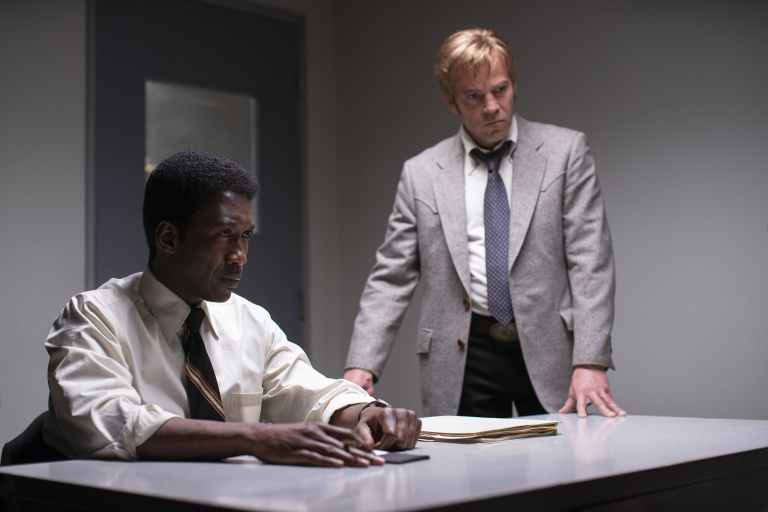
HBO released six pictures from the new season, which stars Oscar winner Mahershala Ali as Wayne Hays, a state police detective in 1980 Arkansas. Stephen Dorff sports an interesting wig as his partner, Roland West. And Carmen Ejogo plays Amelia Reardon, an Arkansas schoolteacher connected to two missing children.
The eight episode season will revolve around a “macabre crime in the heart of the Ozarks” and set in three different time periods.
After years of waiting, fans of HBO anthology series “True Detective” now know exactly when the show will be back for its highly-anticipated third season.
The premium cable outlet announced on Thursday that the season three premiere is scheduled for January 13 at 9 p.m. ET/PT. The eight-episode season will center around what’s being described as “a macabre crime in the heart of the Ozarks,” and will span three different time periods.
Oscar winner Mahershala Ali (“Moonlight“) will play the main character, Wayne Hays, a state police detective from Northwest Arkansas. The supporting cast includes Stephen Dorff (playing Roland West, an Arkansas State Investigator), and Carmen Ejogo (playing Amelia Reardon, an Arkansas schoolteacher with a connection to two missing children in 1980).
Season one of the HBO series, created by Nic Pizzolatto, starred Matthew McConaughey and Woody Harrelson, and was a huge hit with both viewers and critics alike. But the second season — featuring stars Colin Farrell, Rachel McAdams, Taylor Kitsch, and Vince Vaughn — was decidedly less successful, leading HBO at one point to put plans for a third installment on indefinite hold.
This new version, though, has fans hopeful that “True Detective” can once again return to its first season heights. They’ll only have to wait a few more months to find out for sure.