Tag: ron-clements

  • ‘Little Mermaid’ Director Ron Clements and Animator Mark Henn on the Origins of Your Favorite Princess Movie

    ‘Little Mermaid’ Director Ron Clements and Animator Mark Henn on the Origins of Your Favorite Princess Movie

    Disney

    1989’s “The Little Mermaid” is a certifiable classic, as brilliantly conceived and animated as any of the masterworks from Walt’s heyday. It is also one of the most important movies in the Disney animated canon, lifting the studio up out of a precarious position and turning it into the worldwide powerhouse it is today. And it all started with co-director Ron Clements thumbing through an old book of fairy tales in a North Hollywood book store. He took the idea back to work and pitched it in what was then known as The Gong Show — animators would quickly pitch newly instated Disney CEO Jeffrey Katzenberg and if their idea was rejected, it would be “gonged” and other ideas would be heard.

    During this round of pitches, Clements, who would go on to co-write and co-direct the film with John Musker (who quietly retired last year), actually got gonged. But we’ll just let him talk about it … Sitting with Clements was master animator (and honestly one of the nicest guys on the planet) Mark Henn, who also talked about the making of the unforgettable film (which has just been reissued on Blu-ray and digital).

    At the same time that you pitched “The Little Mermaid” you also pitched what would eventually become “Treasure Planet,” right?

    Clements: I pitched both of those. I wrote two-page treatments on all five and when we reconvened, they said, “Just pitch your best idea,” even though we were supposed to pitch five. I thought my best idea was “The Little Mermaid.” It actually got gonged by Jeffrey because, at the time, they were working on a sequel to “Splash” and they thought there’d be too much overlap. So he said, “What’s your second best idea?” And I thought my second best idea was “Treasure Island” in space. They gonged that because they had just come from Paramount and at the time they said the plot for the next “Star Trek” movie was very similar to “Treasure Island.” Now it turned out the next “Star Trek” movie was the one where they went back in time to save the whales. So I don’t know what they were talking about. Of the other ideas, two were science fiction. I was a big science fiction fan and they were based on books and one was “The Trumpet of the Swan,” which actually got made by another studio, and had New Orleans in it.

    Disney

    Were you dealing with a different Jeffrey Katzenberg on this production?

    Clements: Jeffrey picked up pretty quick. He’s a fast learner. On “The Great Mouse Detective,” which we both worked on, at that time it was still pretty new to him. But after “Great Mouse Detective” and “Oliver & Company,” he knew a little bit more.

    Henn: Well, going back to “The Great Mouse Detective,” there was that very fateful day where you guys screened the movie for him. And basically the entire future seemed to be riding on whether or not they were going to make the movie. But once he green-lit it and said, “Okay, let’s do it,” the thing that I remember being impressed with was supposedly Jeffrey took Frank and Ollie’s book, this big thick book, on vacation with him to Hawaii.

    Clements: I think that’s really true.

    Henn: And read it cover-to-cover. So I’ve always appreciated very much that Jeffrey seemed to really appreciate the artform. He didn’t know much about it but invested himself in it, starting with that, all the way to eventually his own company.

    Clements: He would send letters and notes about things he had questions about or wanted to know more about. He would have excerpts. He dug pretty deep.

    Henn: He self-educated himself about the whole Disney animation process.

    Disney

    Mark, when did you go to Florida?

    Henn: Right after I finished “Mermaid.”

    What was it about that prospect that made you go?

    Henn: Well, it’s a long story but I’ll try to keep it short. I wasn’t crazy about it at first. I didn’t like the idea of them having another Disney studio out there somewhere. It bugged me. But I spent a lot of time thinking about it, praying about it, talking about it with my family, and finally the idea of … Because they were bound and determined to do it … And I felt like, Okay, if you can’t beat them, join them. I had a meeting with Peter Schneider [President of Walt Disney Feature Animation from 1985 to 1999] and just basically said, “I’m really torn about this whole thing.” He made it very clear that it would be very important for somebody like myself, an experienced artist. Because most of the people down there weren’t, they were right out of art college and so to use his terminology, to be a tentpole person for that studio. It completely 180’d my thinking. I remember walking out of that meeting thinking it was what I needed to do.

    Disney

    Let’s talk about a character who didn’t make it into the movie — Breaker, the dolphin character. What happened and was Robin Williams really cast?

    Clements: He wasn’t cast. He was just somebody we talked about. Breaker was in the first draft and maybe the second draft. He didn’t make it beyond that. But the interesting thing about Breaker was that in the very first draft, I would say you had Flounder, who was this timid guy, kind of nervous and scared, and you had Breaker, who was the opposite. He wasn’t afraid of anything and was gung-ho and Ariel was in the middle. When we cut out Breaker, primarily because there were too many characters and it seemed like he could go, but we gave some of his dialogue to Ariel and it actually pushed her in terms of her feistiness and fearlessness.

    Henn: “Don’t be such a guppy.”

    Clements: That was originally a Breaker line. He didn’t last that long.

    Henn: I don’t even remember Breaker but that seems like a line he would have said.

    What about the middle stretch of this movie — there’s been a lot of talk about how nervous this made executives, with a main character who didn’t speak. How did you both sell that section of the movie?

    Clements: They were nervous about it, there was no question about it. It really had to do with story reels, which is something John and I have encountered on other films. Because the first time you ever see these movies, you’re just seeing still drawings. And no matter how good the drawings are, it’s not the same as animation. But when you’ve got the dialogue it’s like a radio play. It helps fill in the blanks, so you get it more, even with the still drawings. But when you’ve got a character that doesn’t speak like Ariel or the carpet in “Aladdin” or anything like that they tend to go dead in the story reels. And Ariel, when we screened the movie, she kind of dropped out of the film. Actually Mark animated a lot of the stuff where she doesn’t speak. Where they’re having dinner and she’s combing her hair and we had to say, “Trust us, when it’s animated, she’ll come back.”

    Henn: That was a great challenge of animating her. It was like, “Can’t wait!” That was a lot of fun.

    Paramount

    The moment when she breaks through the water and does the hair flip, you had a lot of Paramount guys at the studio back then, was that a “Flashdance” reference?

    Clements: No, I don’t think it was. It could have been more of a Sports Illustrated reference. But I don’t remember that being referenced at the time.

    Were there any other sequences that got deleted that you wish you could go back and animated?

    Clements: I was talking earlier that Flounder used to have more of an arc. Again, in earlier versions, and this was mostly cut for time because we’re always running long, but Flounder has his encounter with the shark early in the movie and he’s a nervous, insecure guy. Originally he got his revenge. In the whole wedding sequence, the shark returned and caused complications for Ariel getting into the boat. I won’t go into how it happened but Flounder took care of the shark. He was empowered by that. He had a little more of coming through in the end and gaining his courage. 

    “The Little Mermaid” is available on digital HD and Blu-ray NOW.

  • The Director and Producer of Disney’s ‘Moana’ on Its Politics and Taika Waititi

    Walt Disney Animation Studios had a phenomenal 2016. In addition to releasing “Zootopia,” the surprisingly topical animated detective movie, genuine box office juggernaut (with over $1 billion globally), and current Best Animated Feature Oscar frontrunner, they released, later in the year, “Moana,” the beautiful tale of female empowerment and seafaring conquest. It was the cherry on top of an incredible year, and one that I cannot wait to watch again on home video (it’s available now on Digital HD and Disney Movies Anywhere and on Blu-ray March 7).

    To help celebrate “Moana’s” home video debut, I went to the newly renovated Walt Disney Animation Studios, still located in the famous “hat building” that was constructed after the Disney Renaissance of the late-’80s/early-’90s. It was here that select journalists got to sample the disc’s special features, say hello to members of the production team (it’s always good to chat with veteran animator Eric Goldberg, who contributed the “Mini Maui” character to “Moana”) and talk to some of the people who brought “Moana” to life.

    I sat down with co-director Ron Clements, the man responsible for such animated classics as “The Little Mermaid” and “Aladdin,” and his producer on “Moana,” Osnat Shurer, who ushered a number of memorable Pixar short films to the screen (including “One Man Band” and “Lifted”), about what it was like to show “Moana” to the world, what the movie’s political undertones mean today, and what, exactly, “Thor Ragnarok” director Taika Waititi‘s first draft of the script was like. (John Musker, Ron’s partner-in-crime, was out sick on the day that the media event was held.)The last time I spoke to you guys, it was before the movie had opened and there was a lot of hope about a movie that was led by such a strong female character would open in a country also led by a strong female. Things didn’t go that way, and it makes the movie more important.

    Ron Clements: There’s a serendipity with both “Moana” and “Zootopia.” When “Zootopia” was first starting out, the movie was interesting but it wasn’t as relevant. It’s the same with “Moana.” It’s sort of like events converged and that aspect of it became the most important part of it. We’re always thinking story.

    Osnat Shurer: But we were conscious of making a whole character. There’s this weird thing where if it’s a female protagonist you’ve got to make her whole in and of herself. I’m already in a world where it’s not radical. But it’s gone the other way.

    Ron: We always liked the idea that there was no romance in the story. There was never an aspect of that. And we were kind of afraid of it because it seemed kind of risky. All of the female protagonists that we’d worked on before, there was an element of a love story. It was like, How are people going to react to this? We didn’t know but we figured it was worth doing. Then, by the time it came out, it had a symbolism to it because of world events that we weren’t expecting.

    Osnat: As a woman in an industry not known for its inclusion in the past, it’s not a big surprise that there was conversation about her being a strong female protagonist and I’m glad there was. But I do look forward to a time when the creative decision makers in a room are 50/50 no matter who the story is about. The fact of the inclusion in the film, both of her as a female protagonist of the indigenous culture that inspired movie, that is for us, just the right way to do things. I’ll stand behind it. The story led but within all of that, we wanted to do it right. We wanted to have conversations with the people who inspired the movie. We wanted them in the core creative team. We wanted a strong protagonist. And the idea of this person with compassion and courage together is uniquely our heroine.

    It’s obviously going to mean so much to young women and young women of color to see them represented like this.

    Ron: It has.

    Osnat: My niece in Israel won’t go to school until she’s dressed in her Moana costume and gotten her photo taken. She’s got big black curly hair and looks just like her. She looks stunning. Of course her aunt made the movie. But she fully identifies with her.

    The movie has a great environment theme that also seems to resonate now more than ever.

    Ron: It has a little more resonance in light of recent events but it was always a part of the story. Spending time in the islands did highlight something that is very important.

    Osnat: There are islands that are at the forefront of what is happening. There are atolls and islands that are basically at sea level. Some, at the highest point, are 15 feet above sea level. They have a relationship with nature that we tried to capture in the film that has an organic quality that we could all learn from today.

    Ron: One thing I didn’t know that was a little surprising, but makes sense, when we were talking to people … People, when they would first come to a new island, in terms of the great migration, wouldn’t be that respectful of nature to begin with. They would tend to exploit the resources but on an island, as soon as you do that, they learned really fast what the world is learning a little bit slower, because the effects were immediate. And the effects of the opposite were immediate too — if you nurture the land, if you take care of it, if you respect it, you can sustain existence.

    Osnat: That got built into the rituals and into the taboos and into the actual culture. This idea that nature is personified, that the ocean knows what you’re doing, that you apologize to a tree before you cut it down, these indigenous ideas, they create a different relationship with nature. They make us part of nature that we’re living in rather than being in opposition to it and just being able to use it for ourselves. And that’s huge.

    Ron: You just feel it, when you’re there. You can feel it.What has it been like taking the movie around the world?

    Ron: It’s been great. It’s been really gratifying. We really, really did connect with the people of the islands and we wanted the people of the islands to recognize themselves and recognize their culture and connect with the movie. And yet at the same time these things, you want them to work universally for people all over the world. If you go too specific will people in one place relate to it but people in another place won’t relate to at all? But it doesn’t feel like that. The movie is really relatable. Which is always true — the more specific you make it the more relatable and universal it became.

    Osnat: Every culture identifies with a certain part of it. I was in Italy on an earlier tour before I went with the directors and one of the reporters was, in Italian, going, “The grandmother, the grandmother …” And it was so real to him. This was in Italy. In Japan, they are drawn to the cuteness and the sweetness and of course her relationship with her grandmother. In each place, it’s the adventure or something else.

    Ron: Her character always resonates strongly. Certain humor can play differently but Moana really plays universally as someone you care about and root for.

    Osnat: I showed the film in Fiji and it wasn’t even done yet and they didn’t speak English but the kids would be screaming laughing everytime Hei-Hei showed up. I showed it on a turned-around cloth on a wall in a pavilion.

    As a huge fan of his, I wanted to know what Taika Waititi’s draft of the movie was like. Can you talk about that?

    Ron: I think so. Taika was the first writer on the movie. We weren’t that familiar with him and, then we realized he was part of “Flight of the Conchords.” We had a rough outline of the basic storyline. This is basically the story except that she did have six brothers and the situation had more of that aspect. We recognized that was sort of a dated idea, like, Because I’m not a boy I have to try harder and prove myself more. So Taika’s draft reflected that. But he’s a really great writer and we had a script reading that got the movie made.

    Osnat: He likes to joke that “The part that I wrote that’s still in the movie is EXT: OCEAN – DAY.” But the truth is that he brought a spirit of very specific Pacific Island humor. It’s slightly irreverent what he brought into the film and [it] gave us permission to continue down that road because he’s from that culture and he taught us how to keep humor in the movie. It was a really great version of the beats we had then. But it’s an animated movie. That was five years ago.

    Ron: We were really happy with the script and it got the movie going.

    Osnat: He left because he directed three movies!

    Ron: We knew that Taika wasn’t the writer who was going to stay in the building, which you have to do, and work with the story artists and be a part of it in the recording sessions. We knew he was too busy.

    Osnat: As he likes to joke, he had two kids and did three movies in the time he would have been on the movie. But he brought a lot to it in terms of cultural richness that translated later and stayed in the film.

    “Moana” is out now on Digital HD and Disney Movies Anywhere and on Blu-ray on March 7th.

  • ‘Moana’ Star Auli’i Cravalho Talks Breaking the Disney Princess Mold

    "MOANA" -  UK Gala Screening - Red Carpet ArrivalsOne may say that Moana was a role newcomer Auli’i Cravalho was destined to play. After hearing about the auditions for Disney’s first Polynesian princess, “Moana,” at her all-Hawaiian school, Cravalho didn’t think she was good enough to audition. Luckily, a casting director in Oahu discovered her at a charity competition and had her audition on the very last day of casting. The rest is history.

    Moviefone sat down with Cravalho to chat about her first acting experience, representing a new heroine, and how far she’ll go on her own journey.

    Moviefone: How filming “Moana,” considering it was your first role and you headed straight into a booth where you had to act against a microphone?

    Auli’i Cravalho: Yes! That was interesting, there was major learning curve for that. I didn’t know what to do, but I just kind of worked with it. Plus, I had the best people directing me — Ron [Clements] and John [Musker], so I felt right at home. I think it was just finding that pocket of getting comfortable, because I remember being nervous. And I remember being nervous because I was nervous, and I thought that my voice was going to change because I was nervous. All of these thoughts swarmed in my head and I’m trying to digest butterflies as I walk into this booth and when the directors are there, they’re like ‘Ok, we’re going to try it a few times,’ and then Ron’s like, ‘Oh maybe we’ll try it only once though, we think you’re doing great.’ And I was like ‘I haven’t even said a single word, thank you,’ and from then on it just got better and better.

    The chemistry between Moana and Maui (Dwayne “The Rock” Johnson) is so on point. Did you ever get a chance to actually act against Dwayne?

    Thank you! I thought that I was going to be rubbing elbows with Dwayne Johnson in the booth, but no. He’s the busiest man in Hollywood, so I suppose I can forgive him. We met on the Miami shoot though, and we had a lot of fun. But, the way our voices play off of each other, it really does sound like a true conversation, and that’s where I swear some Disney magic becomes involved. I don’t know how they do it, I really don’t. It’s incredible that I can do a line forty times and they can tell which ones they believe will work just from hearing Dwayne’s voice and remembering how the scene plays out.

    I’m old enough to actually remember when Disney princesses looked a certain way and they were all the same with different stories. I was part of the ‘please give us a cultural princess,’ and here you are. You’re fifteen years old and this is your responsibility to carry on. How does that responsibility feel considering that it is your first job and how do you intend to move forward with that?

    I feel so incredibly blessed to be voicing this character, who is inspired by my culture, who is rocking a beautiful tan, whose body is athletic and strong, and whose hair blows freely with those curls. I love my character, and I think she’s so incredibly important in this day. We put Moana in the Disney heroine category. I think it’s hit the major media that Moana doesn’t have a love interest, and they’re like, ‘Oh no!” But it’s like, ‘Oh, yes!’ Moana doesn’t need a love interest. Her journey — finding herself — is something she does all on her own. I’m so excited for young girls and other women and everyone else to see this film because finding yourself should never be compromised.

    You sing a gorgeous song in this film. Can you talk a little bit about the vocal training you did to prepare?

    I didn’t have formal voice training before this.

    Really?

    I sang in my school choir and my church choir.

    You have a stunning voice.

    Thank you! I credit my singing voice to my mom, because she didn’t give me a binky when I was a child, so I screamed and I developed wonderful lungs. So thank you mom, for that. I love our music, I think it encompasses so much of what I’ve heard growing up. Opetaia Foa’i and his band just brings the Polynesian vibe to it. Lin-Manuel Miranda, his lyrics just blow my mind. I remember when I got the lyrics for the first time. I was on cloud nine. Mark Mancina as well, his score just takes it to a new level of emotion. Our music team rocks.

    How are you handling going from being a regular island girl to Disney royalty now?

    I still see myself as a normal fifteen year old. That’s the thing. People come up to me in the store and they’re like ‘Oh my god, are you Moana?’ I’m reaching for the peas, and I’m like, ‘Uh, yeah…’ I’m still quite normal in that sense. I am in love with my character, and I know how special she is. I feel honored that anyone would think of me as a role model, or think of me as someone they would look up to. But quite frankly, I have a lot to learn. I have so many things that I have yet to do and yet to see, and it blows my mind that someone does think of me as a role model. I haven’t quite wrapped my mind around it just yet.

    So, you’re joining the ranks of the Disney heroines of the past, Jodi Benson, Lea Salonga, Idina Menzel… where do you see your career going?

    I don’t know. This film has truly broadened my horizons. I wasn’t planning on auditioning for this role, because I had seen many wonderful auditions for “Moana” on YouTube and I thought, ‘Oh my god, her voice is stellar, it’s so much better than mine. I wouldn’t get chosen anyway, so why should I try out.’ Then, this beautiful blessing happens upon me. I want to try everything that this film world has to offer because this is exciting and I don’t want to limit myself. I think that something that at least I’ve done is think, ‘Well, I’m comfortable where I’m at.’ I don’t want to do that anymore. I want to expand and I want to try television, I want to try live-action, I want to try Broadway if I can. I don’t know what life has in store for me, so whatever it brings me I’m thrilled to try it.

    Disney’s “Moana” opens everywhere November 23.

  • ‘Moana’ Directors Reveal How They Made Disney’s Next Hit

    Directors Ron Clements and John Musker are the duo largely responsible for Disney’s “Renaissance” period during the late ’80s and early ’90s that included “The Little Mermaid” and “Aladdin.”

    Now, they are responsible for Disney’s next hit, “Moana,” which promises to usher in another kind of rebirth for the studio, one that harkens back to the Renaissance full of Disney “princesses” with a new, forward-thinking heroine in the title character. Moviefone recently sat down with the directors to discuss the genesis of the new project and the new tech they used to bring it to life, and the legacy of Disney’s princesses.

    Moviefone: I was a teenager when “Little Mermaid” came out, and it was a big part of my life. And the last film you made was in 2009, “The Princess and The Frog.” Here we are, seven years later, with “Moana.”

    John Musker: We spent five years on this project. We did spend a year on another project that didn’t quite get going, but, yes, here we are again.

    Ron Clements: Most of the films, they are a big part of your life, they take at least, four to five years.

    Musker: He’s been at Disney for 43 years, I’ve been there for 40. We’re long time Disney guys.

    With “Moana,” we’re seeing a very authentic representation of the culture here. Can you talk about how you flipped it from the usual “Western” idea of Polynesian culture to representing it accurately?

    Clements: The trip we took there was a big game changer for us, cause we knew it from that Western point of view. We have a development department with the studio executives who help get things going and they arranged a trip for us, about five years ago, for three weeks. They made sure it was not a “western” trip, it was more an island trip.

    We talked to cultural ambassadors, anthropologists, linguists, choreographers, and we got to visit villages and go sailing with Fijian fisherman. All of this got us in touch with some of the deeper culture, sort of the pre-Christian culture of those islands. They really made a personal impression on us, we felt like we connected with them. Pape Mape, an elder from Moorea, he kinda said to us, “For years we’ve been swallowed by your culture, one time, can you be swallowed by ours?”

    We felt like we really owed it to them to try to do that. When we came back, we were infused with the ideas we learned about navigation, their connection to the ocean, how the ocean being a living thing — having feelings and emotions — so we reworked the story. It was really Ron’s idea — our original story was built around Maui more — and then he was like, “what if we do it around a sixteen-year-old girl, who has the blood of her ancestors in her?” That sounded like a great story and it tied into the culture well; that’s ultimately what we pitched to John Lasseter, he liked that new take, and we built on that.

    The technology to animate the ocean wasn’t quite there in the beginning… So did the story develop as the technology evolved, or…?

    Musker: We assumed that the technology would catch up to the story. Dangerous assumption.

    Clements: The ambitions were there from early on. I think after that first trip, people talked about the ocean as if it were alive. We were with a navigator in Fiji, on a taumako, like they were thousands of years ago, who would caress the ocean, so you have to speak gently to the ocean. Right away, it’s like, the ocean’s gotta be a character in the movie, we want to make it a character.

    Also, anthropomorphizing nature is very much part of mythology, that’s a recurring thing. We knew we were going to have a living island and a lava monster, and things like that. Those things existed from a concept standpoint, from a story standpoint. These things, particularly things like anthropomorphic nature and living oceans, they combine two areas of animation that are usually separate. We have what we call “character animation,” and they’re the actors of the movie, and they really bring the character life in terms of their thought process and their personalities. And we have effects animators, who do things like the water and the ocean and fire — and usually they are separate — but we knew, in this, they were going to combine. In fact, the scene — where the little toddler Moana meets the ocean for the first time — that was actually the very first thing animated for the movie, and it was done way in advance of everything else. We thought that scene would be in the movie, but it was designed as a test to begin with.

    Musker: For awhile, the story evolved where that scene wasn’t in the movie.

    Clements: For a little bit.

    Musker: And we were like: “No, we gotta keep it.”

    Clements: But the test went on, either way, and a lot of things got figured out in that test, and that’s kind of how that happened.

    The music was so key to this story. At what point did you start thinking about where the music would fit?

    Musker: We try to get music involved as early as we can because we want it to tell the story.

    Clements: Even on our first trip five years ago, the music of the islands that we heard — and we heard it everywhere — which we didn’t necessarily expect. People sing welcome songs, farewell songs… when you’re with the village there’s prayer, and celebration, it’s everywhere we went.

    Musker: And I had researched the music, I had a playlist of about 30 songs that were traditionally sung in the islands that I played over and over. We played those for Mark Mancina, who did the score, and he loves the harmonies, in particular, of those islands. It was really our producer, who found Te Vaka, Opetaia Foi’a, and then listen to his music.

    Musker: He even has songs about navigation and sailing, and how important that was to the culture.

    Clements: So then, we wanted to pair him with a narrative storyteller, someone that could tell a story in song. We went to New York three years ago, and interviewed a bunch of musicians, Lin-Manuel Miranda was one of those.

    Musker: The musical team that these three guys — Lin, Mark, and Opetaia — create, they each bring something very different and special. It’s this kind of alchemy, you could definitely put together three guys like that together and it might not work at all. But in this case…

    Clements: They were giving guys and they were super talented in their own areas. They found ways to give each other space, to back off sometimes and other times, to take the lead. The whole score worked that way.

    There’s been a lot of talk about princess culture, whether it’s embracing it or pushing away from it. In “Moana,” we have a new sort of heroine that is kind of leading the way. Can you talk about what your views are for a new princess culture?

    Musker: She is absolutely leading the way. Early on, we thought of this as a coming of age story. She’s the hero of the story, she’s the heroine. It’s her finding herself, her leading the way, her responding to her own voice. We never really had a romance in the story, we thought we didn’t need one. Gender was, in some ways, taken out of the equation. It was just a strong, empathetic character who was capable of great physical stuff. We liked the idea of having, kind of, an action-adventure princess that could dive off cliffs and battle monsters.

    Clements: She’s got this determination, this grit, that no matter how many times she gets knocked down, she gets back up again.

    Musker: Rachel House, she did the voice for Grandma Tala, she’s in some ways the emotional heart and soul of the movie. She’s an actress of New Zealand descent, and she has been moved to tears by the movie. She told us, on several occasions, “I can’t wait to see the effect of this movie on girls around the world.” It’s a source of pride, and empowerment.

    Disney’s “Moana” opens everywhere November 23.

  • Here’s Your First Look at Disney’s ‘Moana’ from the D23 Expo

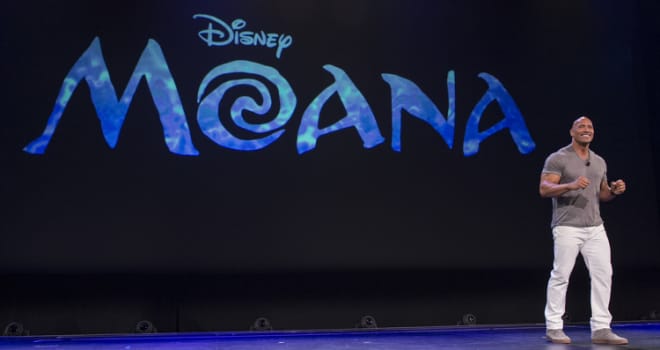
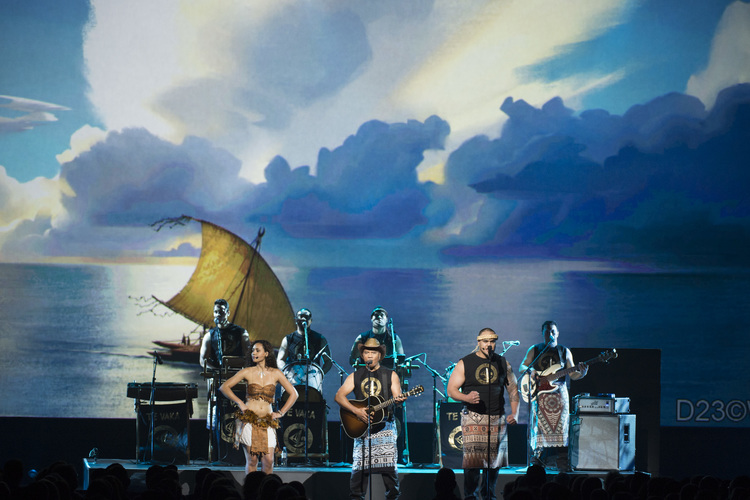
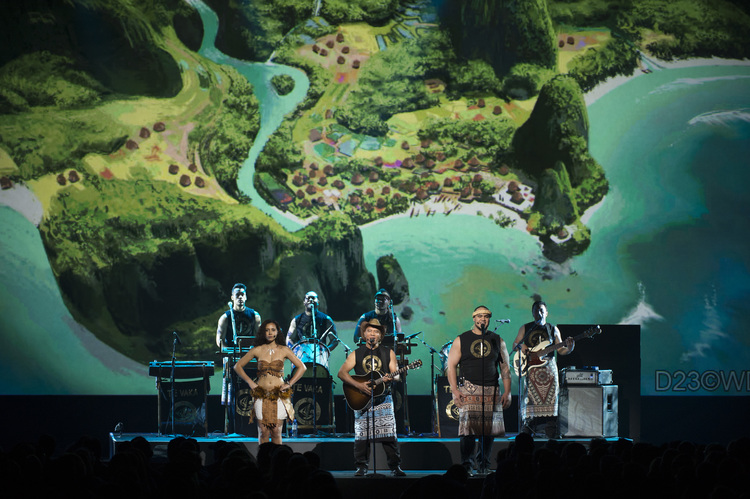
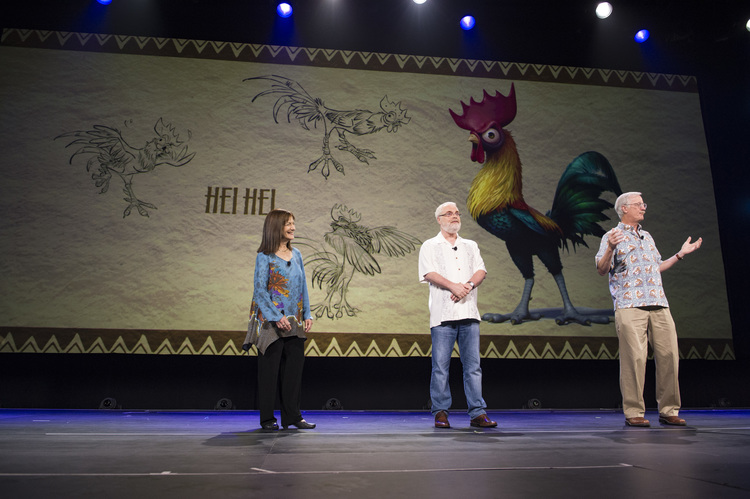
    moana, dwayne johnsonDisney has finally released official images from its D23 presentation of upcoming animated musical “Moana,” and based on what we’ve seen so far, the film is beautiful, colorful, fun, and emotional — basically, everything a great Disney flick is meant to be.

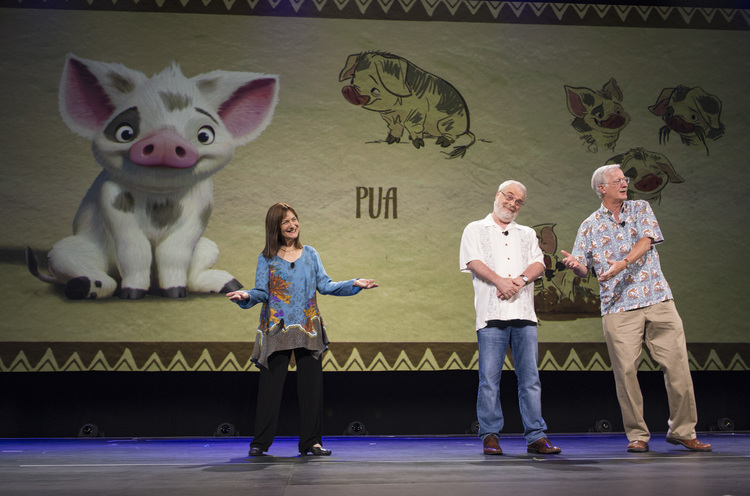
    The presentation, which took place last week, featured a bunch of people involved in the behind-the-scenes action on the movie, including directors Ron Clements and John Musker (“The Little Mermaid,” “Aladdin“) and producer Osnat Shurer (a Pixar consultant making her Disney feature producing debut), along with the team behind the film’s music: Lin-Manuel Miranda (Tony winner for “In the Heights”), composer Mark Mancina (“The Lion King“), and Opetaia Foa’i (lead singer of world music band Te Vaka).

    Te Vaka performed a musical number from the film, complete with Polynesian dancers. Dwayne Johnson, who voices the demigod Maui in “Moana,” also made an appearance, discussing his passion for the project and its focus on the South Pacific culture.

    But the real star of the presentation was “Moana” itself, and the visuals and clips that premiered during the expo. The crowd got its first look at the film’s new logo, beautiful Polynesian scenery, and introductions to a cast of characters that includes Moana’s sidekicks Pua, the adorable pig, and Hei Hei, a cocky rooster. According to the Disney Insider blog, the presentation was nothing short of dazzling:

    Moana is a young woman who sets off to discover her destiny on the open ocean. She encounters a demigod named Maui (voiced by Dwayne Johnson, otherwise known as The Rock) and battles ancient creatures, including an incredible character made out of molten lava. … It’s a story that’s totally new and yet utterly timeless, and the presentation, which included a pair of animated sequences (including one where Maui recounts his epic past and another where a young Moana wades into the ocean, who plays back with her), left us speechless (and a little weepy).

    Check out some photos from the presentation below. (More images can be seen here.)
    moana, disney, d23moana, disney, d23moana, disney, d23moana, disney, d23“Moana” is due in theaters on November 23, 2016.

    [via: D23]

    Photo credit: D23

    %Slideshow-311598%