Tag: michelle-rodriguez

  • Director Walter Hill Discusses the Controversy Surrounding His Thriller ‘The Assignment’

    Tomboy_1673.dngWalter Hill is one of those filmmakers who is probably one of your favorites even if you don’t know his name. This is a man who shepherded the “Alien” franchise, who made, between the years of 1979 and 1984, “The Warriors,” “The Long Riders,” “Southern Comfort,” and “48 Hours,” each of them classics while nimbly working with disparate tones and within wildly different genres. He co-created “Tales From the Crypt.” Later, he worked on “Deadwood.” Even his minor hits are fascinating and awe-inspiring, movies like the rock ‘n roll fable “Streets of Fire” or the hard-nosed pseudo-western “Extreme Prejudice” (a movie that contains maybe my favorite Nick Nolte performance ever). And what’s more, he’s back, with a movie every bit as raw and raucous as his peak era output.

    The movie is called “The Assignment” and features Michelle Rodriguez playing a male hitman named Frank Kitchen (yes, really), who undergoes gender reassignment surgery at the hands of a sadistic doctor (a scenery chewing Sigourney Weaver) after a hit gone wrong. It’s pulpy stuff, brutal and violent. Sometimes the movie flickers into comic book panels. Its depiction of gender reassignment surgery and transgender issues isn’t exactly the most nuanced — but it’s not supposed to be, this is the stuff of dime store novels. And it’s awesome.

    So you can imagine my thrill when I got to talk to Hill about his new movie, whether or not it was a conscious choice to work on a smaller film with more control, and what his thoughts are on “Streets of Fire,” a visionary masterpiece that was critically and commercially ignored at the time of its release, these days. (Our friends at Shout Factory are about to release a new Blu-ray edition, which is so exciting.) He was absolutely charming and open and, if given the opportunity, would have talked to him all day. I mean … just look at his filmography.

    Moviefone: Can you talk about where this story came from?

    Walter Hill: Well, Denis Hamill wrote the original script back around 1977. And I read it then and was very intrigued by the story but I was very busy doing other things and didn’t do anything about it. And then years went by but every once in a while there would be a reference to it from people who had read it or knew that I liked it. And while I was aware of it in the ’70s I didn’t acquire the rights until the ’90s. I then co-wrote I script, which I think I totally screwed up. Then I didn’t think it was going to work and I abandoned it and let the option lapse.

    But, about five years ago, I was doing the classic rooting around in the basement and I ran across Denis’s original, which I looked at again because I remembered it fondly, and suddenly I had an idea about how to do it that I thought would probably work. And I thought I could probably get it made. So I called Denis again and the rights were still available and went to work on this new approach and wrote it very quickly. It wasn’t some magic ingredient but I think my notion was informed by my experience on “Tales from the Crypt.” I had done three of those and I wanted to do this story like an E.C. Comic or a graphic novel if you will, which it now is. I sold it as a graphic novel in France while over there raising money to make the movie.

    When you re-did “The Warriors,” you added similar graphic novel elements. What makes that so appealing to you?

    Well, one, I was always frustrated. I always wanted to make comic books. I think, when I was a kid, it was one of my ambitions, along with athletic fame. And “The Warriors” thing was actually an attempt to show the original intent. I thought it would help explain [the movie]. And the studio had agreed on that and then they decided that it was no longer the agreement. So what I was trying to get at with “The Warriors” thing was, This is what the movie would have been like if I had been given a free hand. I know there are a lot of people who prefer the regular version and I respect that. I just thought it was interesting for people to see what I wanted to do.

    It looks like you used the same technique on “The Assignment.”

    I did. I was free to do it and wanted everybody to know that we were working in a rather special place. A fantasy world is too strong an expression. This is a crime story that has no police in it. This posits a certain genital altering operation that takes place in a basement, which is pretty much impossible. There are a lot of shorthand elements that are rather reflective of comic book literature. I wanted everybody to understand it. I talked to some people who thought that maybe I had made it a little too clear that it was the comic book world. But I leave that to others.

    And yet some people were offended by it, despite it being such a stylized film.

    Well, the people that were offended by it … The essays that were written condemning it, and they were numerous, they had to do with the idea that the movie was somehow going to exploit or belittle or make light of the transgender process and situation and the people who had gone through it. We do live in gender fluid times, especially compared to the world that I grew up in. As you know, I’m an old fella.

    Number one, I think that that’s good. Secondly, this isn’t a movie that challenges transgender theory. As a matter of fact, it reinforces them. Frank Kitchen starts out as somebody committed, inside his head, a very masculine fellow. Probably a little too much so. And when he goes through an act of genital alteration, he remains a fellow inside his head. He remains masculine. Which is exactly reinforcing transgender theory, the idea being we are who we are inside our head.

    But I didn’t say much at the time when all of this was flying around. I figured the movie would be my defense. I always think that’s the best policy, really. I don’t tend to engage in a lot of polemics. So there you have it.

    Was it a conscious decision to make a small, independently financed movie after doing a more large-scale production, with “Bullet in the Head.”

    Well, you find yourself at moments in your career where you ask yourself, Do you still want to work? And do you want to find avenues of storytelling. If you’re not in a position to write a novel anymore for economic reasons or reasons of energy, write a short story. There’s the old saying that you play the cards you’re dealt. I’m fully aware this is not 1985. The phone is not ringing off the hook. If I’m going to keep working, I have to find ways to get things made that are attractive to finance at a certain level. And that’s fine. I don’t object to it.

    Look, I will tell you no director ever made a movie that didn’t wish he had a little more time, a little larger budget. That’s one of the first rules in the DGA manual I think. We all wish we’d had a little more time and we all wish you could shoot the movie, cut the movie, and then go fix a few things. But that’s a privilege you don’t get in this business. Novelists and painters have that privilege but filmmakers don’t.

    I wanted to ask you about working with your producer, Saïd Ben Saïd, because he’s produced some great movies from some legendary directors recently (Paul Verhoeven, Brian De Palma, Roman Polanski, David Cronenberg).

    Well, I finished the script I wanted to make and I took it to my agent and he said, “Well, Jesus Christ nobody is going to make this.” Then he said, “Can you make it really cheap?” And I said, “I think so. I’m not a professional budgeter but I certainly think you could make it at a reasonable level.” I was on my way to Munich, they were doing a retrospective of my films there and my agent told me to stop in Paris on my way back. He said, “I want you to meet Saïd. He might go for this.”

    So I stopped in Paris and we discussed and he said he was intrigued and if we could intrigue a certain level of casting and I promised I would not exceed a rather tight budget that he would go get the money for it. Saïd and I got along quite well, as he’s just shown with Verhoeven, he’s quite open to shall we say veteran directors.Before I go I have to ask you about one of my favorite movies of yours, “Streets of Fire.” It was supposed to be the first part of a larger series.

    Well, I thought it was going to be the further adventures of Tom. Larry Gross, the co-writer and I, had lunch just yesterday. Larry is more articulate than I am about this. But we thought we were onto something with the genre mix of action movies and musicals and comic book representation, and we were kind of exploring new territory. Some of the experiment, I think, worked very nicely, but some of it needed a little more help.

    Larry contends that the movie had one big problem and that was that it was ahead of its time. I’m not sure. It’s a movie that’s hard to define what, exactly, it is. That’s probably a sign that it’s in trouble right away. But [when] people ask me, I always say it was my first foray into musicals. I was disappointed in the reception to the film domestically. But it found, both critical and commercial success, in certain areas of the world but it did nothing here. But we all went on.

    The Assignment” is on VOD now and in select theaters this Friday.

  • ‘The Fast and the Furious’: 10 Things You (Probably) Didn’t Know About the Vin Diesel Hit

    When it came out 15 years ago, on June 22, 2001, “The Fast and the Furious” seemed like just a 1950s exploitation movie with a bigger budget. Little did anyone imagine that the drag-race drama would turn into an enormous franchise that has earned $3.9 billion to date and spawned six sequels, with at least three more on the way.

    As popular as the first “Fast” was — it earned $145 million in North America and a total of $207 million worldwide — there’s plenty you may not know about how the film came to be. Here are a few tidbits of behind-the-scenes trivia, doled out a quarter-mile at a time.
    1. In 1998, reporter Ken Li began writing a series of articles about 30-year-old Dominican street racer Rafael Estevez, first in the New York Daily News, then in Vibe magazine. Director Rob Cohen claimed he was inspired to make the film by reading one of those articles, entitled “Racer X” (for which Universal bought the film rights and adapted into the “Fast” screenplay), as well as by attending an actual illegal street race.

    2. The title was licensed from B-movie legend Roger Corman. His 1955 film, “The Fast and the Furious,” was about a wrongly-convicted man who escapes from prison and takes up with a gang of illegal street racers. Of course, Corman produced his movie for just $66,000, while Cohen’s cost $38 million.

    3. While making “The Skulls” for Cohen and producer Neal H. Moritz, Paul Walker mentioned that he’d love to play an undercover cop one day. He didn’t know at the time that Cohen and Moritz were developing just such a project.

    4. In his college days, Vin Diesel recalled, he had a Suzuki GSX-R sport bike that he would tear along on the highways of Queens, N.Y. But by the time he first played Dominic Toretto in “Fast” at age 33, he admitted, “I’m an SUV kind of guy.”
    5. Michelle Rodriguez’s role of Letty (above) wasn’t part of the original script, but the filmmakers created it for her after seeing her breakthrough performance in the indie boxing drama “Girlfight.”

    6. Neither Jersey girl Rodriguez nor Manhattan-raised Jordana Brewster (Mia) had much driving experience before they made the film; in fact, Brewster (then 20) didn’t have a driver’s license or even know how to drive. Both actresses had to learn some stunt-driving moves, including slides and sideways turns, for the movie. By the end of the shoot, newly-minted car enthusiast Rodriguez was complaining of the filmmakers, “They wouldn’t let us drive faster than 80 miles per hour!”
    7. Seen in the movie are some 150 actual street racers, along with their custom cars. They were easy to recruit, recalled transportation coordinator David Marder. “Every one of these kids have monitors hooked up in their cars, where they play video games and use the Internet,” he said. “We just put out the word, and they appeared!”

    8. The unique circular Beverly Hills house that the police use as their sting headquarters is said in the film to be the home Eddie Fisher built for Elizabeth Taylor. Sadly, that’s not true; it wasn’t built until 1963, when Taylor had left Fisher for Richard Burton. Less juicy trivia: it’s the same house where Walter Matthau‘s screenwriter character lived in the 2000 Nora Ephron movie “Hanging Up.”
    9. Moritz and Cohen both have cameos in the film. That’s Moritz as the driver of the black Ferrari who races Brian (Walker). And that’s Cohen (above) as the pizza delivery man blocked by the first race.

    10. Today, Rafael Estevez, the inspiration for the whole franchise, runs a garage in Queens. Journalist Li says Estevez eventually got compensation from Universal for his role as the franchise’s catalyst.


  • Watch the ‘Fast 8’ Cast on First Day on Set

    Fast and Furious 7“Fast and Furious 8” has revved its engine.

    The upcoming movie from the blockbuster franchise is currently filming in Cuba, and judging by a video from the first day on set, the cast is already having a blast. In the behind-the-scenes video, Vin Diesel, Michelle Rodriguez, Dwayne Johnson, Tyrese Gibson, and others appear to be filming some sort of conference room scene. Kurt Russell and new cast member Scott Eastwood are also present.

    There’s no sign of Charlize Theron, but the Oscar-winning actress is playing the main villain in “Fast 8.” And this scene looks like a meeting for the good guys to hash out a plan.
    F. Gary Gray is directing the latest installment, which takes Dom’s crew to New York for the first time. Filming is also taking place in Atlanta, Cleveland, and Iceland, and possibly Russia. “Fast 8” sees the return of previous stars Eva Mendes, Elsa Pataky, and Nathalie Emmanuel.

    “Fast 8” opens in theaters April 14, 2017.

    Want more stuff like this? Like us on Facebook.

    %Slideshow-275086%

  • Michelle Rodriguez Unveils Student Academy Awards Medalists

    Actress Michelle Rodriguez prior to the 42nd Annual Student Academy Awards
    Michelle Rodriguez presents 42nd Annual Student Academy Awards

    “I know exposure to other cultures can make one’s life richer,” began Michelle Rodriguez as she introduced the medalists in the Foreign Film category at the 2015 Student Academy Awards.

    The “Fast & Furious” star, who relocated from her native San Antonio, Texas to the Dominican Republic for a short time when she was eight years old, kicked off the 42nd annual award ceremony Thursday at the Samuel Goldwyn Theater in Beverly Hills.

    Along with fellow presenters, “Straight Outta Compton” actor Jason Mitchell, Oscar-winning director John Lasseter, and the Oscar-winning team behind the animated feature “Big Hero 6,” Roy Conli, Don Hall and Chris Williams, she announced the gold, silver and bronze Student Academy Award medal winners, which recognized cinematic achievement from 15 student-filmmakers from universities and colleges around the world.

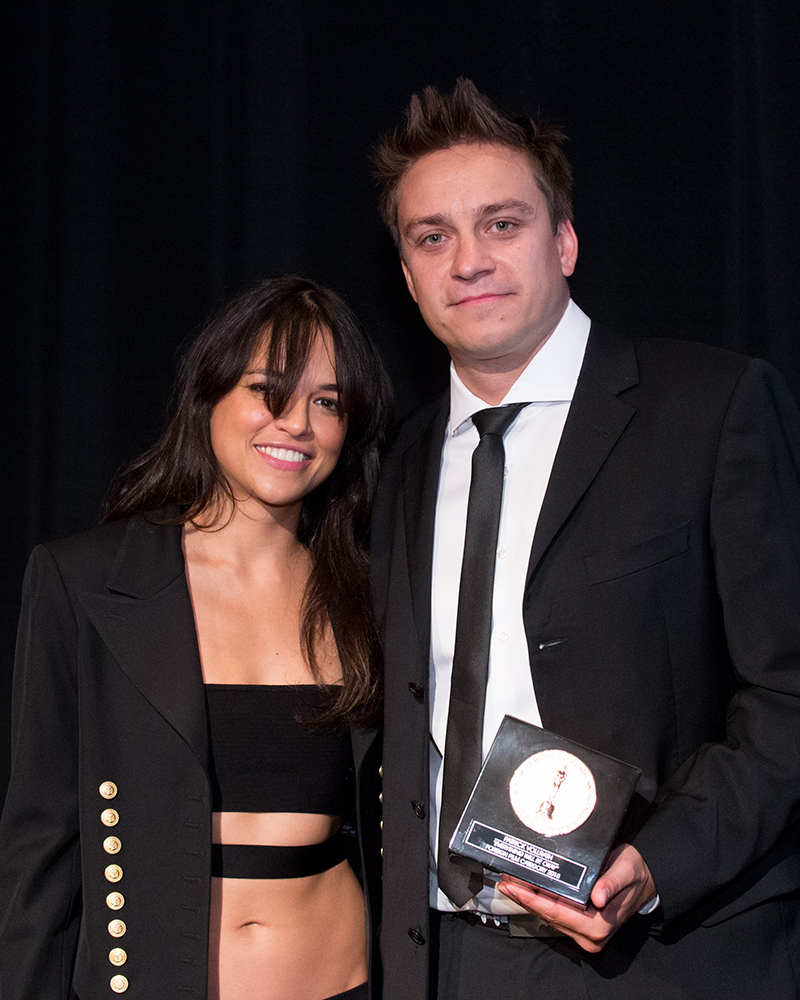
    Actress Michelle Rodriguez and Patrick Vollrath winner of the bronze medal in the foreign film category
    Michelle Rodriguez (left) and Patrick Vollrath, winner of the bronze medal in the Foreign Film category for “Everything Will Be Okay”

    “There’s no orchestra like at the Oscars that’s going to cut me short,” joked the first student on stage – bronze medal winner Patrick Vollrath from Austria’s Filmakademie Wien school, who helmed the drama “Everything Will Be Okay.”

    In closing his acceptance speech, the budding filmmaker echoed what many Oscar winners have famously said over time—a sentiment repeated throughout the night: “Thank you to the Academy.”

    The Academy of Motion Picture Arts and Sciences presented its 42nd Annual Student Academy Awards on Thursday
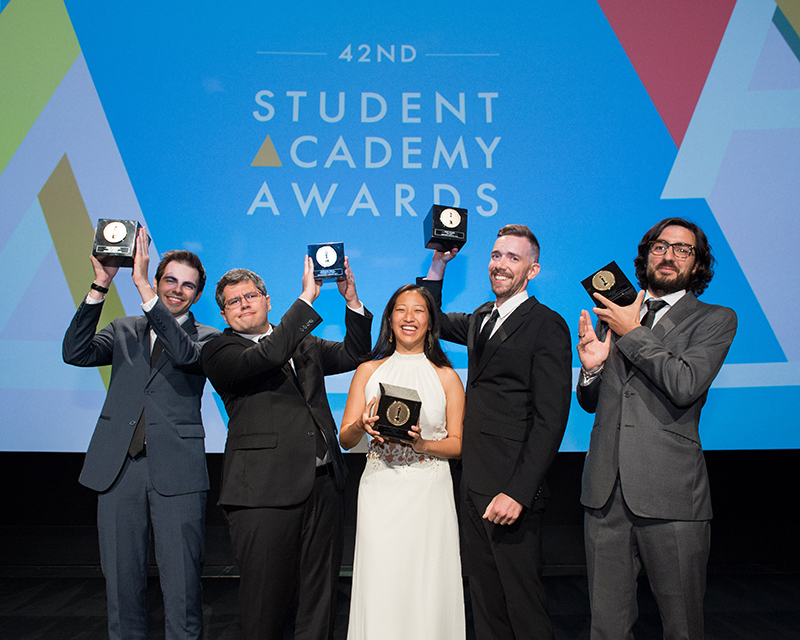
    Gold medal winners (left to right): Alternative film winner Daniel Drummond, Documentary film winner Alexandre Peralta, Animated film winner Alyce Tzue, Narrative film winner Henry Hughes and Foreign film winner Ilker Catak.

    Watch Student Academy Award winners reveal which director has inspired them:

    The 2015 Student Academy Award winners – medal placements:

    Alternative
    Gold: “Chiaroscuro,” Daniel Drummond, Chapman University, California
    Silver: “Zoe,” ChiHyun Lee, The School of Visual Arts, New York

    Animation
    Gold: “Soar,” Alyce Tzue, Academy of Art University, San Francisco
    Silver: “An Object at Rest,” Seth Boyden, California Institute of the Arts
    Bronze: “Taking the Plunge,” Nicholas Manfredi and Elizabeth Ku-Herrero, The School of
    Visual Arts

    Documentary
    Gold: “Looking at the Stars,” Alexandre Peralta, University of Southern California
    Silver: “I Married My Family’s Killer,” Emily Kassie, Brown University
    Bronze: “Boxeadora,” Meg Smaker, Stanford University

    Narrative
    Gold: “Day One,” Henry Hughes, American Film Institute, California
    Silver: “This Way Up,” Jeremy Cloe, American Film Institute
    Bronze: “Stealth,” Bennett Lasseter, American Film Institute

    Foreign Film
    Gold: “Fidelity,” Ilker Çatak, Hamburg Media School, Germany
    Silver: “The Last Will,” Dustin Loose, Filmakademie Baden-Wuerttemberg, Germany
    Bronze: “Everything Will Be Okay” Patrick Vollrath, Filmakademie Wien, Austria

  • Michelle Rodriguez Honors Student Academy Awards Medalists

    Actress Michelle Rodriguez prior to the 42nd Annual Student Academy Awards® on Thursday, September 17, in Beverly Hills.
    Michelle Rodriguez presents 42nd Annual Student Academy Awards

    “I know exposure to other cultures can make one’s life richer,” began Michelle Rodriguez as she introduced the medalists in the Foreign Film category at the 2015 Student Academy Awards.

    The “Fast & Furious” star, who relocated from her native San Antonio, Texas to the Dominican Republic for a short time when she was eight years old, kicked off the 42nd annual award ceremony Thursday at the Samuel Goldwyn Theater in Beverly Hills.

    Along with fellow presenters, “Straight Outta Compton” actor Jason Mitchell, Oscar-winning director John Lasseter, and the Oscar-winning team behind the animated feature “Big Hero 6,” Roy Conli, Don Hall and Chris Williams, she announced the gold, silver and bronze Student Academy Award medal winners, which recognized cinematic achievement from 15 student-filmmakers from universities and colleges around the world.

    Actress Michelle Rodriguez (left) and Patrick Vollrath, winner of the bronze medal in the foreign film category for “Everything Will Be Okay,” during the 42nd Annual Student Academy Awards® on Thursday, September 17, in Beverly Hills.
    Michelle Rodriguez (left) and Patrick Vollrath, winner of the bronze medal in the Foreign Film category for “Everything Will Be Okay”

    “There’s no orchestra like at the Oscars that’s going to cut me short,” joked the first student on stage – bronze medal winner Patrick Vollrath from Austria’s Filmakademie Wien school, who helmed the drama “Everything Will Be Okay.”

    In closing his acceptance speech, the budding filmmaker echoed what many Oscar winners have famously said over time—a sentiment repeated throughout the night: “Thank you to the Academy.”

    The Academy of Motion Picture Arts and Sciences presented its 42nd Annual Student Academy Awards® on Thursday, September 17, in Beverly Hills. Gold Medal winners (left to right): Alternative film winner Daniel Drummond, Documentary film winner Alexandre Peralta, Animated film winner Alyce Tzue, Narrative film winner Henry Hughes and Foreign film winner Ilker Catak.
    Gold medal winners (left to right): Alternative film winner Daniel Drummond, Documentary film winner Alexandre Peralta, Animated film winner Alyce Tzue, Narrative film winner Henry Hughes and Foreign film winner Ilker Catak.

    Watch Student Academy Award winners reveal which director has inspired them:

    The 2015 Student Academy Award winners – medal placements:

    Alternative
    Gold: “Chiaroscuro,” Daniel Drummond, Chapman University, California
    Silver: “Zoe,” ChiHyun Lee, The School of Visual Arts, New York

    Animation
    Gold: “Soar,” Alyce Tzue, Academy of Art University, San Francisco
    Silver: “An Object at Rest,” Seth Boyden, California Institute of the Arts
    Bronze: “Taking the Plunge,” Nicholas Manfredi and Elizabeth Ku-Herrero, The School of
    Visual Arts

    Documentary
    Gold: “Looking at the Stars,” Alexandre Peralta, University of Southern California
    Silver: “I Married My Family’s Killer,” Emily Kassie, Brown University
    Bronze: “Boxeadora,” Meg Smaker, Stanford University

    Narrative
    Gold: “Day One,” Henry Hughes, American Film Institute, California
    Silver: “This Way Up,” Jeremy Cloe, American Film Institute
    Bronze: “Stealth,” Bennett Lasseter, American Film Institute

    Foreign Film
    Gold: “Fidelity,” Ilker Çatak, Hamburg Media School, Germany
    Silver: “The Last Will,” Dustin Loose, Filmakademie Baden-Wuerttemberg, Germany
    Bronze: “Everything Will Be Okay” Patrick Vollrath, Filmakademie Wien, Austria

    J9zshCWFSS5aFhh4fFloT1
  • Michelle Rodriguez Among Presenters at 2015 Student Academy Awards

    Michelle Rodriguez leads a list of Hollywood’s heavy hitters as a presenter at the 2015 Student Academy Awards.The “Fast and Furious” actress will honor a group of budding filmmakers at the 42nd annual ceremony, which recognizes cinematic achievement from student directors. She will be joined by “Straight Outta Compton” star Jason Mitchell, Oscar-winner John Lasseter, and “Big Hero 6” producer-directors Roy Conli, Don Hall and Chris Williams, also Oscar winners.

    “Toy Story” director Lasseter, who will helm the fourth sequel of the Oscar-winning film, has the distinction of being the only two-time Student Academy Award winner for Animation (“Lady and the Lamp,” 1979, and “Nitemare,” 1980; CalArts).

    Acclaimed directors Spike Lee, Pete Docter, Trey Parker and Robert Zemeckis are also previous Student Academy Award winners. The program was established in 1972 to showcase emerging global talent.

    The 15 student champs were selected among a competitive pool of 1,686 films from 282 domestic and 93 international colleges and universities.

    They will be honored with at a fete held Sept. 17 at the Academy’s Samuel Goldwyn Theater in Beverly Hills, where the medal placements in gold ($5,000 grant prize), silver ($3,000 grant prize) and bronze ($2,000 grant prize) for categories in animation, alternative, foreign, documentary and narrative will be announced.

    20066691
  • Michelle Rodriguez Among Presenters at Student Academy Awards

    Michelle Rodriguez
    Michelle Rodriguez

    Michelle Rodriguez leads a list of Hollywood’s heavy hitters as a presenter at the 2015 Student Academy Awards.

    The “Fast and Furious” actress will honor a group of budding filmmakers at the 42nd annual ceremony, which recognizes cinematic achievement from student directors. She will be joined by “Straight Outta Compton” star Jason Mitchell, Oscar-winner John Lasseter, and “Big Hero 6” producer-directors Roy Conli, Don Hall and Chris Williams, also Oscar winners.

    “Toy Story” director Lasseter, who is helming the fourth sequel of the Oscar-winning film, has the distinction of being the only two-time Student Academy Award winner for Animation (“Lady and the Lamp,” 1979, and “Nitemare,” 1980; CalArts).

    Acclaimed directors Spike Lee, Pete Docter, Trey Parker and Robert Zemeckis are also previous Student Academy Award winners. The program was established in 1972 to showcase emerging global talent.

    The 15 student champs were selected among a competitive pool of 1,686 films from 282 domestic and 93 international colleges and universities.

    They will be honored at a fete held Sept. 17 at the Academy’s Samuel Goldwyn Theater in Beverly Hills, where the medal placements in gold ($5,000 grant prize), silver ($3,000 grant prize) and bronze ($2,000 grant prize) for categories in animation, alternative, foreign, documentary and narrative will be announced.

  • Vin Diesel Gives Touching Tribute to Paul Walker at Teen Choice Awards

    vin
    Jordana Brewster, Michelle Rodriguez and Vin Diesel

    Vin Diesel couldn’t hold back the emotions at the 2015 Teen Choice Awards on Sunday night as he and other “Furious 7” cast members accepted the award for Choice Movie: Action/Adventure.

    “I can’t stand here and be rewarded like this without talking about someone very, very important to us,” Diesel said. “One of the best blessings in our lives is that we have the opportunity to call Pablo a brother. Paul Walker is here with us in spirit.”

    Walker died in a 2013 car crash. His family was in the audience at the Los Angeles show.


    “It’s Paul Walker’s family, his brother, his parents, that kept us encouraged when we were filming ‘Furious 7’,”said Diesel, who was joined onstage by Jordana Brewster, Michelle Rodriguez and Ludacris. “But there’s one very, very special teen here and her name is Meadow Walker.”

    Meadow is Walker’s daughter; Diesel is her godfather.

    In a final gesture, Ludacris announced that fans had chosen Walker for the award for Choice Movie Actor Action/Adventure.

    61597
  • How Jake Gyllenhaal and 5 Other Stars Beefed Up to Play Boxers

    Jake Gyllenhaal
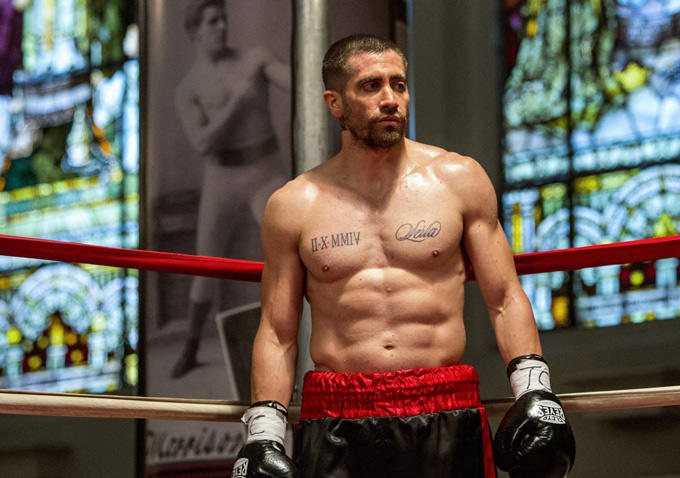
    Jake Gyllenhaal in “Southpaw.”

    Jake Gyllenhaal already has one of Hollywood’s most enviable physiques, but he pulled no punches to transform his bod for his latest role as a boxing champ in “Southpaw.”

    He’s not alone when it comes to dramatic body makeovers in the name of art. Here’s a roundup of six actors who also made transformations to step inside the ring on the big screen.

    Jake Gyllenhaal

    Transformed: After 2014’s “Nightcrawler” saw him drop 30 pounds from his 180-pound muscular frame to portray what he has described as a “literally and figuratively hungry” videographer in last year’s thriller, the heartthrob actor made a turn in the opposite direction to pile on muscle to portray a fictional boxer in “Southpaw.”
    How he did it: He underwent eight months of boxing training by instructor Terry Clayborn. Some of his routine’s included flipping a 300-pound tractor tire and doing 1,000 sit-ups daily.

    20063179

    Michelle Rodriguez

    Transformed: She beat out more than 300 women for the lead role in 2000’s “Girlfight,” starring as a teen who trains as a boxer and keeps her passion as a secret from her father.
    How she did it: Rodriguez committed to five to six days a week of training, having previously never boxed. While promoting the film, she cited “Crouching Tiger, Hidden Dragon” star Michelle Yeoh as her inspiration.

    7369

    Mark Wahlberg

    Transformed: To portray the real-life story of boxer “Irish” Micky Ward in 2010’s “The Fighter,” opposite Christian Bale as his half-brother Dickie Ecklund.
    How he did it: Starting his days as early as 4:30 a.m., Wahlberg would train for three hours every morning with coaching from boxing greats like Freddie Roach and Manny Pacquiao. It took Wahlberg nearly four years to develop a boxer’s body, he has said. He dropped 30 pounds to resemble the figure of a world welterweight champion and installed a boxing gym in his home.

    Christian Bale

    Transformed: Portraying a former pro boxer-turned-trainer who suffers from drug addiction, Bale dropped pounds to resemble the real-life trouble-plagued Dickie Ecklund, who helped train his half-brother “Irish” Micky Ward, played by Mark Wahlberg, in 2010’s “The Fighter,” a role that scored him a Best Supporting Actor Oscar.
    How he did it: Bale previously joked that he did “a lot of coke,” to look gaunt and thin, but he just committed to running up to four hours a day while on set.

    29135

    Hilary Swank

    Transformed: Swank changed her physique to tackle the role of waitress-turned-boxer Frankie Dunn in 2004’s “Million Dollar Baby,” a role that nabbed her a Best Actress Oscar.
    How she did it: Typically svelte Swank weighed 129 pounds after three months of bodybuilding training. The star was asked by producers to gain 10 pounds of muscle to convincingly portray her budding boxer character, however Swank managed to bulk up to 19 pounds.

    20382

    Miles Teller

    Transformed: Teen heartthrob Miles Teller made an incredible transformation to portray real-life boxer Vinny Paz in the forthcoming movie “Bleed for This.”

    How he did it: Throughout an eight-month process, the actor has said that he underwent four hours of boxing and two hours of training with weights to change his body.

    20083439
  • How ‘Furious 7’ Sped to a Record-Breaking Opening Weekend

    furious 7Attention merchants: You should have started stocking barbecue gear and beach balls in March because summer now officially starts before Easter.

    That’s because “Furious 7” opened well beyond the wildest predictions, earning an estimated $143.6 million this weekend, not just setting a new April record but becoming the biggest debut in the history of Universal Pictures and the ninth-biggest opening weekend of all-time. In other words, the film has proved you can earn summer-blockbuster-sized numbers before March Madness is even finished.

    Sure, people expected “Furious 7” to do well — it’s a popular franchise, and it had no real competition this weekend. But predictions topped out around $110 to $120 million. But $144 million? What series on its seventh installment that doesn’t involve teenage British wizards can command that kind of premiere?

    Now, of course, Hollywood will be scrambling to replicate the film’s surprising success, but the studios won’t really be able to, since many of the elements “Furious 7” had going for it were unique. They included:

    Momentum. Over 14 years, “The Fast and the Furious” is the rare franchise that’s gotten only more popular with each installment (except for one misfire, the third movie, “Tokyo Drift”). Since Paul Walker and Vin Diesel returned to the franchise for the fourth film in 2009, each succeeding sequel has opened about 15 to 20 percent higher than the last. That popularity leads to bigger budgets for each succeeding installment, which means more spectacle and more stars, which in turn leads to an even more enthusiastic audience response.

    Timing. Easter is supposed to be a lackluster weekend for moviegoing, since many people have church and family gatherings to attend. Plus, there were college basketball semi-finals this weekend. Still, a lot of kids were out of school on Good Friday, and the movie also did well in sneak screenings on Thursday night. Besides, the conventional wisdom that leads studios to avoid programming major releases in early April left the field wide open for this franchise, which has done well at this time in past years.

    Weak competition. While there were no other new wide-release movies this weekend, “Furious 7” might have expected to face some competition for the young-adult male audience from last week’s “Get Hard.” Instead, the Will Ferrell-Kevin Hart comedy fell hard, dropping 62 percent from its debut and coming in third with an estimated $12.9 million. Second place was last weekend’s unexpected family-film smash “Home,” down a more modest 47 percent, to an estimated $27.4 million. But then, “Home” wasn’t really going after the same audience. There should have been some overlap between “Furious 7” and “The Divergent Series: Insurgent,” but that film, now in its third weekend, came in fifth with an estimated $10.0 million; it’s dropping fast and proved not much of a threat to “Furious 7.” Then there are last month’s male-driven action thrillers “Run All Night” and “The Gunman.” Neither earned more than $650,000 this weekend.

    Word-of-mouth. The movie’s A grade at CinemaScore means word-of-mouth is about as strong as possible. Clearly, the movie is delivering everything fans wanted to see.

    Strong reviews. Not that this franchise is made to appeal to critics, but they like the film anyway. With a current 82 percent fresh rating at Rotten Tomatoes, the critical consensus is more positive for “Furious 7” than for any of the first six movies. The movie didn’t need critics’ help, but to the extent that Universal wanted to draw older audiences who read reviews, the thumbs-up didn’t hurt.

    Four-quadrant appeal. Most action franchises appeal to just one quadrant: young men. But this one appeals to all four. According to studio polling, “Furious 7” ticketbuyers were almost evenly split between men and women (at 51 percent male) and between younger and older (56 percent were over 25). Why do women like the movie? Could be for the masculine eye candy on display, or it could be that Michelle Rodriguez is as much a part of the action as the guys are. Or it could be that women like adrenaline-pumping car chases as much as men do.

    Rainbow casting. Much has been written about the multi-racial casting of the series, not just in the make-up of the gang of adventurers, but even in the mixed-race backgrounds of individual performers (Vin Diesel, Dwayne Johnson). There’s someone here for everyone to identify with, and that includes overseas audiences. This is one element of the franchise’s success that you’d think other Hollywood blockbusters, with their eye on those lucrative foreign grosses, would be quick to emulate. Surprisingly, they are not.

    Big names. In addition to series regulars Walker, Diesel, Johnson, Rodriguez, and others, the series often introduces high-profile action actors as guest stars. After watching him stake out his own place in car-chase history in the “Transporter” movies, who wouldn’t want to see how Jason Statham fares in the “Furious” universe? And Kurt Russell, of course, brings a long history of action cred to “Furious 7,” from playing Snake Plissken in “Escape from New York” and “Escape from Los Angeles” to playing a psychopathic stunt driver in Quentin Tarantino’s “Death Proof.” Of course, both newcomers help bring in older audiences (has anyone under 30 seen Russell’s Snake Plissken movies?).

    Tragedy. Sadly, the biggest draw in “Furious 7” is morbid curiosity. Walker’s death in 2013 in a real-life car crash seemed all too on-the-nose. He’d shot many of his “Furious 7” scenes, but the movie had to be drastically retooled to write his death into the story. The process took an extra year, building anticipation for the film even more. The analogy many pundits have drawn is with Heath Ledger’s unexpected death a few months before the release of “The Dark Knight” in 2008, which only added to expectations for the movie and helped blast it into the box-office stratosphere when it was finally released. That seems to have happened with “Furious 7,” which, by all accounts, has been transformed into a poignant and worthy tribute to Walker; as the CinemaScore grade suggests, fans seem to be satisfied with the way the filmmakers bid Walker adieu. But even casual fans and rubberneckers are curious to see how the movie handle’s Walker’s demise.

    Of course, Walker’s death also led the studio to hint that the franchise won’t be able to continue without him, meaning that “Furious 7” would be the last installment — which also makes people want to see it in theaters while they can. Though, if you really think Universal will stop making these movies after a $144 million premiere, you probably also believe in the Easter Bunny.
    %Slideshow-4501%