Tag: marvel-universe

  • Marvel Orders Vision Series Starring Paul Bettany

    Paul Bettany as The Vision in Marvel Studios' 'Wandavision' exclusively on Disney+.
    Paul Bettany as The Vision in Marvel Studios’ ‘Wandavision’ exclusively on Disney+. Photo courtesy of Marvel Studios. ©Marvel Studios 2021. All Rights Reserved.

    Preview:

    • Marvel is moving forward with its ‘Vision’ series.
    • Paul Bettany will return to star.
    • ‘Star Trek: Picard’ S3 showrunner Terry Matalas is in charge.

    Though the company has certainly committed to slowing down its output of both shows and movies, there continues to be forward movement from Marvel when it comes to new creations, or in this case, spin-offs.

    In terms of follow-ups to the successful ‘WandaVision’, we already have the Kathryn Hahn-starring ‘Agatha All Along’ on the way, and now, following initial chatter in 2022, there is official word via Variety on the series focused on Paul Bettany’s synthezoid, Vision.

    ybWnH3OtcpNRpnPfmNmAT1

    What’s the story of the ‘Vision’ series?

    Paul Bettany and Elizabeth Olsen in Marvel Studios' 'Wandavision' exclusively on Disney+.
    (L to R) Paul Bettany and Elizabeth Olsen in Marvel Studios’ ‘Wandavision’ exclusively on Disney+. Photo courtesy of Marvel Studios. ©Marvel Studios 2021. All Rights Reserved.

    There are no concrete plot details about the new show yet, but back when it was first mooted, there was talk of the “White” Vision looking to reclaim his memories, in a continuation of his storyline.

    After Vision died at the hands of Thanos in 2018’s ‘Avengers: Infinity War,’ he returned twice over in 2021’s ‘WandaVision,’ first as a spectral creation by his beloved, Wanda Maximoff (Elizabeth Olsen), through magic powered by grief; then as a rebuilt, nuts-and-bolts android with a ghost white appearance and zero memory of his past life.

    When the two Visions battled in the ‘WandaVision’ finale, Wanda’s Vision restored the “ghost” Vision’s memories, then Wanda allowed her Vision to fade from existence. The new show will take place after those events, as ghost Vision presumably explores his new purpose in life.

    Related Article: Aubrey Plaza, Joe Locke and More Join ‘Agatha: Coven of Chaos’

    Who is making the ‘Vision’ series?

    Jonathan Frakes as Riker and Patrick Stewart as Picard on the Paramount+ original series 'Star Trek: Picard.'
    (L to R) Jonathan Frakes as Riker and Patrick Stewart as Picard on the Paramount+ original series ‘Star Trek: Picard.’ Photo: Trae Paatton/Paramount+ © 2022 CBS Studios Inc. All Rights Reserved.

    Unlike ‘Agatha All Along’ (which will be on Disney+ with its first two episodes on September 18th), the new show is being handled by someone other than ‘WandaVision’ creator Jac Schaeffer.

    Marvel has hired Terry Matalas, who has worked on shows such as ’12 Monkeys’, ‘Terra Nova’, but rose to acclaim thanks to his efforts overseeing ‘Star Trek: Picard’ Season 3, which definitely pleased fans more than earlier seasons, to run the new ‘Vision’ series.

    His work on ‘Picard’ certainly caught the attention of avowed ‘Trek’ fan Kevin Feige, and so Matalas now has the job. The only people who might be upset are those eagerly awaiting the much-talked-about ‘Star Trek: Legacy’ show seemingly set up by the finale of ‘Picard’.

    It’s another sign that Marvel is switching tracks in terms of who controls its shows. Having launched its Disney+ shows with a system where head writers worked with directors (the latter of which had more control), it is seemingly changing to a model more like traditional TV where showrunners make the majority of decisions.

    Who else will be in the ‘Vision’s series?

    Elizabeth Olsen and Paul Bettany in Marvel Studios' 'Wandavision' exclusively on Disney+.
    (L to R) Elizabeth Olsen and Paul Bettany in Marvel Studios’ ‘Wandavision’ exclusively on Disney+. Photo courtesy of Marvel Studios. ©Marvel Studios 2021. All Rights Reserved.

    Besides Bettany, who will be back as the main character (no word yet on whether it’ll simply be called ‘Vision’ or the previously mentioned ‘Vision Quest’), there are zero details on the rest of the cast.

    We might see Elizabeth Olsen back, at least in flashback, but that remains to be seen.

    When will the ‘Vision’ series land on our screens?

    Disney/Marvel is aiming to have the show arrive on Disney+ in 2026.

    Paul Bettany as The Vision in Marvel Studios' 'Wandavision' exclusively on Disney+.
    Paul Bettany as The Vision in Marvel Studios’ ‘Wandavision’ exclusively on Disney+. Photo courtesy of Marvel Studios. ©Marvel Studios 2021. All Rights Reserved.

    Other Movies and TV Shows Featuring Vision:

    Buy MCU Movies On Amazon

    um1nAFqz
  • Why ‘Thor: The Dark World’ is Still Marvel’s Worst Movie

    Why ‘Thor: The Dark World’ is Still Marvel’s Worst Movie

    Marvel Studios

    Five years later, Thor’s first sequel still leaves a bad taste in our mouths.

    For a company that prides itself on the uniformity of its productions, both visually and thematically, in an effort to create a consistent shared universe, people’s ideas about which Marvel Studios movie is the worst varies wildly.

    There are some that feel “Iron Man 3” was too tonally askew from the previous two Iron Man film. Some folks are convinced that “Ant-Man” is too slight for the Marvel Cinematic Universe, especially in the run-up to this summer’s bleak superhero free-for-all “Avengers: Infinity War.” But for our money, there is a clear outlier in the MCU, standing apart not just for terribleness but for its absolute disposability, and its name is “Thor: The Dark World.”

    Let’s pause for a moment and talk about the development of “Dark World,” which by all accounts was an absolute nightmare, even by the chaotic standards of Marvel Studios at the time. The studio initially hired Patty Jenkins, who wanted to go with a bold new interpretation, having Thor face off against the Enchantress and making that pocket of the universe lusher and more female. Of course, that didn’t happen, and Jenkins was fired and the female villain was nixed, reportedly because of a suggestion from Ike Perlmutter — the reclusive, far rightwing CEO of Marvel. He suggested that female action figures did not sell as well as others.

    Natalie Portman, who aligned herself with Jenkins, was noticeably unhappy and Jenkins went on to direct a little superhero movie called “Wonder Woman.”

    Marvel then turned to Alan Taylor, the director of a number of memorable “Game of Thrones” episodes, to oversee the project. Taylor wanted to make things grimier and more authentic. It didn’t exactly turn out that way. During the run-up to his second feature, 2015’s “Terminator Genysis,” he told Uproxx that, “The Marvel experience was particularly wrenching because I was sort of given absolute freedom while we were shooting, and then in post it turned into a different movie. So, that is something I hope never to repeat and don’t wish upon anybody else.” Welp.

    What made the first “Thor” so much fun was that it was Marvel’s equivalent of “Splash.” Thor (played wonderfully by Chris Hemsworth) is a spoiled god who gets banished to earth and has to find his true power before returning to his kingdom. As it turned out, watching a god bumble around suburban New Mexico is really very funny. (Even, at times, through Kenneth Branagh’s Dutch angle-d lens. This visual approach gave it a somewhat more campy “oomph.”) This is why, somewhat tellingly, the best parts of “Dark World” involve some kind of comedic interaction or misunderstanding based around the intersection of the magical and the mundane — Thor hanging his legendary hammer up on a coat rack, Darcy (Kat Dennings) asking Thor how space was, etc.

    Marvel Studios

    But, again, these moments are few and far between and the rest of “Thor: The Dark World” is an absolute slog.

    The villains are a band of dark elves (led by Christopher Eccleston, who took over for Mads Mikkelson, who left shortly before production began) only slightly more threatening than the Keebler variety, and the entire movie feels slapdash and slipshod, like it was assembled after the fact from disparate elements that nobody knew where to put. Portman reluctantly returned, but is saddled with the lamest of lame storylines, accidentally stumbling upon the otherworldly MacGuffin (a slithery, red goop called the Aether). Starting a movie with such flagrant coincidence is like building a mansion on quicksand; from there on in, all the movie does is sink.

    And things that you might have thought, “Oh there’s no way they could screw that up,” well, they do. Loki’s return, for the first time since the events of “The Avengers,” should have been full of huge moments. But the character is poorly utilized and awkwardly re-introduced. (Tom Hiddleston, for his part, just looks bored.)

    And the action sequences, usually the first thing developed for the movie by a team of very smart people, fizzle, too. There’s a sequence towards the end that, thanks to some mystical something-or-another, sees Thor fighting across multiple planets/realms. This inventive climax should have been an unforgettable showstopper. Instead, thanks to some drab visuals and half-finished effects, it falters. Royally. (At least we got that very funny Chris Evans cameo, scripted by Joss Whedon, when Thor has a walk-and-talk with Loki posing as Captain America.)

    But maybe the most criminal aspect of “Thor: The Dark World,” beyond its lack of entertainment value and sluggish pacing, is the fact that it doesn’t add anything to the larger MCU. Nothing.

    Sure, the Aether, clumsily establishes itself as one of the cosmic Infinity Stones that Thanos comes charging after in “Avengers: Infinity War,” but it was hard to even recognize that as a “stone,” given that most of the time it’s a column of nebulous CG goo. Other than that, the movie is entirely skippable. Almost all of the characters from “The Dark World,” save for Stellan Skarsgard’s kooky scientist, have failed to show up again in the universe — Portman, Dennings, and Eccelston haven’t returned, even in the subsequent “Thor” movie (the brilliant, bonkers “Thor Ragnarok”). Missing this film in the lead up to “Infinity War” meant nothing.

    It’s throwaway quality, noticeable upon initial watch, has only grown in magnitude since. This is unquestionably the worst Marvel movie, one that should have been forever banished to the furthest corner of the galaxy.

  • Here’s How ‘Marvel’s Inhumans’ Went From TV Show to IMAX Event

    “This is the show when I was growing up that I wished was on TV,” muses Marvel Television head, onetime comic book writer and longtime comics reader Marvel’s Inhumans,” the latest TV version of one of the company’s longest-running group of characters.

    The Royal Family of the Inhumans –- an offshoot of the human race that have been genetically modified to each possess incredible powers eons ago by the advanced alien race known as the Kree — have been part of the Marvel Universe for over 50 years. They made their collective comic book debut in a 1965 issue of The Fantastic Four, the creative brainchildren of the two most legendary Marvel pillars, writer/editor Stan Lee and artist Jack Kirby.

    Always ahead of his time, Kirby in particular did some of his most innovative and imaginative character designs while dreaming up the family: Black Bolt, the Inhumans’ leader who can level a mountain with a single whisper; Medusa, who has complete control of her incredibly strong hair; her younger sister Crystal, who can control the four elements; Triton, the green-scaled amphibian; Gorgon, who seismically stomps with powerful hooves for feet; Karnak, the martial artist with the ability to detect flaws in anything; Crystal’s colossal, teleporting bulldog Lockjaw; and their recurring adversary, Black Bolt’s devious, completely human brother Maximus.

    Briefly planned as one of Marvel Studios’ blockbuster big-screen outings and set to be released in 2019, the “Inhumans” property was ultimately claimed by Marvel’s TV division, developed by writer-producer Iron Fist” to television) and is now set to premiere its eight-episode season on Sept. 29. But “Inhumans” still has a life in movie theaters ahead of it: the first two episodes were shot in the epic IMAX format and will be playing on screens across the country Sept. 1.
    While Loeb doesn’t necessarily think that the Inhumans were a better fit TV, he says he felt that “it was something that we could tell a compelling story about [on television] because it was a story about a family. We never really approached it as something that was going to be spectacle first and family second… This was an opportunity for us to be able to tell a story about people, even if those people were royals and that lived on the moon and that had a voice that could level a city.”

    While priding Marvel’s TV division for finding ways to keep its super characters grounded and relatable, Loeb leapt at the opportunity to blow the series up big at IMAX’s suggestion.

    “I’ve been looking for that television show that really captured the way that what Kirby drew could not be contained within a page of comics. It always felt like the borders were not big enough and that he was always reaching out beyond,” he says. “When we partnered with IMAX, the idea of being able to do something that was that big — that you were going to be able to travel in to space, in to the moon, in to the city — and be able to meet these people, and to see that kind of scope, that was very exciting to me.”

    Buck says he enjoyed his learning curve with the characters as he attempted to marry their epic mythology and outsized abilities to recognizable, familial stories. “I was not that familiar with the Inhumans, so once I began to take on this project, I started from the very beginning,” he says. “What was fun about them was just that they are such fun characters, and that they are a family. Rather then dealing with one superhero, we’re dealing with a whole family within a race of people who all have a gift.”

    Buck found taking on a clan of powered characters a distinctly different challenge than his experience on the single, powered one-lead “Iron Fist” — but there was a certain common Marvel quality to both series.

    “‘Inhumans’ is such a much more fantastical show, but at the same time, what was so important about ‘Iron Fist’ was just as important about this show: Make sure — as crazy as some of the stuff is — that all our characters feel real. That their actions are relatable, and genuine, and grounded. That the things they want are things that everyone can relate to. So they can have crazy, wild super powers, but underneath it all — they’re not so different from the rest of us.”

    “In every good TV show, the protagonist has an internal journey that matches the show’s external journey,” says Anson Mount, who plays Black Bolt. “He’s a leader who’s mistaken his need to be calculated and secretive with [emotions]. And he doesn’t realize that’s a mistake yet. You can’t lead people by holding back the emotional part of yourself or any part of yourself, because — as a king — your identity is the state.”

    Serinda Swan said she relished the notion of diving into Medusa’s comic book history as she prepared to take on the role.

    “I got my assistant, and I’m like, ‘Get everything you can! Everything Inhumans and everything Marvel you possibly can!’” she laughs. “She’s existed long before I have, and I think it’s important that you go back and you take a look. But one of the things that Scott Buck had told us was: ‘Please don’t tie yourself to what you’ve read.’ Not because we don’t want to do it justice, but because we’re not showing every single side.”

    “Normally with television, you have to force yourself to think small; it’s going to go on a screen,” says Buck. “Especially these days when so many people are watching something on just a small cell phone. Where as this, we were pushing to think big. Not just in terms of image, but in terms of character, of the world we were creating. It was just a fun challenge to go the opposite direction you might normally go for a TV show.”

    ‘Marvel’s Inhumans’ hits IMAX theaters Friday.

  • Iwan Rheon Says Maximus Is No Ramsey Bolton on ‘Marvel’s Inhumans’

    BUILD Series Event - LondonHis days as the enthusiastically monstrous Ramsay Bolton may be over, but Marvel’s Inhumans.”

    As Maximus, the member of the Inhuman Royal Family residing in their hidden, moon-based kingdom of Attilan whose terrigenesis transformation left him devoid of special abilities and utterly human, Rheon is taking on a decidedly more sympathetic role, but an adversarial one nonetheless: Maximus has begun to challenge the reign of the Inhumans monarch, his brother Black Bolt, and sown the seeds of revolution.

    It’s another pot-stirring turn for the Welsh actor after his stint as the “Game of Thrones” baddie fans loved to despise, and one that Rheon told Moviefone and a small gathering of press at the ABC’s press tour for Television Critics Association felt dramatically different enough to lure him into a new series in a television universe where viewer passions run similarly high.

    What’s been the best part, for you, of joining the Marvel Universe?

    Iwan Rheon: I think every young boy wants to be in the superhero show, so it’s lovely to join it. Even though I don’t actually have a superpower in the show, it’s cool just to be part of the Marvel Cinematic Universe — they make such amazing stuff and it’s great just to be a part of it.

    You’re going from one rabid TV fan base to another. What’s it like to work on shows when people are that invested?

    I approach every character as an individual. I don’t really think about what it is, or what it’s in. It’s more about who’s the person I’m supposed to be portraying, so to me it’s the same and I’m just trying to do the best job I can in playing a character. That’s it for me?

    What was it that hooked you about Maximus?

    Initially, I was a bit unsure whether I wanted to do it, because it seemed like maybe I was going to do the same thing again — which I’m not interested in at all. But [executive producers] Jeph Loeb and Scott Buck spoke to me, they said, “Listen, this guy is different. He’s not vicious. He’s not a psychopath. He wants to change things. He’s a revolutionary. He is a politician who has a really strong idea of how to change the world.” I guess those were the right things to say to me.

    And it looks like he’s one corner of a bit of an emotional triangle between Black Bolt and Medusa. What was fun about seeing that side of him?

    He is vulnerable. He has empathy for people. Ramsay doesn’t — or didn’t, I should say. I think it’s quite a touching story, the fact that Maximus and Medusa were best friends and then as soon as Genesis happened and it rendered him a human without anything, she kind of ditched him and went off with his brother. Which is kind of harsh, really. I think everyone could empathize with that.

    And that’s why he’s saying that to her in the scene, “Don’t you remember how much fun we had? And how is your life now, where everything has to be so serious?” And I guess if you ask Kate Middleton the same question she might have a similar answer. It’s quite a touching side to him and it shows his humanity — not “inhumanity.”

    Was there anything you saw in the comic book source material you wanted to bring to your performance?

    For me, creating the character, the source material wasn’t very useful because he’s, like, “Maximus the Mad.” There were certain elements of it and things I read that I was like, “Oh, okay,” but the source material gave me more of an idea of who these Inhumans are: what it means to be in this society; how they view everything; how they’ve just tried to ostracize themselves away from society — from the world, really — from humanity. So I think that’s what it gave me, the idea. And it was quite difficult to comprehend and to believe, but that’s kind of what it was.

    How would you describe his story arc over the first eight episodes?

    Wonderful. I think he has to make some very big decisions and he starts to feel the weight of those decisions. And that affects him.

    How long were you unemployed before you got this job? A minute?

    More than a minute! Between finishing “Game of Thrones” and starting [this] I did another job, I did a series called “Riviera” in between, and a film, but it wasn’t that long. It’s like a bit of time. I’m at a stage in my career where I have to be a bit more careful as to what I take because I don’t want to be typecast — it sounds odd now. But that’s why I took Maximus, because I didn’t think it was anywhere near the same character. But it wasn’t that long.

    I’m sure you got offered a series of bad dudes after playing Ramsay so well. But what was the fun with that first bad dude you played?

    I think the fun thing about Ramsay was that he was so happy doing what he was doing. He enjoyed himself. Not every villain is like that. In the audition, that was the note that David [Benioff] and Dan [Weiss] gave me, which was, “Find the joy. He loves this.” And that was like, “Oh right!” And that was the key for me.

    Obviously, there were certain scenes which I dreaded and I never wanted to do, as a human being with real morals, but Ramsay couldn’t give a f*ck and he just does what he wants.

    By way of career experiences, where does “Game of Thrones” fall?

    It changed my life, I think. I wouldn’t’ be here right now, talking to you. It’s really changed my life. It’s such a huge show. And the character seemed to strike such an important chord, in that people really f*cking hate him — and it’s great! And they enjoy hating him, which is even better. So I feel really privileged to have been a part of such an amazing show, and it is probably the greatest show of all time.

    Do people come up to you and express those feelings?

    Yeah! They come up and go, “Ooohhh — you’re horrible,” and it takes them about five seconds to realize I’m nothing like the character. But that’s how it is. And the fact that people have responded so well is humbling because it really means I did my job well and that’s what I aimed to do.

    That’s what every actor should be trying to do, is to play their character truthfully. It doesn’t matter when he’s ugly, you have to play it truthfully and that, I think, is what people respond to, because they see the lack of vanity and people are insecure about stuff, and I think that shows in that character — he doesn’t care. And I went there and I did it.

  • Who the Heck Is Peter Dinklage Playing in ‘Avengers: Infinity War’?!

    “Game of Thrones” star Peter Dinklage has been cast in an unspecified role.

    Marvel Studios may not be saying much, but we have a few ideas as to what characters Dinklage could be playing as the Avengers head into space to battle Thanos. Scroll down to check out our theories.

    1. M.O.D.O.K.
    M.O.D.O.K.’s name stands for “Mental Organism Designed Only for Killing,” and you can get a pretty good idea of his personality from that. Basically a gigantic head with a penchant for murdering minions with his forehead laser, M.O.D.O.K. is one of the primary leaders of the science terrorists known as AIM.

    We saw a version of AIM. in “Iron Man 3” led by Guy Pearce‘s Aldrich Killian, but we want to see the group’s true lord and master enter the fray.

    2. Eternity
    As “Infinity War” delves deeper into Marvel’s cosmic elements, it only makes sense that moviegoers will start to be exposed to some of the more powerful entities that pull the string of the Marvel Universe.

    We could see Dinklage and his soothing voice easily filling the role of Eternity, the ageless being who exists everywhere at once and can reshape reality at a whim, especially with Benedict Cumberbatch‘s mystical hero Doctor Strange playing such a big role in this sequel.

    3. Starfox
    With Thanos stepping into the spotlight, we’re hoping we’ll get to meet the rest of the Mad Titan’s family in “Infinity War.” Dinklage would be a perfect fit to play Thanos’ estranged brother and occasional Avenger, Starfox.

    Starfox spends most of his time drinking and womanizing when he isn’t saving the universe, and we can think of a certain other Dinklage character who matches that description.

    4. Pip the Troll
    Pip the Troll is perhaps the most obvious choice for Dinklage, given the actor’s short stature. Perhaps too obvious, but the fact that Pip is so closely tied to Thanos does make it a likely possibility. The mischievous Pip is a frequent sidekick to Adam Warlock, one of Thanos’ greatest enemies and another character we assume will play a central role in “Infinity War.”

    5. Arno Stark
    Given Dinklage’s knack for playing sarcastic, charismatic characters, he reminds us more than a little of Robert Downey Jr.‘s Tony Stark. Why, they could almost be brothers. So why not take the opportunity to cast Dinklage as Arno Stark?

    Originally an evil Iron Man from the future, Arno was recently re-imagined in the comics as Tony’s long-lost brother. We’d love to see the two Starks join forces on the big screen.

    6. The Watcher
    The Watcher is an immortal being cursed to observe all events in the universe but never interfere. A rule which he sometimes breaks when the situation is dire enough (for instance, when Thanos is trying to assemble the Infinity Gauntlet).
    There’s been speculation that Stan Lee has actually been playing The Watcher in his various cameo appearances, but we think Dinklage would be perfect to play another character whose main skill is “knowing things.”

    We’ll find out when “Infinity War” hits theaters Summer 2018.

  • ‘Agents of S.H.I.E.L.D.’: Clark Gregg Is ‘Nervous Just Talking About’ a Coulson & May Romance

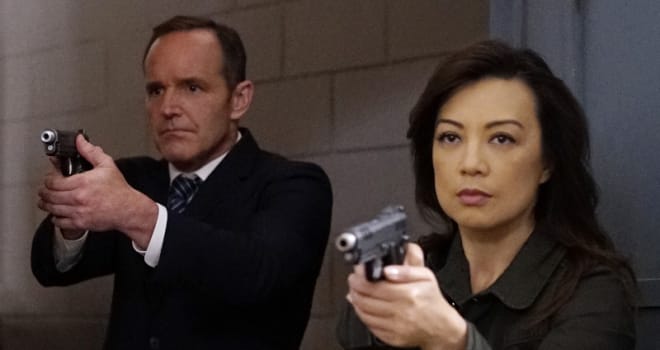
    Clark Gregg and Ming-Na Wen in Marvel's AGENTS OF SHIELDIt’s looking like the action may about to get even hotter for “Marvel’s Agents of S.H.I.E.L.D.’s” perpetually under-fire operative Phil Coulson — or make that steamier.

    Coulson and his longtime colleague and increasingly close friend Melinda May have, of course, been through a multitude of Marvel Cinematic Universe wringers over three and half seasons, and in recent weeks it looks like the two espionage veterans may be inching closer to pushing their relationship beyond its professional boundaries.

    It’s a dicey proposition for the heroic agents, not to mention the show — despite a very vocal fan contingent that’s long been rooting for a Coulson-May hookup; as the show launches its new midseason “LMD” storyline on Jan. 10, even star Clark Gregg admits to Moviefone that he’s feeling his own set of stomach-fluttering butterflies at the prospect, even given his potent chemistry with co-star Ming-Na Wen — especially since May’s been replaced with an A.I. duplicate.

    Moviefone: How do you think the “Philinda” fans, the Coulson-May ‘shippers, are going to feel about the latest turn the show is going to take? It’s partly a dream come true, and partly not exactly what they’ve been crossing their fingers for, as it’s not necessarily a given that’s it’s the real May he’s getting closer with.

    Clark Gregg: Yes, one of the things that goes on in television and in our universe now is our fans are very active. They make it known which romances they’re interested in, which they’re less interested in. Certainly, there have been very vocal supporters of what you call the Philinda relationship. I think in different moments, it’s certainly something that has to have popped into the head of both Phil and Melinda.

    I love the difficulty of it. I love how dangerous it is because this is a job where family relationships really are not possible in the normal sense. These people become family. She is so much more to him than a coworker. I think there’s a reason that they’ve been working together for more than 20 years, off and on, without crossing that line, because it’s a dangerous line to cross as everyone knows. Certainly, with the passing of Andrew Garner, her ex, and some of the business she did about that, something is different now, and that possibility is being explored.

    I think some of the moments that we’re not sure which Melinda we’re dealing with, that’s certainly a whole new part of the equation — but I think that there’s something going on in the actual Phil and the actual Melinda that is different. I don’t know. I have really passionate feelings, pro and con, you know what I mean? We’ve all been in a situation like this with a very close friend, I think, and boy, it makes me nervous just talking about it.

    Tell me about having those conversations with Ming to move this forward as you guys are figuring it out, developing that chemistry, and pushing it forward. What’s been fun about collaborating with her?

    There’s a lot of chemistry just to begin with.

    Ming kind of has that with everybody.

    I know. It’s true — she’s a chemistry-full person! There’s always been something there. It’s a little bit: these poor horses at some point should be let out of this barn before they kick the rest of the slats out. On the one hand, alright already! If it’s going to happen, let’s go! But nothing is that simple on this show.

    I’m excited to play out the various permutations you mentioned. I’m wary of talking about them because I don’t really know what’s going to happen. If it’s anything like the rest of the show for poor Coulson, it’s going to end up in heartbreak.

    Or another missing limb.

    Yeah.

    You mentioned that sense of family. At the close of the “Ghost Rider” arc, his S.H.I.E.L.D. “family” has reunited. It has to feel good for Coulson that his wayward children have come back into the fold. Tell me what that means to him and where that positions him going forward.

    He’s vastly relieved to have Daisy at least within sight of him on the base, but I think the idea that just because she’s moved home means that the damage is healed, and the guilt that she feels is healed, is naive. He’s too savvy. I think he knows that the person who comes back still is really hurting and not sure now to open up again. So it’s hard. It’s complex.

    As Coulson learns more about Director Mace, he’s an interesting character because we still don’t know which way the wind blows with him, necessarily. Tell me a little bit about where that’s going and what’s been fun about discovering that relationship for you.

    I love what the writers have done with the character Jeffrey Mace, the Patriot. We did not know what to make of him. He was very much someone we believed was thrust upon them. Later, we learn he’s an Inhuman, and that Coulson requested an Inhuman to be running S.H.I.E.L.D., which is a very smart move. It puts Coulson back in the field, which he likes, and someone else is running S.H.I.E.L.D. and making decisions that he doesn’t endorse quite often.

    I also love that they haven’t made him a villain, at least as far as I can tell. He’s a flawed person who happens to have powers, which is a smart, logical extension of this idea of Terrigenesis. Some people are going to be weird PR freaks who may not be necessarily the greatest leaders who suddenly have powers.

    What Jason [O’Mara] has done with him is so surprising and compelling that it’s really hard for Coulson to hate the guy. There is something about him that wants to do the right thing and, as Coulson knows, has been thrust to an impossible job.

    For you, what has been the creative thrill of this particular season, and as we move forward with Coulson now?

    There’s so much from the beginning, the reveal of HYDRA, the destruction of S.H.I.E.L.D., rebuilding S.H.I.E.L.D., the Sokovia Accords — I don’t know. I guess, to have the HYDRA plot, the Grant Ward plot, really played out so magnificently and finished to a certain extent, for now anyway, and to be playing with new things, LMDs, the magical elements of the Marvel Universe that are connected to “Doctor Strange.” That’s exciting.

    But I think our version of the Sokovia Accords, the way Inhumans are being treated as The Other, and registered, and treated as some kind of different species than the rest of us, though they didn’t change because of any choice they made, I don’t know, suddenly feels remarkably timely: I read about an idea of having a Muslim registry yesterday. I went, “Wow, OK.”

    We’ve heard that General Talbot is coming back, and I love the dynamic between Coulson and Talbot.

    Me too!

    What are you looking forward to? Do you want to see them butting heads? Do you want to see them on the same side and butting heads?

    Usually, they end up trying to do the same thing with such radically different styles that they end up at each other’s throats half of the time, but also, they’ve gradually built a lot of respect from when Talbot was first hunting us down.

    We all get happy when The Three Stooges.”

    New episodes of “Marvel’s Agents of S.H.I.E.L.D.” return to ABC on January 10th.

  • How Vincent D’Onofrio Conjured His ‘Emerald City’ Wizard

    Emerald City - Season 1As an actor, Vincent D’Onofrio has long been great and powerful — and now he’s the great and powerful Oz.

    NBC’s ambitious, expectation-bending new series, “Emerald City,” which bows Jan. 6, challenges the pop cultural perception of author L. Frank Baum’s long beloved series of novels set in the land of Oz as largely defined by the classic 1939 musical “Game of Thrones” –flavored sensibility.

    And that includes the show’s interpretation of the Wizard: he’s still a man from the earthly realm who found his way to Oz and achieved a position of tremendous power, but he’s also a haunted, lonely, isolated figure with an enigmatic agenda and precarious hold on his position.

    And as D’Onofrio — who still expects to revive his acclaimed portrayal of “Daredevil’s” Kingpin, Wilson Fisk, very soon — reveals to Moviefone it’s another opportunity to subtly shade a role that’s existed in the pop conscious in a less complex incarnation.

    Moviefone: When you get offered a role like this, I’m sure it comes with a lot of thoughts like, “Well, OK. We know the movie. We know that there’s a bunch of books by L. Frank Baum. What are we bringing to the table?” How did you wrap your head around what you were all doing, since this was such a fresh take — and what you wanted to bring to it?

    Vincent D’Onofrio: I was fortunate to come in late. I heard that [filmmaker/producer] Tarsem [Singh] was doing it, so I asked Tarsem if I could play the Wizard. I hadn’t even read the script … [then] I read a few of them, so my entry into the whole story and how I realized it was through the character of the Wizard: how we could take it further than he was in the original script?

    And they reacted so positively to it and started writing immediately. We were talking about all different aspects and how far we could go with it, his psychology and why he is the way he is, what makes him the fraud that he is in the original, but what really makes him that, whether it’s issues with self-worth and things like this. So we got pretty far deep into that, and I was reading, reading, reading.

    I just loved that the take that I had on the Wizard as I was reading, I realized that that was the movie. You get to learn page by page who the Lion is, who the Tin Man is, who Dorothy is. And you’re like, “Oh sh*t. That’s the Lion! He’s going to be the Lion on that.” “That guy’s going to turn into the Tin Man!” But you knew this through their emotional makeup as human beings, or as beings, and I thought that was fascinating.

    So the more we dove into the character of the Wizard with Tarsem, and the more I read, and finally I read the whole 10 hours of it, I was so immersed in the world. I couldn’t wait to start. I’d come up with the voice. We’d do a couple of different things. He has different voices at different times, and he has a different look in public than he does in private. It was very interesting stuff.

    Once you got to work, and you also had the costumes and his environment to play with and help inform you, tell me a little bit about how they affected you and what you wanted to do.

    I really try hard not to stick my nose in everybody’s business. I really try hard. But when you have such an amazing project like this, you can’t help but never stop thinking about it. So even the way we approached the wardrobe, it’s kind of in a way Falstaffian, in a way at times. I wanted that kind of Shakespeare [feel], like maybe an actor from, like, the ’70s, a British actor in the ’70s, doing Shakespeare. Like with the weird hair, and with the wigs and everything. I really wanted to do that kind of a thing.

    They just loved the idea. At one point in the show, I’m wearing a bald cap, a wig on top of the bald cap, and then a wig on top of that. So there’s the bald cap which is supposed to be me, really, and there’s a wig on top of that, which is supposed to be really the Wizard’s hair, and bald cap, and then a wig that everybody knows is not the Wizard’s hair on top of that. So you get to go deeper and deeper into his psyche and what makes him up.

    We took the idea of — in the original “Wizard of Oz,” in the movie, anyway, the musical — how they project that image that he has, that image projector. Instead of projecting image, in this he brings the image forward.

    Obviously, the Baum work has proven to be timeless over 100 years. Did you see something sort of allegorical in this interpretation that was really relevant to us today?

    All of my life — and everybody else’s life as well, obviously — there are always different factions in society. As you get older and you start to become more and more aware and realize what these factions stand for, these ideologies and these beliefs, you start to understand the scope of society better, and how things change the world, and how lands like Oz or a city like Emerald City, or a country like ours, the countries in Europe and all over the world, how they move into being far right and far left, and being military and non-military, and forming alliances with other countries that sometimes people end up backing out of.

    All that goes on in Oz, just like it does here. All of it. Everything that I just said goes on. And you just hope for the best, like we do in real life. You just hope that, in the end, people are good, and that people really prefer to be calm inside themselves, and that’s their favorite thing. So you just have to hope that in Oz that that’s going on as well. That in the end, people are going to prefer for there not to be war, and there not to be overt manipulation, and a lot of lying going on and a lot of behind the scenes deals being made. So it’s pretty relevant.

    This is another seemingly larger than life but very rooted in reality character you’ve gotten to play for TV, “Daredevil’s” Wilson Fisk being the most recent before the Wizard. Tell me what you liked about that character, and how you see these men, like the Wizard and like Wilson Fisk. It would be easy to be caricature-ish with them, but you find a way to make them feel real.

    It’s always interesting. I’m sure you can relate to this, you’re a writer: we all have things that we create. Some of them are on bigger scales than others, but so what? It’s still just about ourselves creating a certain thing. So to hear people talk about him in the way that you are, it’s very interesting to me because the only answer I can really give you to that is that it’s my job, and I approach it in a very kind of academic kind of way.

    I’m not a very romantic actor in the sense that I don’t live the characters. I used to when I was young. Now that I have kids and a family, and I hope to be a good father, I have to leave it behind me when I go home, the characters. So, for instance, who Wilson Fisk is comes from a single emotion in my life. One very specific emotion. I won’t tell you what that is, but it’s a very particular emotion that happened during an event in my life at one point, and that’s where his voice comes from. It comes through that all the time, like it never doesn’t. And that’s what makes him who you see him as.

    Then you take a guy like the Wizard, it’s the hiding behind the character. It’s the cloak that we put over ourselves when we don’t want to be seen. It’s a very interesting subject, especially for an actor to deal with. I’m not a kid anymore. I’ve played, I wouldn’t be able to tell you how many roles I’ve played. This is something that’s become part of my life, cloaking, disappearing, and there’s a price to be paid for that. So the Wizard character comes from that. So that’s the only way I can answer your question.

    What’s got you excited about returning to the Marvel Universe?

    I always want to be there. Honestly, I’m the biggest kid in the world when it comes to that. James Gunn and I have been tweeting back and forth to each other — I really want to work with him. A good friend of mine is Chris Pratt. We’ve done two films together. He’s just an awesome guy. We want to work together again.

    Then there’s this Netflix Marvel thing that I’m doing. I’m always talking to [Marvel’s Head of Television] Jeph Loeb over there about what we’re going to do next, and when. I just love it. I, of course, am not allowed to talk about anything in particular. But I know for sure that they love Fisk over there, and that Fisk will be back. When is that going to happen? I have no idea.

    I’m as bad as my kids when it comes to movies. Like I’m dying to see a few movies, like “Nocturnal Animals,” right? But I also want to see “Wonder Woman.” That’s what I’m saying: I’m dying to see “Wonder Woman.” I’m dying to see these other films as well. But I’m as big a kid as my kids are when it comes to these movies.

    And, of course, the comic book Wilson Fisk began as a “Spider-Man” villain. How great would it be to play the Kingpin against Tom Holland?

    If it’s part of that story, yeah. It’d be awesome.

  • Peyton Reed Teases ‘Crazy Stuff’ in ‘Ant-Man and the Wasp’

    ant-man and the waspHere’s something to grow on, Ant-Man fans: even after the superhero’s surprise growth spurt in Marvel‘s “Captain America: Civil War,” filmmaker Peyton Reed promises he’s got plenty more tales to astonish for the sequel, “Ant-Man and the Wasp.”

    When Moviefone caught up with director Reed, who helmed the first installment of the insect-sized superhero’s adventures with last year’s “Ant-Man,” he was about to head into pre-production on the follow-up film, which is slated to hit theaters in July 2018. And, as he reveals, this one’s going to dig much deeper into exactly what kind of heroes Scott Lang (Paul Rudd) and Hope Van Dyne (Evangeline Lilly) will become.

    Moviefone: What does seeing a new Marvel movie like “Doctor Strange” do for you, creatively? What kind of stuff does it stir up?

    Peyton Reed: Well, it’s a mixed bag. Because, as a comics fan growing up, to see all these heroes brought to life on the screen in such huge fashion is always exciting. As the director of a movie that’s coming like three, four, five movies later, the bar is always raised, and it’s great. It’s a challenge.

    Because they’re always making technical breakthroughs, and also just story breakthroughs, one of the great things about Marvel is you want to do movies that are doing something different and not treading on what the other movies are doing. So it’s always exciting because they manage to top themselves.

    Where are you in your creative efforts for the next one? Have you broken your story?

    We’re in the writing phase right now and we start official prep this month. So it’s sort of long-lead prep, but we’re starting to get into all of the visual development stuff, and it’s really exciting.

    Tell me about how Paul Rudd adds his voice in this early startup process, because he is so much of what makes Ant-Man Ant-Man.

    Well, he is Ant-Man on screen, but he also was one of the screenwriters on the first movie, and, for me as a director, that’s great because he’s so invested in the character, and so he’s a part of the writing process on this movie, as well.

    And it’s great because when you make a movie with someone, it’s a very close relationship. So we’re going into this movie already having forged that bond, and we’re playing with a lot of ideas, and we’re coming up with some crazy stuff!

    Is your tendency to be like, “OK, let’s grab what we can in the Marvel Universe and have some fun with it,” or do you want to keep the “Ant-Man” corner of the universe a little more Ant-Man-centric?

    No, I think we like our little Ant-Man corner of the universe. Because it’s a whole different vibe tonally, but also just in terms of who Scott Lang, who Ant-Man is: he is a guy who is maybe not so sure he wants to be like this Avenger-style, full-on superhero.

    He’s got a kid, and this is the inner conflict with him, and he’s very much just like a normal guy who has come into contact with some incredible power. So, we like that aspect of kind of like it being its own little corner of the universe.

    The flipside of that is that we heard that Evangeline Lilly and the Wasp are going to be in “Avengers 4.” Tell me about sharing your characters. What’s fun about letting one of your heavy-hitters go into somebody else’s movie.

    Again, that is one of the sort of things where it’s a mixed bag. When I first found out — gosh, I don’t know, two years ago, a year-and-a-half ago — that “Civil War” was going to get the Giant-Man premiere, I was like “No!” But, now, I’ve since recovered, and we have a lot more in store for Scott Lang in this movie.

    We get to see the Wasp debut — we’re all about the Wasp and Ant-Man. So I like it, because we spend a lot of time with our different writers and directors, and there’s a lot of crosstalk, and I love that.

    Lastly, what do you want to do with the Wasp now that we’re in this great moment for female superheroes and you’re going to have an opportunity to do something fun and cool with one of the premiere Marvel superheroines — one of the very first. What are you excited about in collaborating with Evangeline, to carry the Wasp forward?

    Well, I’m just personally excited to get to introduce yet another character into the Marvel Universe. After Ant-Man, now we get to see Wasp, so really designing her look, the way she moves, the power set, and figuring out, sort of, who Hope van Dyne is as a hero — because we know her in a certain context in the first movie, but now she’s going to have her coming out party — that’s exciting!

  • Marvel’s Russo Brothers Tease ‘Infinity War,’ ‘Distinctly Different’ ‘Avengers 4’

    The Russo Brothers may have just called for a cease-fire in one superhero war, but the sibling filmmakers are about to hit the trenches for another.

    Now that their most recent opus, “Captain America: Civil War,” has emerged as one of the most satisfying superhero films in an otherwise polarizing year for the genre, directors Joe and Anthony Russo are about to embark on their next foray into the Marvel Cinematic Universe with “Avengers: Infinity War,” the most ambitious effort from Marvel Studios yet: scores of characters introduced in all of the MCU films (and possibly the television seres) to date are potentially in play — nearly 70, the filmmakers have posited — in a showdown with death-courting Thanos the Mad Titan, a confrontation that’s been looming since 2012’s “The Avengers.”

    Of course, “Civil War” ably demonstrated that the brothers — who previously worked in the heavily populated sitcom worlds of “Arrested Development” and “Community” — had a knack for deftly handling both large-scale casts and interwoven storylines, with tremendous payoffs for both. With “Civil War” available for digital download on Sept. 2, the Russos joined Moviefone for a look back at how they approached the challenges the film presented, as well as a glimpse at how they’re applying those lessons to their first of two Avengers adventures.

    Moviefone: You had the thankless task of incorporating a large amount of characters; introducing significant characters, like Spider-Man and Black Panther, into “Civil War,” and still telling a Captain America story. Can you tell me how you approached it to make sure you got all of those moving parts in, but kept it Cap’s story?

    Joe Russo: Sure. Our focus is always on Cap. That’s our intent. That’s how we came into the universe. We love him as a character. We wanted to track his story, and it was necessary to bring other characters in the story to help tell that story. One of the more significant aspects of his character is the patriarch Avengers, and the movie is about a family divided. So you have to have a family in order to show division, and we wanted characters who were new who could complicate that division.

    So the movie begins through Cap’s point of view, and also ends in his point of view. And we make sure that all the major moments of the film flow through Cap. That’s how we keep the focus on him in the storytelling.

    Easily the most definitively Marvel Comics-feeling sequence in the film is your big superhero smack-down at the airport between Team Cap and Team Iron Man. Can you tell me about the influences and the inspiration from the original comic books that got you guys to how you wanted to present this sort of epic superhero clash, fighting each other in the grand Marvel tradition?

    Joe Russo: I was a big comic book collector when I was a kid, and splash panels were always the reason I got kicked out of comic book stores. I would grab a double issue or a big crossover event issue, and I flipped right to the splash panel, the double panel, and I would sit there and study who was fighting who, matching in my head how the story was unfolding, spending 10 or 15 minutes studying that splash panel. Then I’d get a surly counter guy, he would yell at me, “Hey man, buy that thing or get out of here!”

    So it was really a way to recapture what I loved about them in my childhood, the level of detail and that wish-fulfillment notion of, is this character or that character going to win in a fight? And I also had a Marvel role-playing game that had everybody’s attributes, so my friends and I would sit around and argue who was stronger than who, and who would win the fight, who’s more cunning. Would this person’s street smarts outweigh this person’s strength? So that really is the sort of childlike essence of what’s behind that sequence.

    From a storytelling standpoint, we had to obviously get much deeper and make sure that every character had an arc that tracked through that sequence, and some of their arcs climax in that sequence. So it was by far, I think, the hardest thing we’ve ever worked on in our careers.

    You guys got to push things forward technologically in your filmmaking quite a bit — everything from an increased level of action in the big fight sequences, to using the technique that allowed Robert Downey Jr. to play a much younger version of himself. Tell me what that was like, figuring out how to use brand-new technology like that, and how it set up what you guys want to do in your future films with Marvel.

    Joe Russo: Using technology to tell the story is part of the value of being in a place like Marvel. It’s extremely technically gifted company, where you work with some of the best people, if not the best people in the business, at what they do, from the visual effects standpoint. Getting to work with the best companies in the world, like ILM, and basically being able to put whatever you can imagine on the screen. That is a rare gift for a filmmaker. It’s not often that you’re in a situation where whatever you dream up you can actually figure out how to accomplish.

    So part of that, again, is the wish fulfillment and scale of what these movies require, and what frankly our imaginations require of the material and trying to honor how, again, I felt about it as a 10-year-old comic book fan. I think comic book movies have become so popular because it’s finally reached the point where CG can capture our imaginations and you can tell a story where Giant-Man fights Spider-Man and it looks incredible on screen. So if we can do that, then f*ck yeah! As a director, we’re going to figure out a way to do that.

    And to be able to take 30 years off of Robert Downey [Jr.] is a technological marvel, and we wouldn’t do it if it didn’t have a purer function in storytelling. It’s probably one of the most critical flashbacks in the movie. That’s one of the critical moments in the film. But to be able to do that certainly drives our desire to think of ideas and ways in which to try new things. Of course “Infinity War” has to live up to its name, and we’re going to pull out all the stops on this one.

    You brought this film to a satisfying conclusion, but you definitely left yourself some rich things to pick up on when you get to “Infinity War.” Can you talk about finding that balance and making it feel like a self-contained movie, but still having the potential for all that MCU interconnectivity that the Marvel films are famous for?

    Anthony Russo: I mean, look: leaving the MCU in a place of very high conflict at the end of this film was very exciting for us. The great thing for Joe and I, we love these movies as fans, as much as we do as filmmakers. So we always look for: How do we excite ourselves? How do we surprise ourselves? How do we satisfy our own desire for what we want to see as fans? And leaving the MCU in a very divided place — leaving the Avengers in a very divided place — was an exciting place for us to go at the end of this film.

    The idea that we would have to wait a couple years to sort of push that story forward in a new movie — we love all the possibilities that can go through your mind there during that down period before the story is taken up again. But as storytellers, we’re very much going to pick up the storytelling in “Avengers: Infinity War” exactly where we left at the end of “Civil War.”

    You have been candid about how many Marvel characters you have to work with in “Infinity War.” Are you happy with where you’ve gotten, that everybody gets the right amount to do as you get closer and closer to shooting?

    Anthony Russo: It’s a never-ending process. The great thing about these movies is … you were talking about the technology early on … is that you continue to make these movies all the way through the process. There are still new things you can bring to the storytelling, even after you put the cameras away.

    So that’s a process that we pay a lot of attention to in the script development phase, and, again, we approach it with fresh eyes during production, and we very much have [screenwriters Christopher] Markus and [Stephen] McFeely as partners with us during the production phase, making sure we’re doing exactly what you said: Are we maximizing the fun we’re having with the characters? Are we doing the best thing we can be doing with that? Is there a better idea that we can bring to the table that we haven’t thought of yet?

    We’re always asking ourselves that question, all the way through production, all the way through post-production, the editors coming in. We’re really testing where we’re going with each character, and always thinking about the possibilities. We’re never satisfied until the movie is locked and gets pried out of our cold dead hands.

    Do you get to give some attention to a character, or characters, that you haven’t had a lot of time to play with yourselves that you were especially excited about? And you can be as teaser-y about that as you want to be.

    Anthony Russo: Yeah, look, it’s an interesting process. I don’t know. Characters that we have worked with before, and characters that we haven’t worked with, I would say, we give the same amount of thought to both, because with characters that we have worked with before, we want to work hard to bring those characters to a new place, place them into a new situation that we haven’t seen them in yet, and that is surprising to us. It takes a lot of creative work to find those places.

    Characters that we haven’t worked with yet require the same sort of really intense emotional investment when we’re figuring it out. So it’s like you’ve kind of got to give the same amount of love to everybody. They’re like children. You just work very hard to explore all the possibilities and all the opportunities with all these characters, regardless of whether you’ve worked with them before or not.

    Now that we know that your two “Avengers” movies are not specifically a two-part extravaganza, but two separate movies, is there some sort of blanket statement that you can put out there to sort of define how the movies differ from one another?

    Joe Russo: There’s certainly connectivity in terms of some characters and some story arcs, as there always is in the continuing collective narrative of the Marvel Universe. But they’re distinctly different films, and they’re distinctly different stories. We don’t want to tease anything yet, but we will say that “Avengers 4” has a completely different title, which will be revealed at a future date.

    You were so effective in marrying the superhero structure to a film genre like the political conspiracy thriller that you did with “Winter Soldier.” Is that part of the game plan, too? Do you have a film genre in mind along with all the comic book inspiration as you head into your first “Avengers” movie?

    Joe Russo: Yeah, we always do. We love to be intertextual. It’s kind of who we are as filmmakers. That’s how we grew up. We grew up as students of film. We weren’t necessarily making movies as kids, but we were watching them when we were down at the local cinematheque, watching foreign films, art films. So that was our approach to filmmaking back then, and intertextuality is an important part of that.

    We always look for a way to find a genre that we think is fresh with the superhero genre because it creates something unique and gives the movie a different tone and a different point of view. In the other movies in the Marvel Universe, I think “Ant-Man’s” tone is a comic tone, and we can only get the comedy that we’ve gotten out of that character from Spider-Man in “Civil War,” because they’re coming from different tones. If those characters weren’t pre-existing, those tones would have felt out of place and potentially ruined the film.

    So I think that’s one of the more unique aspects of collective storytelling, is that the pre-existing talent and the baggage that the audience brings to a movie with experience of the characters in their own diverse franchise is special, and can give us something very unique that we can’t get in other films or other kinds of storytelling.

    Even though we know that two “Avengers” films are in your future, do you want to keep your hands at the reigns of Captain America, if possible? Do you hope to return to him as a solo character as filmmakers?

    Joe Russo: I mean, we love him. As long as [Chris] Evans wants to keep playing that character, we would certainly consider continuing on with him. But there are also are other stories that we do want to tell, so who knows where we’ll be by the time we’re done with “Avengers 4,” if we’ll have anything left to say in the Marvel Universe, or if it’ll be time to look for some new stories to tell?

    Marvel’s “Captain America: Civil War” arrives on Digital HD, Digital 3D and Disney Movies Anywhere on Sept. 2 and on Blu-ray™ 3D, Blu-ray, DVD and On-Demand on Sept. 13.