Tag: exclusive

  • Corey Hawkins Is Blowing Up Big With ’24: Legacy’ and ‘Kong: Skull Island’

    '24: LEGACY' Premiere Event - ArrivalsIf Corey Hawkins can fill Dr. Dre’s shoes, why not Jack Bauer’s?

    The 28-year-old actor has been enjoying a meteoric ride to the top of Hollywood’s A-list in recent years, including a six-episode stint on “The Walking Dead” and a breakthrough performance as one of the real-life architects of hip-hop in 2015’s “Straight Outta Compton,” which led him to be cast as a Yale-educated seismology expert entangled with a legendary gigantic ape in this summer’s presumptive blockbuster “Kong: Skull Island.”

    But his most visible — and perhaps riskiest — role yet is that of the young war hero turned Counter Terrorist Unit operative Eric Carter, the central character of “24: Legacy,” Fox’s hotly anticipated revival of one of its most beloved and influential television series of recent vintage.

    It’s a major showcase for Hawkins, a demanding turn that requires him to deftly navigate both intense acting and intense action, and as the actor reveals to Moviefone, he’s ready for his star turn, 24/7.

    Moviefone: You’ve had a lot of heat on your career since “Straight Outta Compton,” you’ve got “Kong: Skull Island” coming up. What made you say, “Let’s go down this road in TV and see what happens”? The key thing that made you say, “I’m in”?

    Corey Hawkins: It’s always interesting, because television always has this way of doing this sort of reinventing itself. There’s a push, there’s a goal in there. For me, it’s always only about the character, and it’s always only about that opportunity to tell that story. And this actually will be a broader audience than any of the films than I’ve done. I don’t know — we’ll see when “Kong” comes out.

    But to be in people’s homes night after night after night, I felt an immense responsibility once I started doing the research, once I started doing the work to figure out Eric’s backstory, and to figure out what it means to be a soldier, what it means to be someone who fights for our country that in the past hasn’t seen him fully, and what that responsibility is, where his allegiances lie.

    We have soldiers who are coming back home from war right now who are dealing with mental health issues. We saw it in that airport incident that just happened. It’s so scary how close to reality this show is, and how we are not actively talking about it. We talk about it because it’s happening, and it’s news, and we want to report on it, and then all of a sudden the next day, we’re talking about silly things during this political campaign.

    But what needs to be focused on is that the great thing about television is that week after week after week, he is going to be in their homes. Whether people like it or not, choose to tune in or not, but you’re going to go on this journey with him, and we’re going to have the conversation about what it means to live in this country, to look this way, to run through the streets with a gun and you’re not a CTU agent, and what that means, and struggling, and the family unit. It’s rich. That was the jumping off point.

    The action format is the candy-coating on the medicine of the messages.

    That’s it, that’s it. That’s the thing that we all kind of hunger for. These write so well, without them being didactic about it, without them being pushy. They don’t beat you over the head with a message. You want to sit back and watch it, or lean in and watch it, but you’ve got to trust that he can get the job done.

    In the original series, Jack Bauer got tested, morally and ethically, in some extreme cases in his 24-hour periods. Is it going to be that same for Eric, with those sort of issues coming in his way and deciding where he lands on the side of things?

    Exactly: it’s how do you deal with that? That’s the thing. You get to Season 4, 5, 6, and 7 of “24,” the original “24,” you pretty much know Jack Bauer is going to take care of the job. You know exactly what he’s going to do. He’s going to take care of it. With Eric, we don’t know, and that’s the fun of discovering this new character. You know in your heart, you’re like, “Dammit, Jack would just beat the crap out of …” or whatever. But you get to watch Eric, and you get to say, “Would I do that? Would I put myself in that situation? Would I go through with that?”

    And Eric has to deal with that because he has a responsibility. He has people that he cares deeply for, people that he feels very responsible for, Grimes, you know what I mean? He has to reckon with those allegiances and figure out how to make the best of it, and we get to go on that journey with him towards being or not being a CTU agent, or his involvement in this world, his trust of this world.

    How ready were you, personally, to dive into the action side? Obviously, the stuntmen get to do their thing, but to get as much as they could give you safely, were you excited?

    I was gung-ho! I’m still gung-ho about it, but I’m gung-ho because this is the thing. You show them that you really want to do it, they’re going to make it safe. Eric Norris is our stunt coordinator, obviously the son of Chuck Norris. He has made such a name for himself in terms of stunts in this industry, and my amazing stunt double, Nico Woulard, they’re like, “Whatever you want to do, this isn’t about us showing people jumping there and bullets flying. It’s about Eric and it’s about making that real.”

    Even in the construction site at the end of the pilot, it’s not karate/kung fu. He has to survive. They’re gouging each other’s eyes out. It doesn’t go on forever. He sees a piece of rhubarb on the ground, and that’s how we crafted it out. Stuff was lying around — that’s what I would f*cking do in this moment! It’s life or death.

    And to really go down that path, when they heard my enthusiasm — we’ve been running with it, much to my dismay sometimes! But it’s fun. I love it. I love it, and they give me as much as I can handle, and I take as much as I can handle. Sometimes they’ll be like, “OK, let’s make it safe.” I’m like, “No, let’s shoot it! Let’s do this. Let’s keep the energy.” It’s fun, because they love that stuff, and I love it, and it keeps the realness of “24” real. So that when it looks like I’m tired, I’m tired. That’s definitely me.

    As far as the high-profile projects with “Straight Outta Compton,” NWA and its music — that’s something people had feelings about. King Kong is something that people have feelings about. “24,” people are invested in. “The Walking Dead,” the same. To do these projects like that, where you’re like, “Oh, OK — this isn’t just a movie or a TV show. I’ve got to show up and work,” what’s that been like for you to have those experiences lined up that way?

    It’s been fun. You can do something that people kind of like, “I’ll go see that. I’ll see what that’s about. I don’t feel any kind of way about it.” Or you can do stuff that people are going to have really strong feelings about. They’ll be like, “I’ll look at it once. I’ll look at the first episode and see how I feel. I’m definitely going to watch the first episode because he better bring it, you know what I mean?”

    That’s the bar you’ve got to set for yourself. I set it for myself regardless of the audience anticipation or whatever. That’s the bar that you have to kind of set and exceed. I f*cking love that, man! I haven’t been like, “Oh, that’s a big thing, let me do that. Oh, that’s bigger, let me do that.” I’ve just been fans of all of the people that I’m working with on it. I just saw it as an opportunity. It’s just been crafted that way.

    Next, I’m going to go do a Broadway play and go back to Broadway. That’s just because I want to go and do it. We’ll see if it becomes a moment, or if it’s timely. I think the play is extremely timely, but it’s that kind of thing. It’s like picking projects that you like, and actors that you like to work with, directors, that’s how you’ve got to look at this business. Some will succeed and some won’t, and I’m OK with that, because I’m invested in it regardless.

    Tell me what that experience was like for you to be a part of the production of the scale of “Skull Island.”

    It was crazy. It was like a merry band of brothers — and sister, with Brie Larson. We were all super-close, and when I say super-close, all of us. It was me, Sam [Jackson], all the stars of the movie: John Goodman, John C. Reilly, Tom Hiddleston — they were just in the mud with us, too. They were going on new little outings with all of us.

    Everybody was sort of there for the entire six months in Hawaii, in Australia, in Vietnam together. And it was challenging. It was really, really, really hard to make this movie, because it’s such a big thing, and you’re trying to hone in on what the story is. But I think in the end, we made something that we were all really proud of, and we put stuff on camera that we were really proud of, and I learned so much.

    I learned about working with Sam Jackson, and John Goodman, and John C. Reilly’s life and love of life. I learned that preparation from Sam and John, that sort of always being ready. Never a wasted moment. You have to be ten times better than anybody would normally expect. I learned that from Sam. You’ve got to come correct.

    It’s just been great. Jordan Vogt-Roberts is an amazing director. We would try stuff, wouldn’t work, would work, whatever, whatever. It was guerrilla filmmaking, no pun intended.

    Since “Straight Outta Compton,” have you talked to Dr. Dre?

    Yeah, yeah. We’ve talked since. We’ve talked since. He’s actually working on a project right now with Michael K. Williams — I did a little piece in it, so we’ll see what happens with that, too. I’m just really excited for him because he’s just been expanding his world view, and expanding what he’s doing.

    It’s very easy to become a mogul and to rest on your laurels. But he’s always been a huge supporter. He’s been a huge mentor throughout filming. Before filming, throughout filming, and since. So he’s been super supportive.

    “24: Legacy” premieres February 5th, after the Super Bowl, on Fox.

  • Carla Gugino’s ‘Extremely Difficult’ ‘Gerald’s Game’ Shoot Left Her Battered & Bruised

    Marc Jacobs - Arrivals - September 2016 - New York Fashion WeekExactly when Carla Gugino sleeps, we have no idea.

    A professional actress since childhood, Gugino has long been vying for the title of the hardest working actor in Hollywood, or at least one of the most employed. Her long list of film credits include high-profile movies such as “Entourage,” “Californication,” “Wayward Pines,” and “Roadies.”

    Gugino’s back on the big screen in the near-future fusion of sci-fi and YA, “The Space Between Us,” playing a maternal-minded astronaut trying to ensure the safety of a teenager born and raised on Mars (Asa Butterfield) as he makes his way to Earth to meet the girl (Britt Robertson) he’s fallen for from very afar. And she’s already completed the much-anticipated Netflix film adaptation of novelist Stephen King‘s harrowing, S&M-tinged psychological thriller “Gerald’s Game,” a role she admits sorely tested her own psyche and physique.

    And, as she chatted with Moviefone about her always-in-motion career, Gugino also took a rare look back at some of her earliest TV acting roles, which found her cast opposite the likes of Tony Danza, Neil Patrick Harris, Fred Savage, and ALF.

    Moviefone: How much of a space nerd were you before taking on this movie? Were you interested in space exploration?

    Carla Gugino: Not a big space nerd. I’ve always been so impressed and fascinated by people who would choose to do that on our behalf. It’s such a noble profession. But I never have had an inkling to want to do it, and I don’t even think playing this character made me feel differently, but I really love seeing the world through her eyes.

    I think in this particular case, and the majesty of it I guess was something. Gary Oldman‘s character in this, too, I find to be influenced obviously by like Elon Musk, Richard Branson, those kind of guys, who have that really forward-thinking attitude and the wherewithal to be able to actually execute it. So I find it fascinating, but not personally something I would want to do.

    Did you learn anything where you were, like, “Astronauts have to do THIS?” Was there any research aspect that surprised you?

    One thing that I found out that was really fascinating to me, when I was speaking to this female astronaut — she was really interesting, and I was asking her about it being predominantly men. None of that really phased her. She said, “I was in science class from when I was a little kid with all boys. It was always the case for me.”

    But what is really interesting, because I was really intrigued about like, if I had lived on Mars for this period of time, what would it be like coming back to Earth? Would it be like riding a bike? Would it be completely foreign to me? How soon would you lose memory of things? Obviously, the reason you exercise up there is to keep your muscles and everything like that. She said, “Even when you go up on the satellite, I was gone for a week, and I couldn’t remember — you lose time in space to such an extent, so quickly within a matter of days, that looking down, I was like, which way is Earth? And where on Earth is my family? Where are my kids? And what time is it for them?”

    She said it almost seems like a fake life you’re thinking about. Like you really lose any kind of just those tentpole things, markers of where you are, and who you are, and what your life is made up of. So she said, “If you were really on Mars for this period of time, it would be really foreign coming back,” and I just thought that was really interesting.

    Has it ever happened to you as an actor? Have you stepped into a world so deeply that going back to your own world felt a little strange?

    There’s always a little transitional period into and out of projects in that way. But yes, there was one time that it was more than I have ever experienced. I think it was because I did it for so long. I did a Eugene O’Neill play called “Desire Under the Elms,” and I started it in Chicago, did it with Pablo Schreiber and Brian Dennehy, and then we moved it to Broadway. And it’s a real Greek tragedy, in the sense that she murders her child. It’s a very, very intense role.

    That was one that I have to say, because I’m not a Method actor, really stuck with me for a good period of time after in a very intense and slightly concerning way, where I really thought, “God, will I be able to get out of this?”

    And I didn’t, for a little while, do a play of that nature. I think also, with a play, it’s eight shows a week, so it’s this strange kind of repeat, and your body doesn’t really realize that it’s false. So your body is going through this trauma over and over and over again, and that one did. That one did really stick.

    “Gerald’s Game” sounds like it could be a very intense, something you’d have to shake off before you go home.

    That was incredibly intense. It’s true. You know what was interesting about that is that I went in so full force, and we shot six-day weeks in Alabama. So when I was in it, I was in it. Then, I was able to shed that pretty quickly, but I think part of that was also because we shot in sequence for the most part, and that was really helpful.

    There were some things we had to shoot out of sequence, but really a large portion of it we shot in sequence, so I was able to have that kind of natural process, I guess. But no, that was one of the most challenging — in all the right ways — roles that I’ve ever played.

    Was it tough material for you to sit with?

    It was very tough material. Do you know the story? Yeah. [filmmaker] Mike Flanagan had been wanting to make that movie since he was 19. Then he did a film called “Hush” for Netflix that I guess Stephen King saw, loved, and Tweeted about. And they connected through that experience.

    And Mike said, “I’ve been wanting to make ‘Gerald’s Game’ for this period of time, but it’s always been considered unfilmable because it is such a tricky story.” And Stephen King said, “If you give me a script, if you give me something that could work, I’d love for you to do it.” So Mike wrote this script.

    It’s so interesting because this obviously is a thriller with some horror elements, but then also is dealing with child abuse, and that kind of childhood trauma. And, tonally, it’s really challenging. So I felt like, “Boy, we have to have somebody who really has that delicate touch and understanding of the material, and of the genre.” So when I actually spoke to Mike, I really felt like ‘This is the guy. This is the guy to do it, and he feels so passionately about it.” I think it’s going to be really good. I’m really excited about it.

    And I play two versions of myself of this character, and that was also really bizarre and surreal, especially with how quick we were shooting it. We had 23 days, I think, to shoot the movie. 24, maybe.

    I bet that helps.

    Yeah. I think in this particular case it did. Also, because just physically, I’m in handcuffs for half of it. I have bruises all over my back from the headboard of the bed. It was a physically and emotionally extremely difficult experience, but also in a profound way and a way that appropriate for the material. And I loved working with Bruce Greenwood. Everybody that I worked with on it, I felt so blessed to be doing that with them.

    So it was all worth it, but I agree with you that if that had been a four-month shoot, that would have been a different thing, and a different thing for the movie. I think it gives the movie this sense of urgency as well.

    Like Hitchcock — the lean and mean way he shot “Psycho.”

    Exactly. Or “Rope.” Yeah.

    I was looking at some of your old credits from when you first started out as a child actor. What was it like to drop in on some of those now-classic sitcoms? “The Wonder Years,” “Doogie Howser, M.D.,” and “ALF.” You were on “ALF!”

    I know — “ALF” was my very first job! That’s not true: “Webster” was my very first job. “ALF” was my second job. It was amazing because those were the big shows at that time. So as a young actress, I had one line on “Who’s the Boss?” I had a bigger role on “The Wonder Years.” “Doogie Howser” — they were exciting to get.

    It was funny because I had considered, the reason that I wanted to act was because of Meryl Streep in “Silkwood” and “Sophie’s Choice.” I had seen them both in the same year, and I was so blown away by these two completely different women, and women who I felt that I therefore somehow understood, even though as a 12-year-old, I had had no experiences like either of these women. And it really made me think, “Oh my gosh, acting can teach you empathy,” and I want to get inside people that are different than me and see life through their eyes.

    So those sitcoms weren’t the kind of work I thought I would be doing, but I also was a working actor who was getting jobs. And they were all very helpful to me because the thing is the only way to learn anything is to actually start doing it. So those were also kind of nice ways to dip my toe into the water.

    I love that you still come back to TV. I thought “Roadies,” which got some rough reviews, was well worth the trip by the end.

    Thank you. I so appreciate that. The people who love “Roadies” really love “Roadies.” I don’t know quite why people are so harsh on Cameron [Crowe], because he’s so extraordinary, and he has this amazing innocent heart, and I almost feel like that’s part of what people go for or something, because we’re in a time that’s a bit more jaded, or I don’t know, self-referential or something, kind of meta. But I love that show, and I love doing that show.

    And I’ve always felt … I remember when I did “Spin City,” I went from “Spin City” to doing “Snake Eyes” with Brian De Palma and Nicolas Cage, and I do the theater. So for me, it’s about how all three mediums teach you different things, are different experiences, and it’s always about the role and the people. So I will hopefully be able to continue doing that. I really do love it.

  • ‘The Space Between Us’ Star Britt Robertson Goes From Sci-fi to Sitcom in ‘Girlboss’

    Premiere Of STX Entertainment's 'The Space Between Us' - ArrivalsEven though she’s starring in the young adult, sci-fi-flavored romance “The Space Between Us,” Britt Robertson admits she’s more of a girlboss than an astronaut.

    The more down-to-earth ambition suits her role: in the film, Robertson plays Tulsa, a high school student who makes online contact with Gardner (Asa Butterfield), a teenage boy who, through a twist of fate, was born and raised on a space exploration outpost on Mars, and their emotional connection is tested when Gardner finally makes his way to Earth and the two embark on a journey for him to see as many of the planet’s wonders as possible.

    The actress also gets a little more earthbound in her next project, “Girlboss,” the Netflix sitcom based on young, self-made entrepreneur Sophie Amoruso’s bestselling autobiography, written by “Pitch Perfect” screenwriter Kay Cannon and produced by Charlize Theron, debuting in April. Robertson tells Moviefone about taking charge of her own career — and knowing when to let the stuntwoman come in.

    Moviefone: Were you ever, or are you currently, a space exploration nerd? Were you fascinated with any of that world at any point?

    Britt Robertson: No — never. A lot of people talk to me about space and sci-fi, just because of some of the films that I’ve been in, and I’m always like, “What’s happening? I don’t even know.” I’ve retained a lot of the information, but much like my early childhood years, I’ve dropped all of it out and don’t remember a thing.

    It’s cool, I’m interested. If people want to talk to me about it, I love to get more knowledge. But I’m not so intrigued that I’m, like, going out and trying to get everybody on a SpaceX jet and travel up to Mars.

    What was the thing about this that did catch your eye as an actress?

    I think it’s a really well-written script. I was a big fan of the story, and I love the characters of Gardner and Tulsa, and their relationship, and where that goes, and what it brings out of both of the characters.

    Then I also love the idea of the whole Gardner story and trying to find his father, and then finding family within the love that he has around him. Just the journeys that we all take on this Earth, and what they bring to us, and what they bring out of us. That is what fascinates me about these types of stories.

    Did you try to convince them to let you fly the biplane?

    No. I tried to convince them not to let me ride a motorcycle. Other than that, there was no convincing.

    How do those stunts hit you? Is it like, “Oh, I think I can try to do that?” Or are you like, “Is there someone else ready to step in here?”

    You always think it’s going to be much simpler than it is. When they were like, we want you to actually drive the motorcycle, I was like, what? Why? Then I was like, OK fine. People do it all the time. I see motorcyclists everywhere. I could do this. Then you get there and you’re like, this thing is heavier than I am, it’s like three times my size. My feet don’t even touch the ground. It’s almost impossible for me to drive that thing. You’ve just got to do it over and over and over again. You figure it out.

    What was fun about creating the right chemistry with Asa?

    What was fun? What’s most fun about it is that he’s a nice guy, and he’s one of the most peaceful people I’ve ever been around in my life. He’s so calm. I enjoyed being around him. I remember being on set every day and was just like … Asa is such a dream. He really is. He’s a dream.

    That inspired me. It inspired me to be better at being an actor, and also work harder, and to make the chemistry come alive that much more. I wanted to do it for him, I wanted to do it for the movie, and ultimately myself. You get comfortable with someone and then you act.

    Your characters’ energies are very different, and it seems like, as actors, you kind of come at things in a different way, too. Did you find that?

    Yes! Asa and I are truly opposites. We’ve done interviews before, like the “would you rather?” interviews, and almost every time we have the opposite answers, to everything. But there’s something really awesome about that, like complimenting each other in that way. Yeah, it’s cool to see the opposite sides of things.

    Are you still absorbing stuff from the more mature actors, like somebody as legendary as Gary Oldman? Are you still watching them with one eye and asking, “What can I learn from this guy?”

    I love Gary Oldman. I love watching him. He’s just the most delightful. Down to just the science of being an actor and taking control over a set. He would never take control over the set, but if he needed something and he realized that things were falling apart, or we were losing time — you get to these points where it can be really challenging; you’ve got like 150 people all trying to do the same thing — the way he would go about being the leader was really impressive, and so sweet.

    He’s a really compassionate guy. He cares about everybody. He would never hurt anyone or break them down. He’s always building people up. So I think he’s just a really good guy, and he also happens to be a phenomenal actor. So I’ll take tips from him any day.

    Tell me about “Girlboss,” because that sounds like a pretty exciting project.

    It’s so exciting! It’s really fun. I’m so excited about it. It was the coolest shoot ever. We did 13 episodes, half-hour comedy, about this disaster of a chick who’s, like, jumping into garbage dumpsters so she can get food and bagels, and she can’t pay her rent, and she doesn’t want to commit to anything, she doesn’t want a nine-to-five job, but she feels really entitled to have all of these things in life.

    Then she stumbles on this idea to resell this badass jacket that she found, and she becomes very successful to the point where she builds her own website, and then it becomes an online empire, and she ends up making billions of dollars. But it’s just a really cool journey to go on.

    And, also, I had the coolest boss ever: Kay Cannon’s so funny, and she writes the best stuff, and it was just so much fun to play. I had such a ball on that set. It’s hard. It was really hard, but it’s so fun.

    Tell me about going from this level of production, or something like this film or “Tomorrowland,” where it’s often you, a lot of special effects, and a lot of technical things to you playing a character were the effects are funny lines?

    Oh God, is it refreshing. But I never even thought I could do it necessarily. I’ve done television, like that sort of style of production, which is the “Girlboss” format, but I’d never done really a comedy in film or TV. I’ve done some, but never to this extent. So I didn’t think that I was capable of it, until I read the script and I was like, “Oh God — this is so funny. I could do this really funny take on this. I know this girl. I can play this girl.”

    I went into the audition. I kind of thought it was good, but then, when they called me and told me that I got the role, I was just like, “What?! No way!” I didn’t even think they wanted to see me for this thing. It’s gratifying to know that you can bounce around and do it all if you want, if you try hard.

    The book was huge. I’m sure you read it.

    I did.

    Aside from the little character notes that you took for yourself, what was the interesting thing that you got out of the book? Was there some element of it that really appealed to you?

    Yeah, I think the whole idea of just taking ownership of your life, and being your own boss, like in the world. Not just as an employee, but to really own what you have to offer this world, and offer it to people, and make something out of it. She’s really big into capitalizing on the success that makes you happy and thrive. So I thought that was an important takeaway.

    How much of your own girlboss do you want to be? Are you going to be that actor who segues into producing, and directing, and writing, and developing? Or are you primarily the actor that shows up and says, “Give me a part and I’m going to nail it?”

    I don’t know. I’m into, “Give me a part and I will try to nail it.” I’m into that. But also, I think it would be cool to direct, but I don’t think that I deserve it. I think there’s a lot of people who would be better, and deserve it more, and have worked harder. Maybe producing I could dabble in a little bit. For the most part, I just like to be good at what I know, and those are the things I don’t know very well.

  • ‘Madiba’s’ Laurence Fishburne on the Revelations of Nelson Mandela and That ‘Black-ish’ Election Episode

    Carl F. Bucherer Sponsors Premiere Of 'John Wick: Chapter 2' With Keanu ReevesJust when you get used to seeing Black-ish’s” curmudgeonly Pops Johnson on TV or as Daily Planet newsman Perry White in the DC Comics superhero films, he reminds you that he’s also an Emmy Award-winning, Oscar-nominated actor of considerable power.

    The latest reminder comes in the form of “Madiba,” the ambitious six-hour BET miniseries chronicling the epic life of Nelson Mandela, who was imprisoned over decades for his attempts to combat South Africa’s racist rule of apartheid but eventually became the country’s president. A longtime admirer of Mandela, Fishburne immersed himself in research in preparation for playing one of the preeminent leaders of the 20th century, discovering unexpected grace notes along the way, as he reveals to Moviefone.

    Moviefone: You were very familiar with Nelson Mandela prior to your involvement with “Madiba” — you saw him speak in Atlanta during his U.S. tour. Tell me what this project brought to you that was new about him.

    Laurence Fishburne: So many things. Really interesting, unknown things, from the years that he worked in the rock quarry on Robben Island, they forbid the prisoners to wear shades while they were working. So it damaged his tear ducts, and he was unable to cry. Little things like that are just fascinating.

    He had a very interesting relationship with food. Orlando said in another interview, he was institutionalized. He lived in jail for a long time. So as a result of that, when he was released from prison and began an earnest to travel the world as a statesman, he never changed time zones on his watch. Never. And he always ate at the same time. No matter where he was, he ate on South African time. Little things like that.

    Versions of his story have been told before. Why do you think the time was right for this particular angle?

    I think the time has always been right, it’s just — it’s taken somebody a long time to develop it and really get the opportunity to do it. So we have the opportunity to tell the story in six hours, which nobody has done, which means we have the opportunity to really, really open the thing up and start bringing up more information, and introducing more characters.

    He was really concerned that people understood that it wasn’t just him. That if the ANC was the spear that broke apartheid he was the tip of the spear. But there are other parts to the spear, and you get to meet those other individuals in this in a real way. You get to learn more about Sisulu, and Tambo, and Ruth First, and Joe Slovo, and Kathrada, and all these people that have been on the periphery of the story in different tellings of it. But now they really all come front and center. It’s really good.

    Is there something good about the timing of the film, with the current political climate?

    I don’t know. The whole timing of things — I never stop to think about those kind of things. I’m too invested in trying to just get my little part right. I’m not worried about the timing of it

    To have the opportunity as an actor to bring your own skills to one of the great inspiring speakers of history — tell me about figuring that out that element of the equation.

    That’s huge. That’s huge. First of all, I was excited and I was honored to be asked. Then you get a little scared. You go, “Oh sh*t, what am I getting myself into?” I realize that I could trust myself after a while, if I was just honest, and I did my best, and was humbled with it.

    But it’s a huge thing, because there are very few personages, there’s a handful of personages like this in history. There’s Gandhi. There’s Christ. There’s a few kings, a few emperors, some queens, you know what I mean? So it’s daunting, but again, I had a lot of help. [Director] Kevin Hooks and I have known each other for over 40 years. We have a history in this business together. So there was a lot of safety in that for me. I’m very trustful to be in his hands.

    For you, personally, what’s the abiding lesson to take away from Madiba, the man?

    The man? That humility. Humility is one of the most important qualities for any human being to have, and to develop, and to nurture. We’re all capable of greatness, but we’re also susceptible to being complete fools.

    When you treat your fellow human beings with dignity and respect, and you do it with a certain kind of humility that is born of your common humanity, then there’s room for your differences, and there’s also room for cooperation, and for really meeting each other with the best that you have.

    This election episode of “Black-ish” was so well-received. I imagine putting it together must have been a very special experience. What did that mean to you to be able to tell that story?

    I was still reeling from the election results, frankly, when I got the call from Kenya [Barris] that he wanted to do something special about it. And he told me about it, and I thought, “Oh, that’s cool.”

    So for me, I think it was smart to do with Junior and Pops, to sort of create a generational link, contextualize it that way for that generation of people. And yeah, the fact is, there was more to the speech than what we’ve become accustomed to. So it was nice to give that piece of information, have that piece of information out there. Because people are upset. Some people are happy, and some people are upset.

    We live in a great country, in that you can actually be upset. You can actually give voice to your feelings. And we also have a responsibility to try and figure out how to deal with it, how to deal with it in a civilized way. So yeah, it’s cool.

    At this stage in your career, to be able to do a dramatic historic piece like this, to be able do a thoughtful sitcom, to do a big blockbuster where you play an icon from comic books — you’ve got to be living an actor’s dream.

    Sure, it’s fun. Dude, I’m so happy! I’m loving it. Where I’m at is a beautiful place, and the other good thing is, the other really sweet thing is, particularly this season, it’s like I’m seeing all these other young actors who are coming up and doing this great work. All the guys from “New Edition [telepic] — all these guys are now like, they’re having their moment, too, and getting to watch them, and be like, “Go, boys!” So that’s cool, too.

    The first installment of “Madiba” premieres tonight (Feb. 1) on BET.

  • How Christina Ricci’s ‘Really Specific Vision’ Brought Zelda Fitzgerald to Life

    Christina Ricci in Z THE BEGINNING OF EVERYTHINGIt’s a role Christina Ricci thought suited her to a Z.

    For nearly a century, Zelda Fitzgerald has been a subject of enduring fascination, as the ultimate muse of the Jazz Age, a woman whose high living and high spirits fueled the much revered writings of her novelist husband F. Scott Fitzgerald and who danced with spilling champagne flutes upon café society tabletops at home and abroad as the living incarnation of the American flapper.

    Though she would not live to see 50, Zelda Fitzgerald’s life, gin-soaked antics, and turbulent marriage would gradually be elevated to legendary status, symbolic of both spirited excess and proto-feminist defiance, until she emerged as a bona fide 20th century icon.

    Now Ricci, who, as a popular actress since her childhood years, is no stranger to living life in the public eye — though not with nearly Zelda’s level of wild abandon — teams with Amazon Studios for “Z: The Beginning of Everything.” Premiering in full on January 27th, the ten-episode series, with Ricci serving as both executive producer and leading lady, offers a look at the prototypical jazz baby with fresh eyes, simultaneously bringing her down to earth while shedding light on just how much of a societal status quo-shattering force she ultimately was, as Ricci reveals in conversation with Moviefone.

    Moviefone: When did Zelda Fitzgerald hit your radar for the first time?

    Christina Ricci: I don’t know when I first heard of Zelda. But the book that the show’s based on, “Z: A Zelda Fitzgerald Novel,” by Therese Fowler, is a book that I discovered; I think it was on a bestseller list or something in a magazine, or must-have summer reading or something. So I read it, and I absolutely just loved it. I loved how intimate Therese made the story. I love how accessible and sort of modern Zelda’s voice was. I just thought it was something really worth telling, a story worth telling.

    She’s been a figure of fascination for generations, of both women and men. What do you think is the secret of her ongoing allure and the appeal of her story?

    I think she really was a person out of time. It’s like she was out of place in the time period she was. It’s almost like a mistake happened in the universe, and she was born, like, 60 years too early or something, or 70 years too early, or 80 years too early. Because, I think, that it’s taken that many generations for us finally to evolve, and women who understand her behavior, women who are like her.

    I think that the fascination, and why it’s now all kind of coming to a head with her, is that she’s finally relatable. I think before, her behavior was just too bizarre, because the rest of us hadn’t gotten there yet.

    On the most personal level, what was that thing about Zelda that really resonated with you, that you felt you got, or that you related to particularly?

    I think the thing that I always love about, one through-line I think, when you read about really fantastic women in history, strong women, women who struggled, is there seemed to be this strength in, realizing a situation they were in, but making the best of it. That’s a real survivor. Somebody who was able to turn their situation into something palatable or even enjoyable. What I loved about Zelda is that she made the best out of her situation. She was always herself and just couldn’t help it.

    Her love story with F. Scott Fitzgerald has become legend. What was, to you, the challenge or the joy of making that story real and making it relatable for the modern audience?

    That wasn’t such a conscious thing. You put two actors in parts, and you write scenes for them and they’re in love, and you hope it works. David [Hoflin] was cast very late. We didn’t rehearse at all. I think we just really lucked out. David and I get along really well. We worked really well together. Both of us are child actors, and I think it’s that kind of comfort on screen and on set that allows us then the space to really work on the chemistry.

    We see her early struggle rebelling against the world in which she’s raised. We all do that to a degree as we come up. You came up in Hollywood, which is probably an interesting world to rebel against. Did you find yourself at any point in your life wanting to move in different directions than the world you lived in was telling you to move in?

    You mean do something other than be an actress?

    Or just maybe even be an actress in a different way than the system was trying to tell you to be an actress, or the kinds of roles they were telling you to play.

    Yeah. I’ve never been very good at doing things that don’t occur to me naturally. I think I’m very much like Zelda, in that I have a hard time not being myself. So yeah, I’ve definitely felt at a certain point that I was supposed to become something different, but I tried really hard, and I couldn’t. I think it’s almost, in trying really hard that I did my career a lot of damage. Because you should always be the thing that makes you special, the thing that no one else can do, but you can do.

    What was the creative reward of shepherding this project as a producer? Was there a particular territory that you gave extra attention in that role?

    I love filmmaking. I love movies. I’ve been on sets my entire life. I’m obsessed with the process. I’m obsessed with the nuance of story, with performance, every aspect of it. So for me, it was just … I wanted to see this told, and I wanted to see it told the right way. Quote-unquote, the right way, according to me.

    You are a producer!

    I have a very strong opinion, generally, about everything. I had really specific vision for this.

    Do you feel there’s a very specific takeaway for a generation that’s going to discover Zelda Fitzgerald for the first time through this series? Do you think that there’s a really apt metaphor for today’s times to draw from her?

    It’s a person and a life, so I think there are many lessons to be learned from this, as many as she learned in her lifetime. I think it’s a story worth telling now, because I think it’s important that we, as women, don’t forget what the world was like for us in the past. I think it’s important that we realize we have something to protect, and more to fight for. I think it’s a great story. It’s a great story to really show how far we’ve come. Because her life wouldn’t have been tragic if she was alive today. She would have had recourse.

  • Aaron Paul Wants His ‘Better Call Saul’ Cameo as Much as You Do

    Aaron Paul THE PATH Season 2The Path.” In a good, non-cult-y way, of course.

    Launching its second season on January 27th, the Hulu drama is set in the world of the fictionalized religion known as Meyerism, where, after a season of coming to grips with a faith-breaking spiritual awakening, Paul’s character Eddie Lane finally found the fortitude to break away from the movement, even as he had to walk away from his still zealous wife (Michelle Monaghan) and kids.

    Now, Eddie’s finding his way in an unpredictable landscape outside of Meyerism while still trying to stay tethered to the family he left behind. It’s a scenario not unfamiliar to Paul, who reveals to Moviefone that, not only does he have real-world friends who’ve confided their own similar struggles to him, he also understands what it meant to leave the praised and adored phenomenon “Breaking Bad” to enter an uncertain future — but one he now seems to have well in hand.

    Moviefone: The subject matter here is so interesting and unique — as you got into Season 2, what were the fascinating things you were learning, not just about where the show was going, but where the creative team was drawing real inspiration from?

    Aaron Paul: They were pulling from a lot of different areas around this world, around these different movements, and religions, cults. What I really loved about it, obviously, I have to point out what my character’s journey is going through: I just love that he is stepping foot outside of the reality he called home for so many years, so he’s back to where he started.

    He knows what life is like on the outside, unlike Sarah. She was born into the movement, so this is all she knows. So maybe that’s why he has this sort of aha awakening moment saying, you know what, everything we’re preaching is bullsh*t. It’s all lies.

    So we all saw his journey from Season 1, just living a life of lies. Does he open up about what he’s feeling, knowing that he will lose his family? Or does he just keep everything buried and just sort of go on with those movements? I just love that he’s outside of the pearly gates that he called home, and just trying to come to terms with his new reality.

    What’s been interesting for you in playing that crisis of faith, now that he’s out? Because that’s got to be both freeing and terrifying for him.

    It is freeing and terrifying. I feel like the new kid in school every time I come to work. The Meyerism, Meyerists are there at work on stage. I’m so detached. It feels a little off, which is great for me as an actor. It’s nice to put myself, truly, in those shoes. For me, it’s been so fun just to live on the outside. Getting back to his old reality. Running into old friends, new flings. It’s an interesting world.

    Since viewers have gotten a chance to watch this show, have people come up to you and almost felt compelled to tell you their experiences with cults or similar sorts of organizations?

    Yeah, it’s actually been quite amazing and beautiful — and heartwarming, in a way. I’ve had endless amounts of people, especially in Los Angeles, come up to me, because they feel so connected to my character’s journey, so they feel like they want to just talk to someone about it. Maybe a stranger that they feel connected to about it.

    Endless amounts of strangers opening up to me about their journeys of certain movements/cults, and just saying, “Thank you. I know what your character is going through. I stood up and said to my family that I just don’t believe in what we’re selling. Hear me out here. This is why I don’t believe it.” And they see their family members just shut down and just turn their backs. Not even slowly, just quickly just shun them.

    A lot of these people come up to me, they thought, “Well, my family wouldn’t turn their back on me. They love me.” But no. That’s so, so scary that these movements have such a tight grip on families. That’s one of the reasons why I’m so proud to be a part of a show like this that’s not afraid to tell this sort of story.

    I’m sure, probably unintended, but there’s almost now a sociopolitical allegory to it, too. You see these same kinds of estrangement over political allegiances today in our country.

    It’s a crazy time we’re living in. We’re so split. No matter what side you’re on, you’re pointing fingers at the other side in such a passionate way. There’s no sort of talking through it. Trying to understand the other side’s point of view is, obviously … Each side wants change, but it’s just an interesting time.

    After your experience on “Breaking Bad,” what did that do to you as far as your thoughts on the kinds of things you wanted to do next, having that on your resume, after all the accolades that the show got and the love it got from the audience? Did that affect the way you saw your career going forward?

    I think, at the beginning of my career, we all aspire to do good work, good material. We want to be a part of a good story. We want to tell that story. But, at the beginning of my career, I just wanted to work in general. You just want to act, build your resume, get better jobs, build your career. But with “Breaking Bad,” we were so blessed to be a part of such a special show for so many years. It really just kicked open doors for everyone involved.

    So I think you just approach your career after “Breaking Bad” in a more delicate way. It’s hard because you’re a part of something so incredibly special, and the world knows it’s special. They’re going to be looking at you, OK, what’s your next move? So I just wanted to be a part of interesting stories. I’ve always wanted to be a part of that.

    So you’ve just got to kind of stick to your guns in that way. Stay away from any sort of cash grab you can. If you want longevity in this business, you’ve got to just listen to your gut. Don’t spend your money. Be smart. And know, with acting, you’re unemployed the moment they say cut and say, “That’s a wrap.” You may have some things lined up. You’ve just got to be smart.

    It seems inevitable that you’re going to get a call from Better Call Saul.” Are you looking forward to hearing what they come up with when they call you?

    Oh, absolutely. It’s a dream come true, and it hasn’t even happened yet. Maybe it won’t even happen, I don’t know. But I’m such a big fan of that show, of course, for obvious reasons. It’s just brilliant. I watch the show, and especially in this last season, seeing all of these great cameos pop up, throwbacks from the pilot, like Krazy-8, Max Arciniega, who’s a dear friend of mine. I saw him show up. It’s so beautiful getting a deeper look at these backstories. So yeah, of course. It’d be nice to have more layers revealed for this character that I love so deeply.

    What haven’t you done yet that you’re really dying to do?

    I look at Eleven from “Stranger Things”; Millie Bobby Brown is just so brilliant, but also another tortured character. I gravitate towards characters with conflict, characters that are going through a lot. She just does it so beautifully. Also, she has special powers. So I think that would be fun. A character with special powers. I would like to fly. Why not?

    Been in to talk to Marvel yet?

    Exactly! I don’t know — I love it all!

    Being a person who’s attracted to those kind of conflicted characters, do you have a pretty peaceful life away from work?

    I do. I think that’s what it is because I have a beautiful family. I’m so blessed to call Lauren my bride. I’m happily married. I don’t know. I love going to work and feeling heavy emotions. Feels like I’m doing something. For me, it’s just fun to portray a gamut of stories. It doesn’t have to be torturous and drag through the heart. It’s just more fun.

    Do you have a couple projects in your back pocket that you’re developing as a producer?

    Not for myself — not for myself to act; definitely for myself in general. We have some great projects in the works. Some things set up at many different places, which we’re very excited about. Yeah, it’s so fun. All of it’s so fun. I really got a big taste of it with “BoJack [Horseman],” and now with “The Path.” I get almost as much joy — not as much, but almost as much joy — developing and creating stories. For me, it’s a little bit more fun really being inside of those stories as a character.

    I know in my 20-odd years in Los Angeles, I’ve seen friends get sucked into, not necessarily always cults, but some bigger system that they’ve given themselves over to. It’s been interesting, sometimes sad, sometimes “wow” to see these things happen. Have you had those experiences with friends of yours since being here?

    Not so much. But I do have an experience of two buddies of mine, separate group of friends, who have been a part of a movement their entire life. Separately, they have come up to me, and this is the first time they have ever talked to me about their movement. Never opened up one time. Never mentioned it. I always knew they were within a certain movement.

    They just said, “I love your journey you’re going through on ‘The Path.’ I feel that journey.” But, they tell me, they refuse to open up to their family, because they know that they will lose their family, and obviously they don’t want that to happen.

    So they were in Eddie’s shoes in Season 1: “I’m just going to decide to just go through the day-to-day motions, fine. Wake up, go to whatever their family’s a part of, and just know, deep down, I don’t believe in it, but I’d rather not believe in it and still do my day-to-day reality, and still have my family.” They know if they say anything, their families just would turn their backs.

    So that was so interesting that my show sort of allowed that door to just open up just enough for them to feel they had the courage to just talk to me about such a heavy thing, because that’s their life. They trust in me with that. I think it’s a beautiful thing. Also, a little sad.

  • Anya Taylor-Joy’s Preparation for ‘Split’ Included Spooning With James McAvoy

    Anya Taylor-Joy as Casey Cooke in M. Night Shyamalan's SPLITM. Night Shyamalan is a director whose films are widely praised for their high concept ingeniousness, beautiful camerawork, and soul recalibrating twists. But they’re rarely commended as acting showcases, even though a handful of performances in his films serve as near-career highlights for the actors performing them (Bruce Willis in “The Sixth Sense” and “Unbreakable,” Mel Gibson in “Signs,” Bryce Dallas Howard in “The Village“).

    Shyamalan’s latest mind-bender is “Split,” and features a handful of peerless performances. “Split” is the story of a man (played by James McAvoy) who suffers from dissociative identity disorder, meaning that he has 23 personalities living in the same body. His shrink (Betty Buckley) tries to get through to him and, all the while, he has three teenage girls locked up in a subterranean lair. One of these girls, Casey (Anya Taylor-Joy), is a bit of a black sheep and her own mysterious past is teased throughout the movie.

    If you don’t know Taylor-Joy yet, you will. As Casey, she brings a quiet strength and wily intelligence to the role. It’s the kind of star-making performance that feels like it only comes around every so often. And what makes it even more incredible is that it’s following Taylor-Joy’s breakout role in Robert Eggers’s “The Witch” from last year.

    I got to sit down with Taylor-Joy in New York City to talk about “Split,” what it was like working for Shyamalan, whether or not she knew that “The Witch” would be such a sensation, and, given the movie’s unexpected ending, if she’d be back for further adventures.

    Moviefone: Most of the movies you’ve made so far have been genre-based. What’s the appeal of these movies for you?

    I don’t think about it that way. I never thought, “Now I’m a serious actor and I’m only going to do genre movies.” I just follow my characters. I have a real instinct for This is my character and if I don’t do this I am going to die. It just happens that those characters and those stories exist in darkness. But that said, it’s been really good fun.

    What about this character made you think, I have to do this?

    It’s either an instinctual thing, or my heart goes like this [makes a motion of her heart beating fast]. With Casey, I just heard her voice. I really did. The first thing I read of anything was sides [specific scenes that are taken from the script], because it’s Night and he’s secret. So my scene was the window scene. And I just heard her voice. It wasn’t even specified who I was reading for. It was just one of the girls. Instantly, Casey’s voice came so strongly for me I never even considered Marcia or Claire. And then, when I read the script …

    Something that is very common for me in all of the characters that I do play is that I love them. It’s an intense love and it’s kind of scary sometimes because I’m not very good at sticking up for myself but if you mess with my character, you’re going down. I go mama bear protective over it. I loved Casey so much. We’re similar but we’re also very different beings. She’s so quiet and, as you can tell, I never shut up. She’s so quiet and so observant and has such a strong core strength. Her inner world that she’s built to protect herself is so rich and deep and I really wanted to see if I could challenge myself to communicate with the audience without speaking. Because most of her stuff in the script is stage direction, it’s not dialogue.

    How much did Night let you know about the character?

    When I met Night to do the audition I got nothing. Absolutely nothing. But from the second I met him I thought, I have to work with you. I have a very strong feeling with directors, too, and I love directors. It’s an aspect of my job that I absolutely love — getting to work with these incredible people and create something bigger than yourself. So he offered me the role, and I said, “Well I have to read the script.” And he said, “But I’ve offered you the role.” I had to tell him that it doesn’t work like that. I’ve been so proud of my work thus far, even if other people didn’t like it, but it was my choice and I’m very proud of that. So, after I read the script, I knew I was in.

    Of all of James McAvoy’s personalities, which were the most fun to play against?

    Ooh … I’d have to say it’s a combination of Patricia and Hedwig. If you had to say, “Which relationship did I enjoy the most?” It would be Hedwig. The scenes with him in his room were just so intense. With James dancing at you and you have to tell yourself, “You’re scared, you’re scared, this isn’t funny.” But with Patricia, I had such a visceral reaction to her as a person. She’s so desperate to be a part of the girls that she fetishizes them in a way. Anytime she would brush my hair, it would make me extremely uncomfortable. After the take was over I’d say, “It’s James, it’s fine.” But him with the brushing was like, Ahhh, this isn’t funJames McAvoy as Hedwig in M. Night Shyamalan's SPLITWas he actually dancing to a Kanye West song?

    Yes, he was. We did it twice. One was with a Kanye West song and one was with the song that’s in the movie. But I can’t remember which Kanye West song it was.

    Did McAvoy talk you through what he was going to do, or was it a complete surprise?

    We were lucky enough to have a week of rehearsals prior to filming. So I met James, we shook hands, and he proceeded to spoon me on Night’s couch. And I was like, “OK. And this is just my life now. Cool!” But he’s so fearless in this film. I feel like a lot of actors couldn’t have done it, because there’s a big possibility for failure. And he just knocked it out of the park. I have to really commend his ability to move his face. I could tell which character I was talking to just with the flicker of an eyebrow.

    Really?

    Oh, yeah. He would straighten his posture, the eyebrow would go up, and I would say, “Patricia.” Instantly. He wouldn’t have to say anything. But I was also seeing it through Casey’s point-of-view. So, at the end, when he’s flickering through all of the personalities, Casey is done. And I was done, too. I was like, “I don’t understand anything. Bye!”

    We were told not to explicitly discuss the ending. But is there a possibility for you to be a part of future adventures?

    I would love to. I would love to!

    So you’d do another movie with Night?

    Oh, absolutely. After Robert, he’s the director who has had the biggest influence on me. He’s changed the way I act, forever. He’s given me such a love for the craft. I always knew I loved acting, but now I’m in love with what I do. He demands excellence, and it’s a privilege to work with someone who pushes you in that way. He’s a friend and a mentor but working with him is different. When you have someone you vibe with like that, it elevates working to a whole other level.

    Congratulations on your BAFTA nomination. That was this morning, right?

    Yeah!

    When you were making “The Witch,” did you have any idea it was going to have this impact?

    Oh, hell no! I will remember this moment for the rest of my life. And I would like to preface this by saying everyone that made that movie is my legitimate family. It was the first time I ever felt like I fit in. But I remember seeing Robert, in my puritan gear, covered in blood, and I said, “You know, we made a really cool movie but it’s a shame nobody will ever see it.” And he said, “I know, I know.” We were completely calm about it. Then the reaction that we got at Sundance was so unprecedented. I guess we hit the zeitgeist at the right time.Anya Taylor-Joy in Robert Eggers's THE WITCHIt’s so weird seeing you in modern clothes.

    And talking with a normal accent.

    Yes! Was it hard for you to learn that dialect?

    Not at all. It’s super annoying for me and people get irritated with me because they can’t figure out my accent. And the reason they can’t figure out my accent is because I don’t have one. I spoke Spanish until I was 8. And so when I speak English I just mimic whoever I am around. I grew up my whole life having a thick English accent and I’m here for two minutes and I’m already using the accent. So not only was the language super poetic but we had a little boy, Lucas, who was from Yorkshire. I would just talk to him for two minutes before going up and I’d be fine.

    OK … one last question: Would thou like to live deliciously?

    I am! [Laughs]

    “Split” is out this Friday. We’ll have more from writer/director M. Nigh Shyamalan next week, including a discussion of the movie’s seriously insane twist.

  • ‘Grey’s Anatomy’s’ Sarah Drew Teases ‘Pivotal’ Japril Episode Airing in March

    2017 Winter TCA PortraitsAre “Grey’s Anatomy’s” April and Jackson actually on their way to happy ending? Well, let’s see what a road trip does to their relationship.

    Sarah Drew, who plays one half of the up-and-down couple, says that there’s a big Japril episode ahead as the series resumes its 13th season that will have the oft-dallying doctors on a business trip together … away from the confines of Grey Sloan Memorial.

    Meanwhile, the actress — the mother of two children with her husband, academian Peter Lanfer — admits that, as thrilled as she was to dive back into the “Grey’s” drama, there’s a pang of mommy guilt every time she heads off to work.

    Moviefone: What can you say about where we’re picking up with April and Jackson as the season restarts?

    Sarah Drew: Well, there’s a lot of fun things in store, especially for Japril coming up. We have actually — it’s going to air in March — but a whole episode dedicated just to the two of us, where we go on a trip to Montana together for a case, a throat transplant. And it’s really pivotal for the two of them, individually and also as a pair. But it’s a really incredible opportunity for them to be kind of still and have to face one another with nothing else distracting them out of the normal environment.

    And we’re really, really proud of it. Kevin McKidd directed it. It’s very different, tonally, than a lot of the other episodes. There’s a lot of quiet space and stillness. It’s not like frantic and moving super-fast. And it’s really lovely.

    How do you feel about them as a couple? Are they meant to be together?

    Yes — yeah. I think so. I mean, they’ve been through so much, and they still have so much love for one another. And they just need to get past their sh*t.

    As an actress, you’re not like, “Can you bring in somebody new to kiss?”

    Nah. I already have two men that I’m regularly making out with. They don’t need to throw another one in there!

    How is your husband with this onscreen relationship?

    It’s always weird, but what’s wonderful is that both Jesse [Williams] and I are super-professional. And we always have been.

    And super-married.

    Super-married, super-have-children. There’s a really good separation that exists, but we have a really great working relationship together. We’re good friends. It’s totally safe in terms of my husband’s perspective.

    How’s mommyhood treating you?

    My daughter just turned two, and my son is about to turn five. And we’re doing a “Harry Potter” birthday party because we’ve been reading the “Harry Potter” books. My husband has been reading them to him, and so he’s on the second to last one. And he is, like, incredibly invested. My son is also obsessed with all things costume. He loves dressing up. So it’s a costume party. Everybody has to come. So my daughter is Professor Umbridge. I’m Tonks, and he’s Harry, obviously. And my husband is Mr. Weasley.

    As you headed back to work after hiatus, did you feel a little pang of parental guilt?

    Oh, yes. I feel like the whole women-can-have-it-all — there are elements about that that are definitely true, yes. But I also feel like it’s kind of a great, big lie. I say that only because I agree that women can have all of the elements, one-hundred percent they can. But there will always be a tug and a push and a pull, and you will always feel like you’re sacrificing something for something else — always. I don’t know how anybody can ever get around that. It is inherent in our DNA, and maybe people would disagree with me. But that has been my experience.

    I will say there are times when my daughter reaches for the nanny before she reaches for me, and my heart breaks a little. But I really, really love my job. And I’m a much more present mom because I go and do something that I love a lot, and I feel very fulfilled by it. And I come home refreshed and energized to be mom. So it’s an interesting balance. And I think I’m going to be challenged by it forever, and I welcome that challenge. And it’s a good challenge.

    Have you ever been taken in by the breadth of medical information you’ve recited on the show and think, “I think I know what’s wrong with you”?

    No, no. Do not trust me with anything medically related! The only thing that I feel like I’ve gleaned is that when my kids fall and clonk their heads, I immediately check their pupils to see if one is bigger than another. And I keep them awake for a while to make sure, and stimulate them to make sure they’re not getting drowsy. There are a lot of things that I feel like I’ve said as a “doctor” and then I find myself doing.

    When you’ve had some time off, what’s it like that first day back on the “Grey’s Anatomy” set?

    It’s interesting, because on the one hand, I’m super-psyched to be back because I love my job. I really do — I love the people that I work with, and I crave routine so intensely. But being home with the kids for the whole two-week Christmas break …

    “Where’s the nanny now?”

    Yes, that’s exactly what I was saying every, single day. [Laughs] Oh, that sounds horrible, and now I have a pang of mommy guilt by saying that out loud. But there you go. It is a whole other job that is as consuming and requires different emotional gymnastics than work does. And, sometimes, the emotional gymnastics at work are a hell of a lot easier than the emotional gymnastics at home with the children. So it’s different.

    I crave the balance. I crave having time there and time at home. That’s when I am absolute happiest.

    “Grey’s Anatomy” Season 13 returns Thursday, January 26, on ABC.

  • Adria Arjona Was Fated to Play the Oz-Kicking Dorothy of ‘Emerald City’

    EMERALD CITY -- "Prison of the Abject" Episode 102 -- Pictured: (l-r) Oliver Jackson Cohen as Lucas, Adria Arjona as Dorothy -- (Photo by: Rico Torres/NBC)There’s a new Dorothy in town and she doesn’t need ruby slippers to do kick some Oz.
    True Detective” and “Person of Interest” and soon to appear in the kaiju-powered sequel “Emerald City,” which amps up the darker fantasy elements in a “Game of Thrones”-ian vein.

    The series reimagines its Dorothy as a tough, capable Latina nurse who’s emotionally hamstrung by some family issues. What she does have in common with the more familiar take on the character is how she’s swept away by a violent storm and finds herself in a very strange land where she encounters its even odder — and often more dangerous — inhabitants. And, as Arjona explains to Moviefone, it’s a role she almost never considered herself playing — but a childhood memory suggests it may have been her destiny.

    Moviefone: What did you think of the concept when it was brought to you, figuring out exactly what you’d be doing and how you’d prepare to go in and build a brand-new Dorothy?

    Adria Arjona: I completely went the opposite way. I read it, and I thought to myself, “This is such wonderful material. It’s so cool. But now, let’s be realistic. I’m never going to be Dorothy.” It was just so far away from me. I couldn’t really figure it out. I was just like, there’s no way. Then I decided, “You know what? No. That’s not the way I should be thinking. Anyone can be anything, especially today, and I want to be a firm believer that you can.”

    So I went in there and prepared as much as I could. I just went in there and I had fun. And then I flew to Miami. NBC flew me back to LA and tested me. Then I got it. Honestly, I could not believe it. I remember it perfectly: I was at a sushi restaurant having chocolate soufflé, while crying, speaking to my manager like, “I’m Dorothy.”

    Obviously, you had this script to start with, but how much extra homework did you do? Did you look at the L. Frank Baum books?

    I looked at the books, yeah. I didn’t look at the movie. I love the movie so much, and I love Judy Garland so much, I just didn’t want to fall into any sort of imitation or anything. These scripts are so different from the movie. I think the books do it more justice. So I went into the books.

    It was wonderful, because I got to see so many of the characters that I was seeing in the script in the books itself. So that was a really good correlation. The books are a lot darker as well, and I think informed me a little bit more.

    I just did a lot of physical work for the role. I worked with Tarsem, worked with these two wonderful people, David and Shaun, to create this character and make it dimensional, and make her real, and grounded, and human, and relatable. I take the audience on this journey, and I just want to be their friend.

    Tell me what you like about your Dorothy that’s different from any other Dorothy that we’ve seen before. And the things that are consistent with the meta-Dorothy?

    I think Dorothy’s always going to be this girl who has a huge heart, and who always thinks of others, and always wants to help us. She’s almost like a fixer. In the books, in the movie, in anything.

    This Dorothy, I think goes from being an insecure young girl who is unsure of what her future might bring her, to thanks to this world, becoming a powerful woman who is very secure of herself in her own skin.

    I just hope that people go on this journey with it. I don’t think I’ve seen that before. It’s not being tough. It’s not being feisty. It’s not being a hero. It’s owning your own skill and knowing what you’re capable of, and not being afraid to show it.

    It’s a very physical role for you. Tell me what was cool, skill-wise, to learn and master for the part.

    Oh, my God — I did so many things! I remember, we did stunt training: I kid you not, I’m a pro at roly-polies. They made us do so much, because, apparently, it would stretch your spine. I’m a pro.

    We did a lot of wire work, which I’d never done. They put you up on these wires and they kind of hook you here, and you’re suspended probably, like, 10 feet up from the ground, and it’s for when the witches torture me. So you have to do all this choreography that takes a while. It’s not very comfortable, but I love all that kind of stuff. I also did horseback riding. We did a lot of physical training just to keep me in shape throughout the entire show and not just crumble in the middle.

    The only thing we didn’t do is a lot of driving, because the second I had my first driving lesson, the teacher actually got afraid and told me he didn’t want anymore. I was like, “Wait, I don’t understand …” I was like, “I’m Mexican. I can drive. I grew up in Mexico City. I can drive.” He’s like, “No no no, you can drive, you can drive, you can drive, you can drive — just get me out! Get me out!” So he got out of the car.

    How did you bond with your Toto? Did you have an instant rapport with the German Shepherd?

    Yes. I had a really good bond, which is a problem, with one of the dogs. And Oliver [Jackson-Cohen] had a bond with the other dog. The problem was that, his dog, Rocky, only spoke Hungarian. We use him so much. I kid you not. I didn’t know how I made the dog do what he did. I would just make up words. I was like, [spews unintelligible commands] “Just freaking do what I’m telling you to do!”

    Sometimes it worked. We’d have to feed him and give him food while we were filming. He only spoke Hungarian. The horses also only spoke Hungarian. So I did so great with Toto, because I loved him off set — but while we were working, it was just so hard. You have to memorize lines, the choreography of the scene itself, where the cameras are, and plus a dog that doesn’t want to listen to you. All he did was hump!

    Dorothy’s traditionally a hugely popular Halloween costume. Did you ever dress up as Dorothy before in your life?

    I did. When I was little I did. I had the wig and the two little pigtails. I dressed up as a poppy as well. I used to dance ballet, and I was a poppy in the “Wizard of Oz” show. So I had that costume, so I was that for another Halloween.

    So you were being prepared for your destiny?

    Yes. It’s so weird. My mom keeps reminding me of that. I had completely forgotten about that. “Oh sh*t, I was in the ‘Wizard of Oz’ musical.” Just as a dancer, obviously — not as a singer.

    Those photos will be on the internet soon enough.

    Yeah, and my mom will be the one posting them, by the way. She’ll be the first one.

    Where were you as far as your fandom of this particular fantasy genre? Were you into “Game of Thrones,” “Lord of the Rings,” and all the great genre material we’ve had, especially over the past 15 years? Or was it a new thing for you?

    I think it was a new thing for me. I’m a big documentary fan. I love indie films and dramas. But, obviously, I’m a huge “Lord of the Rings” fan, “Harry Potter,” all of those are just so magical. What you’re asking is if I like them? I love them. But I never imagined myself in one of them. And now that I am in one of them, I still can’t believe it. Until January 6th, I’m going to think all of this is fake!

    What was your favorite day on set?

    That’s so hard. That is so hard. There were so many, honestly. So many! I think about it and I have like a huge smile on my face. The mud pit, the Prison of the Abject, was a blast, which is where they throw mud at us — and it’s real mud! You have about five pounds of mud on top of you, and you have to contort and stuff. That was a lot of fun. There were a bunch of extras, and all we would do is mud fights between takes.

    Was there an element to the role, or something you had to do, where you were like, “I didn’t know I was signing up for this?”

    No. I was pretty much on the contrary. I was like, “No — sign me up for that!”

    “I’ll do this, instead of the stuntwoman?”

    Oh yeah. That was my biggest fight. I would constantly make, like, little baby tantrums at [director/executive producer] Tarsem for him to make me do the stunt. Because, a lot of the time, you obviously want to be protected. He needed me to be useful for eight months. And sometimes he’s like, “You can’t do it. You can’t do it.” And I would get so upset, because I just wanted to be in everything. I pretty much was. My stunt double didn’t work much.

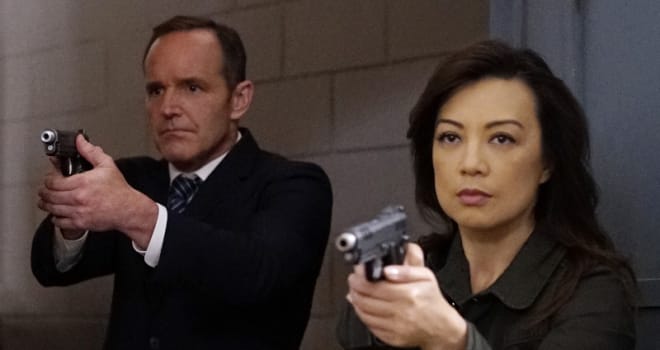
  • ‘Agents of S.H.I.E.L.D.’: Clark Gregg Is ‘Nervous Just Talking About’ a Coulson & May Romance

    Clark Gregg and Ming-Na Wen in Marvel's AGENTS OF SHIELDIt’s looking like the action may about to get even hotter for “Marvel’s Agents of S.H.I.E.L.D.’s” perpetually under-fire operative Phil Coulson — or make that steamier.

    Coulson and his longtime colleague and increasingly close friend Melinda May have, of course, been through a multitude of Marvel Cinematic Universe wringers over three and half seasons, and in recent weeks it looks like the two espionage veterans may be inching closer to pushing their relationship beyond its professional boundaries.

    It’s a dicey proposition for the heroic agents, not to mention the show — despite a very vocal fan contingent that’s long been rooting for a Coulson-May hookup; as the show launches its new midseason “LMD” storyline on Jan. 10, even star Clark Gregg admits to Moviefone that he’s feeling his own set of stomach-fluttering butterflies at the prospect, even given his potent chemistry with co-star Ming-Na Wen — especially since May’s been replaced with an A.I. duplicate.

    Moviefone: How do you think the “Philinda” fans, the Coulson-May ‘shippers, are going to feel about the latest turn the show is going to take? It’s partly a dream come true, and partly not exactly what they’ve been crossing their fingers for, as it’s not necessarily a given that’s it’s the real May he’s getting closer with.

    Clark Gregg: Yes, one of the things that goes on in television and in our universe now is our fans are very active. They make it known which romances they’re interested in, which they’re less interested in. Certainly, there have been very vocal supporters of what you call the Philinda relationship. I think in different moments, it’s certainly something that has to have popped into the head of both Phil and Melinda.

    I love the difficulty of it. I love how dangerous it is because this is a job where family relationships really are not possible in the normal sense. These people become family. She is so much more to him than a coworker. I think there’s a reason that they’ve been working together for more than 20 years, off and on, without crossing that line, because it’s a dangerous line to cross as everyone knows. Certainly, with the passing of Andrew Garner, her ex, and some of the business she did about that, something is different now, and that possibility is being explored.

    I think some of the moments that we’re not sure which Melinda we’re dealing with, that’s certainly a whole new part of the equation — but I think that there’s something going on in the actual Phil and the actual Melinda that is different. I don’t know. I have really passionate feelings, pro and con, you know what I mean? We’ve all been in a situation like this with a very close friend, I think, and boy, it makes me nervous just talking about it.

    Tell me about having those conversations with Ming to move this forward as you guys are figuring it out, developing that chemistry, and pushing it forward. What’s been fun about collaborating with her?

    There’s a lot of chemistry just to begin with.

    Ming kind of has that with everybody.

    I know. It’s true — she’s a chemistry-full person! There’s always been something there. It’s a little bit: these poor horses at some point should be let out of this barn before they kick the rest of the slats out. On the one hand, alright already! If it’s going to happen, let’s go! But nothing is that simple on this show.

    I’m excited to play out the various permutations you mentioned. I’m wary of talking about them because I don’t really know what’s going to happen. If it’s anything like the rest of the show for poor Coulson, it’s going to end up in heartbreak.

    Or another missing limb.

    Yeah.

    You mentioned that sense of family. At the close of the “Ghost Rider” arc, his S.H.I.E.L.D. “family” has reunited. It has to feel good for Coulson that his wayward children have come back into the fold. Tell me what that means to him and where that positions him going forward.

    He’s vastly relieved to have Daisy at least within sight of him on the base, but I think the idea that just because she’s moved home means that the damage is healed, and the guilt that she feels is healed, is naive. He’s too savvy. I think he knows that the person who comes back still is really hurting and not sure now to open up again. So it’s hard. It’s complex.

    As Coulson learns more about Director Mace, he’s an interesting character because we still don’t know which way the wind blows with him, necessarily. Tell me a little bit about where that’s going and what’s been fun about discovering that relationship for you.

    I love what the writers have done with the character Jeffrey Mace, the Patriot. We did not know what to make of him. He was very much someone we believed was thrust upon them. Later, we learn he’s an Inhuman, and that Coulson requested an Inhuman to be running S.H.I.E.L.D., which is a very smart move. It puts Coulson back in the field, which he likes, and someone else is running S.H.I.E.L.D. and making decisions that he doesn’t endorse quite often.

    I also love that they haven’t made him a villain, at least as far as I can tell. He’s a flawed person who happens to have powers, which is a smart, logical extension of this idea of Terrigenesis. Some people are going to be weird PR freaks who may not be necessarily the greatest leaders who suddenly have powers.

    What Jason [O’Mara] has done with him is so surprising and compelling that it’s really hard for Coulson to hate the guy. There is something about him that wants to do the right thing and, as Coulson knows, has been thrust to an impossible job.

    For you, what has been the creative thrill of this particular season, and as we move forward with Coulson now?

    There’s so much from the beginning, the reveal of HYDRA, the destruction of S.H.I.E.L.D., rebuilding S.H.I.E.L.D., the Sokovia Accords — I don’t know. I guess, to have the HYDRA plot, the Grant Ward plot, really played out so magnificently and finished to a certain extent, for now anyway, and to be playing with new things, LMDs, the magical elements of the Marvel Universe that are connected to “Doctor Strange.” That’s exciting.

    But I think our version of the Sokovia Accords, the way Inhumans are being treated as The Other, and registered, and treated as some kind of different species than the rest of us, though they didn’t change because of any choice they made, I don’t know, suddenly feels remarkably timely: I read about an idea of having a Muslim registry yesterday. I went, “Wow, OK.”

    We’ve heard that General Talbot is coming back, and I love the dynamic between Coulson and Talbot.

    Me too!

    What are you looking forward to? Do you want to see them butting heads? Do you want to see them on the same side and butting heads?

    Usually, they end up trying to do the same thing with such radically different styles that they end up at each other’s throats half of the time, but also, they’ve gradually built a lot of respect from when Talbot was first hunting us down.

    We all get happy when The Three Stooges.”

    New episodes of “Marvel’s Agents of S.H.I.E.L.D.” return to ABC on January 10th.